
-
 Australia
-
 Austria
-
 Belgium
-
 Brazil
-
 Canada
-
 China
China
-
 Czech Republic
-
 Denmark
-
 Finland
-
 France
-
 Germany
-
 Greece
-
 Hong Kong
-
 Hungary
-
 Iceland
-
 India
India
-
 Ireland
-
 Israel
-
 Italy
Italy
-
 Japan
Japan
-
 Korea
Korea
-
 Luxembourg
-
 Malaysia
-
 Netherlands
-
 New Zealand
-
 Norway
-
 Poland
-
 Qatar
Qatar
-
 Romania
-
 Saudi Arabia
-
 Singapore
-
 Spain
Spain
-
 Sweden
-
 Switzerland
-
 Taiwan
-
 Turkey
-
 United Kingdom
-
 United States
Axl
Other Protein Tyrosine Kinase Related Inhibitors
| Cat.No. | Product Name | Information | Product Use Citations | Product Validations |
|---|---|---|---|---|
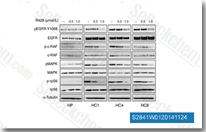
| S2841 | Bemcentinib (R428) | Bemcentinib (R428, BGB324) is an inhibitor of Axl with IC50 of 14 nM, demonstrating >100-fold selectivity for Axl over Abl. This compound is also more than 50- to 100-fold selective for Axl versus Mer and Tyro3, and exhibits 100-fold greater selectivity compared to InsR, EGFR, HER2, and PDGFRβ. |
|
|
| S9662 | UNC2025 | UNC2025 is a potent and orally active dual inhibitor of FLT3 and MER with IC50 of 0.35 nM and 0.46 nM, respectively. This compound also inhibits AXL, TRKA, TRKC, QIK, TYRO3, SLK, NuaK1, Kit (c-Kit) and Met (c-Met) with IC50 of 1.65 nM, 1.67 nM, 4.38 nM, 5.75 nM, 5.83 nM, 6.14 nM, 7.97 nM, 8.18 nM and 364 nM, respectively. |
|
|
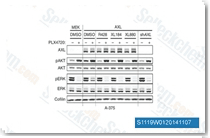
| S1119 | Cabozantinib (XL184) | A potent VEGFR2 inhibitor with IC50 of 0.035 nM, Cabozantinib (XL184) also inhibits c-Met, Ret, Kit, Flt-1/3/4, Tie2, and AXL with IC50 of 1.3 nM, 4 nM, 4.6 nM, 12 nM/11.3 nM/6 nM, 14.3 nM and 7 nM in cell-free assays, respectively. It induces PUMA-dependent apoptosis in colon cancer cells via AKT/GSK-3β/NF-κB signaling pathway. |
|
|
| S7754 | ASP2215 (Gilteritinib) | Gilteritinib (ASP2215) is a small-molecule FLT3/AXL inhibitor with IC50 values of 0.29 nM and 0.73 nM for FLT3 and AXL, respectively. It inhibits FLT3 at an IC50 value that was approximately 800-fold more potent than the concentration required to inhibit c-KIT (230 nM). |
|
|
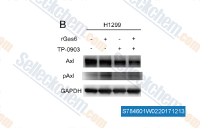
| S7846 | Dubermatinib(TP-0903) | Dubermatinib (TP-0903) is a potent and selective AXL Inhibitor with IC50 of 27 nM, and it is highly effective in inducing apoptosis. |
|
|
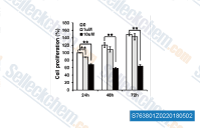
| S7638 | LDC1267 | LDC1267 is a highly selective TAM kinase inhibitor with IC50 of <5 nM, 8 nM, and 29 nM for Mer, Tyro3, and Axl, respectively. This compound displays lower activity against Met, Aurora B, Lck, Src, and CDK8. |
|
|
| S7576 | UNC2025 HCl | UNC2025 HCl is a potent and orally bioavailable dual MER/FLT3 inhibitor with IC50 of 0.74 nM and 0.8 nM, respectively, about 20-fold selectivity over Axl and Tyro3. |
|
|
| S8570 | CEP-40783 (RXDX-106) | CEP-40783 (RXDX-106) is an orally-available, potent and selective TAM(TYRO3, AXL, MER)/Met (c-Met) inhibitor displaying low nanomolar biochemical activity and slow (T1/2 >120 min) inhibitor off-rate in peptide phosphorylation assays and in vitro kinase binding assays, respectively. |
|
|
| S8933 | Tamnorzatinib (ONO-7475) | Tamnorzatinib (ONO-7475) is a potent, selective, and orally active novel inhibitor of Anexelekto(Axl)/MER tyrosine kinase with IC50 of 0.7 nM and 1.0 nM for AXL and MER, respectively. This compound suppresses the emergence and maintenance of tolerant cells to the initial EGFR-TKIs, osimertinib or dacomitinib, in AXL-overexpressing EGFR-mutated NSCLC cells. It also arrests growth and kills FMS-like tyrosine kinase 3-internal tandem duplication mutant acute myeloid leukemia cells. |
|
|
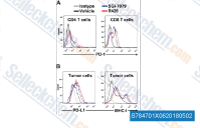
| S7847 | SGI-7079 | SGI-7079, a novel selective Axl inhibitor with an IC50 of 58 nM in vitro, inhibits tumor growth in a dose dependent manner and is a potential therapeutic target for overcoming EGFR inhibitor resistance. |
|
|

Products are for research use only. Not for human use. We do not sell to patients.
©Copyright 2013 Selleck Chemicals. All Rights Reserved.