
- Bioactive Compounds
- By Signaling Pathways
- PI3K/Akt/mTOR
- Epigenetics
- Methylation
- Immunology & Inflammation
- Protein Tyrosine Kinase
- Angiogenesis
- Apoptosis
- Autophagy
- ER stress & UPR
- JAK/STAT
- MAPK
- Cytoskeletal Signaling
- Cell Cycle
- TGF-beta/Smad
- DNA Damage/DNA Repair
- Compound Libraries
- Antibodies
- Bioreagents
- qPCR
- 2x SYBR Green qPCR Master Mix
- 2x SYBR Green qPCR Master Mix(Low ROX)
- 2x SYBR Green qPCR Master Mix(High ROX)
- Protein Assay
- Protein A/G Magnetic Beads for IP
- Anti-Flag magnetic beads
- Anti-Flag Affinity Gel
- Anti-Myc magnetic beads
- Anti-HA magnetic beads
- Magnetic Separator
- Poly DYKDDDDK Tag Peptide lyophilized powder
- Protease Inhibitor Cocktail
- Protease Inhibitor Cocktail (EDTA-Free, 100X in DMSO)
- Phosphatase Inhibitor Cocktail (2 Tubes, 100X)
- Cell Biology
- Cell Counting Kit-8 (CCK-8)
- Animal Experiment
- Mouse Direct PCR Kit (For Genotyping)
- New Products
- Contact Us
-
 Australia
-
 Austria
-
 Belgium
-
 Canada
-
 China
China
-
 Czech Republic
-
 Denmark
-
 Finland
-
 France
-
 Germany
-
 Greece
-
 Hong Kong
-
 Hungary
-
 Iceland
-
 India
India
-
 Ireland
-
 Israel
-
 Italy
Italy
-
 Japan
Japan
-
 Korea
Korea
-
 Luxembourg
-
 Malaysia
-
 Netherlands
-
 New Zealand
-
 Norway
-
 Poland
-
 Qatar
Qatar
-
 Romania
-
 Saudi Arabia
-
 Singapore
-
 Spain
Spain
-
 Sweden
-
 Switzerland
-
 Taiwan
-
 Turkey
-
 United Kingdom
-
 United States
-
 Other Countries

PF-04217903
PF-04217903 is a selective ATP-competitive c-Met inhibitor with IC50 of 4.8 nM in A549 cell line, susceptible to oncogenic mutations (no activity to Y1230C mutant). Phase 1.
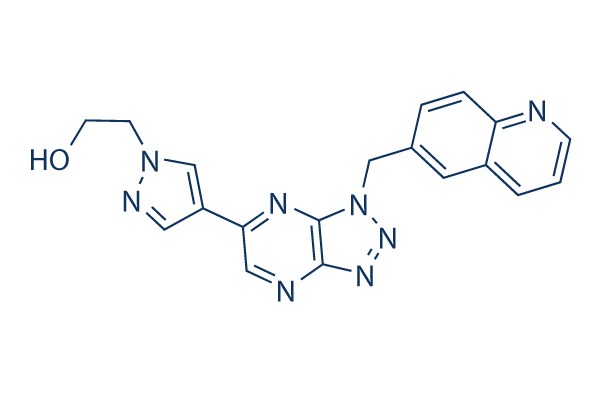
PF-04217903 Chemical Structure
CAS No. 956905-27-4
Purity & Quality Control
PF-04217903 Related Products
| Related Products | SGX-523 Foretinib PHA-665752 SU11274 BMS-777607 JNJ-38877605 Tivantinib Tepotinib Savolitinib (AZD6094) MGCD-265 analog Golvatinib (E7050) Merestinib (LY2801653) MK-2461 NPS-1034 AMG 337 Sodium L-ascorbyl-2-phosphate NVP-BVU972 BMS-794833 S49076 | Click to Expand |
|---|---|---|
| Related Compound Libraries | Kinase Inhibitor Library Tyrosine Kinase Inhibitor Library PI3K/Akt Inhibitor Library Cell Cycle compound library Angiogenesis Related compound Library | Click to Expand |
Signaling Pathway
Cell Data
| Cell Lines | Assay Type | Concentration | Incubation Time | Formulation | Activity Description | PMID |
|---|---|---|---|---|---|---|
| human A549 cells | Function assay | 1 h | Antagonist activity at c-MET receptor in human A549 cells assessed as inhibition of autophosphorylation after 1 hr by ELISA, IC50=4 nM | 22924734 | ||
| Click to View More Cell Line Experimental Data | ||||||
Biological Activity
| Description | PF-04217903 is a selective ATP-competitive c-Met inhibitor with IC50 of 4.8 nM in A549 cell line, susceptible to oncogenic mutations (no activity to Y1230C mutant). Phase 1. | ||
|---|---|---|---|
| Targets |
|
| In vitro | ||||
| In vitro | Being more selective than staurosporine or PF-02341066, PF-04217903 displays >1000-fold selectivity for c-Met over a panel of 208 kinases, although more susceptible to oncogenic mutations of c-Met that attenuate potency than PF-02341066. In addition to WT c-Met, PF-04217903 displays similar potency to inhibit the activity of c-Met-H1094R, c-Met-R988C, and c-Met-T1010I with IC50 of 3.1 nM, 6.4 nM, and 6.7 nM, respectively, but has no inhibitory activity against c-Met-Y1230C with IC50 of >10 μM. [1] PF-04217903 in combination with sunitinib significantly inhibits endothelial cells, but not the tumor cells B16F1, Tib6, EL4, and LLC [2] PF-04217903 significantly inhibits the clonogenic growth of LXFA 526L and LXFA 1647L with IC50 values of 16 nM, and 13 nM, respectively, yielding an additive effect when in combination with cetuximab. [3] PF-04217903 potently inhibits c-Met-driven processes such as cell growth, motility, invasion, and morphology of a variety of tumor cells. PF-04217903 treatment (2 μM) increased cell death of GTL-16 cells, which involves the downregulation of phosphorylated 4E-BP1, ERK/MAPK associated proteins and PI3K/AKT pathway. [4] | |||
|---|---|---|---|---|
| Kinase Assay | Cellular c-Met phosphorylation ELISA | |||
| A549 cells with endogenous human WT c-Met are seeded in 96-well plates in growth medium and cultured overnight. On the second day of the assay, the growth medium is replaced with serum-free medium (with 0.04% BSA). Serial dilutions of PF-04217903 are added to each well, and cells are incubated at 37 °C for 1 hour. Then 40 ng/mL HGF is added to the cells for 20 minutes. The cells are washed once with HBSS supplemented with 1 mM Na3VO4, and protein lysates are generated from cells using lysis buffer. Phosphorylation of c-Met is assessed by an ELISA method utilizing capture antibodies specific for c-Met and a detection antibody specific for phosphorylated tyrosine residues. Antibody-coated plates are incubated in the presence of protein lysates at 4 °C overnight and washed with 1% Tween 20 in PBS seven times. HRP-PY20 (horseradish peroxidase-conjugated anti-phosphotyrosine) is diluted 1:500 in blocking buffer and added to each plate for 30 minutes. Plates are then washed again, and TMB peroxidase substrate is added to initiate the HRP-dependent colorimetric reaction and the reaction stopped by addition of 0.09 N H2SO4. ELISA end points are the absorbance measured at 450 nm using a spectrophotometer. IC50 value is calculated by concentration-response curve fitting utilizing a Microsoft Excel-based four-parameter analytical met | ||||
| Cell Research | Cell lines | B16F1, Tib6, EL4, and LLC, HUVECs and C166 cells | ||
| Concentrations | Dissolved in DMSO, final concentrations ~2 μM | |||
| Incubation Time | 4 days | |||
| Method | Cells are treated with different concentrations PF-04217903 for 4 days. Cell proliferation is assessed by counting content of each well using a Coulter counter machine. | |||
| In Vivo | ||
| In vivo | Although unable to inhibit tumor growth in the sunitinib-sensitive B16F1 and Tib6 tumor models, the combination of PF-04217903 and sunitinib significantly inhibits tumor growth in sunitinib-resistant EL4, and LLC tumor models compared with sunitinib or PF-04217903 alone by significantly blocking vascular expansion, indicating a functional role for HGF/c-Met axis in the sunitinib-resistant tumors. [2] | |
|---|---|---|
| Animal Research | Animal Models | Immunodeficient nude mice (nu/nu) subcutaneously implanted with tumor cell lines B16F1, EL4, LLC, or Tib6 |
| Dosages | 45 mg/kg | |
| Administration | Orally | |
| NCT Number | Recruitment | Conditions | Sponsor/Collaborators | Start Date | Phases |
|---|---|---|---|---|---|
| NCT00706355 | Terminated | Neoplasms |
Pfizer |
August 2008 | Phase 1 |
|
Chemical Information & Solubility
| Molecular Weight | 372.38 | Formula | C19H16N8O |
| CAS No. | 956905-27-4 | SDF | Download PF-04217903 SDF |
| Smiles | C1=CC2=C(C=CC(=C2)CN3C4=NC(=CN=C4N=N3)C5=CN(N=C5)CCO)N=C1 | ||
| Storage (From the date of receipt) | |||
|
In vivo Add solvents to the product individually and in order. |
In vivo Formulation Calculator |
|||||
Preparing Stock Solutions
Molarity Calculator
In vivo Formulation Calculator (Clear solution)
Step 1: Enter information below (Recommended: An additional animal making an allowance for loss during the experiment)
mg/kg
g
μL
Step 2: Enter the in vivo formulation (This is only the calculator, not formulation. Please contact us first if there is no in vivo formulation at the solubility Section.)
% DMSO
%
% Tween 80
% ddH2O
%DMSO
%
Calculation results:
Working concentration: mg/ml;
Method for preparing DMSO master liquid: mg drug pre-dissolved in μL DMSO ( Master liquid concentration mg/mL, Please contact us first if the concentration exceeds the DMSO solubility of the batch of drug. )
Method for preparing in vivo formulation: Take μL DMSO master liquid, next addμL PEG300, mix and clarify, next addμL Tween 80, mix and clarify, next add μL ddH2O, mix and clarify.
Method for preparing in vivo formulation: Take μL DMSO master liquid, next add μL Corn oil, mix and clarify.
Note: 1. Please make sure the liquid is clear before adding the next solvent.
2. Be sure to add the solvent(s) in order. You must ensure that the solution obtained, in the previous addition, is a clear solution before proceeding to add the next solvent. Physical methods such
as vortex, ultrasound or hot water bath can be used to aid dissolving.
Tech Support
Answers to questions you may have can be found in the inhibitor handling instructions. Topics include how to prepare stock solutions, how to store inhibitors, and issues that need special attention for cell-based assays and animal experiments.
Tel: +1-832-582-8158 Ext:3
If you have any other enquiries, please leave a message.
* Indicates a Required Field
Tags: buy PF-04217903 | PF-04217903 supplier | purchase PF-04217903 | PF-04217903 cost | PF-04217903 manufacturer | order PF-04217903 | PF-04217903 distributor



Products are for research use only. Not for human use. We do not sell to patients.
©Copyright 2013 Selleck Chemicals. All Rights Reserved.