
-
 Australia
-
 Austria
-
 Belgium
-
 Brazil
-
 Canada
-
 China
China
-
 Czech Republic
-
 Denmark
-
 Finland
-
 France
-
 Germany
-
 Greece
-
 Hong Kong
-
 Hungary
-
 Iceland
-
 India
India
-
 Ireland
-
 Israel
-
 Italy
Italy
-
 Japan
Japan
-
 Korea
Korea
-
 Luxembourg
-
 Malaysia
-
 Netherlands
-
 New Zealand
-
 Norway
-
 Poland
-
 Qatar
Qatar
-
 Romania
-
 Saudi Arabia
-
 Singapore
-
 Spain
Spain
-
 Sweden
-
 Switzerland
-
 Taiwan
-
 Turkey
-
 United Kingdom
-
 United States
Caspase Inhibitors
| Cat.No. | Product Name | Information | Product Use Citations | Product Validations |
|---|---|---|---|---|
| S7313 | Z-LEHD-FMK TFA | Z-LEHD-FMK TFA (Caspase-9 Inhibitor) is a cell-permeable, competitive and irreversible inhibitor of enzyme caspase-9, which helps in cell survival. |
|
|
| S8102 | Z-VAD(OH)-FMK | Z-VAD(OH)-FMK (Caspase Inhibitor VI) is an irreversible pan-caspase inhibitor. |
|
-FMK-S810201Z0220161121.gif)
|
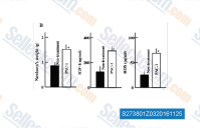
| S2738 | PAC-1 | PAC-1 is a potent procaspase-3 activator with EC50 of 0.22 μM and the first small molecule known to directly activate procaspase-3 to caspase-3. |
|
|
| S8507 | Z-YVAD-FMK | Z-YVAD-FMK is a cell-permeable and irreversible caspase-1 specific inhibitor with anti-inflammatory and anti-tumor activities. |
|
|
| S2927 | Apoptosis Activator 2 | Apoptosis Activator 2 strongly induces caspase-3 activation, PARP cleavage, and DNA fragmentation which leads to the destruction of cells (Apaf-1 dependent) with IC50 of ~4 μM, inactive to HMEC, PREC, or MCF-10A cells. |
|
|
| E5825 | Z-VAD | Z-VAD is a competitive, irreversible pan-caspase inhibitor with broad specificity and weakly inhibits caspase-2. It induces autophagy and necrosis in irradiated breast and lung cancer models. |
|
|
| S3865 | Taurochenodeoxycholic acid | Taurochenodeoxycholic acid (Taurochenodeoxycholate, TCDCA, Chenodeoxycholyltaurine), a bile acid formed in the liver of most species, is used as a cholagogue and choleretic. |
|
|
| S6846 | Gly-Phe β-naphthylamide | Gly-Phe β-naphthylamide (Gly-Phe beta-naphthylamide) is a substrate of cathepsin C that accumulates within the lysosome. Gly-Phe-β-naphthylamide can inhibit the cathepsin-dependent activation of caspase-8. |
|
|
| S7326 | Tasisulam | Tasisulam (LY573636) is an antitumor agent and an apoptosis inducer via the intrinsic pathway. Phase 3. |
|
|
| S5550 | Ethyl gallate | Ethyl gallat (Phyllemblin, gallic acid ethyl ester), which could be found naturally in a variety of plant sources, is a food additive with antimicrobial activity. Ethyl gallat activates the death receptor-dependent pathway of apoptosis by enhancing the expression of caspases-8, -9, and -3 and the Bcl-2 interacting domain (Bid). |
|
|
| S9634 | Phenoxodiol (Haginin E) | Phenoxodiol (Haginin E, Idronoxil, Dehydroequol, NV 06, PXD) is an isoflavone analog with antineoplastic activity. It activates the caspase system, inhibits XIAP (X-linked inhibitor of apoptosis), and disrupts FLICE inhibitory protein (FLIP) expression, resulting in tumor cell apoptosis. This compound also inhibits DNA topoisomerase II. |
|
|
| S6501 | NVP 231 | NVP 231 is a novel CerK inhibitor that inhibits the catalytic activity of recombinant CerK in vitro with an IC50 of 12 nM. This compound induces cell apoptosis by increasing DNA fragmentation and caspase-3 and caspase-9 cleavage. | ||
| E3053 | Mentha Arvensis Leaf Extract | Mentha Arvensis Leaf Extract is extracted from the leaf of Mentha Arvensis, which might be considered as a promising anticancer agent in breast cancer therapy in combination with synthesised GSNPs because they are less toxic and nonmutagenic and mediate caspase 9-dependent apoptosis. | ||
| E3835 | Cordyceps Militaris Extract | Cordyceps Militaris Extract is extracted from Cordyceps militaris, which induces apoptosis and pyroptosis via caspase-3 and can be used as an anticancer agent. | ||
| E3281 | Eleutherine Plicata Extract | Eleutherine Plicata Extract is extracted from Eleutherine plicata, which is a promising medicinal plant, and its activity is associated with cytotoxicity by binding to caspase-8. | ||
| E3638 | Lysinotus pauciflorus Extract | Lysinotus Pauciflorus Extract is extracted from Lysinotus Pauciflorus, which induces apoptosis of hepatocellular carcinoma cells via caspase-3 mediated mitochondrial pathway. | ||
| E6477New | Taurolithocholic acid | Taurolithocholic acid is a taurine-conjugated tertiary bile acid. It induces apoptosis in hepatoma cell lines via caspase-3/7 activation and serves as a model to study the endocrine and metabolic roles of bile acids in enterohepatic circulation and liver physiology. | ||
| S3088 | (±)-Methyl Jasmonate |
(±)-Methyl Jasmonate (MeJA, Methyl jasmonate, Methyl 2-(3-oxo-2-(pent-2-en-1-yl)cyclopentyl)acetate), a phytohormone that acts as a vital cell regulator in plants, is a new candidate for the treatment of Inflammatory bowel diseases (IBDs), modulating the expression of the major classes of caspase-type protease families. |
||
| S9097 | Alisol B Acetate | Alisol B acetate, a triterpene from Alismatis rhizoma, induces Bax up-regulation and nuclear translocation, the activation of initiator caspase-8 and caspase-9, and executor caspase-3, suggesting the involvement of both extrinsic and intrinsic apoptosis pathways. | ||
| E7500 | BOC-D-FMK | BOC-D-FMK is a broad-spectrum inhibitor of caspase. It inhibited TNFα-stimulated apoptosis in neutrophils with an IC50 values of 39 μM. | ||
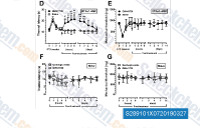
| S2891 | GW441756 | GW441756 is a potent, selective inhibitor of TrkA with IC50 of 2 nM, with very little activity to c-Raf1 and CDK2. This compound produces a relevant increase of caspase-3 that leads to apoptosis. |
|
|
| S2271 | Berberine chloride | Berberine chloride is a quaternary ammonium salt from the group of isoquinoline alkaloids. This compound activates caspase 3 and caspase 8, cleavage of poly ADP-ribose polymerase (PARP) and the release of cytochrome c. It decreases the expression of c-IAP1, Bcl-2 and Bcl-XL. This chemical induces apoptosis with sustained phosphorylation of JNK and p38 MAPK, as well as generation of the ROS. It is a dual topoisomerase I and II inhibitor. It is also a potential autophagy modulator. |
|
|
| S3275 | Senkyunolide I | Senkyunolide I (SEI, SENI) is an orally active compound isolated from Ligusticum chuanxiong with analgesic, anti-migraine, neuroprotective, anti-oxidation and anti-apoptosis activities. This compound up-regulates the phosphorylation of Erk1/2 and induces Nrf2 nuclear translocation with enhanced HO-1 and NQO1 expressions. It also promotes the ratio of Bcl-2/Bax and inhibits the expressions of cleaved caspase 3 and caspase 9. |
|
|
| S2448 | Gambogic Acid | Gambogic Acid (Guttatic Acid, Guttic Acid, Beta-Guttiferrin) activates caspases with EC50 of 0.78-1.64 μM and competitively inhibits Bcl-XL, Bcl-2, Bcl-W, Bcl-B, Bfl-1 and Mcl-1 with IC50 of 1.47, 1.21, 2.02, 0.66, 1.06 and 0.79 μM, respectively. |
|
|
| S3238 | Resibufogenin | Resibufogenin (Bufogenin, Recibufogenin), a component of huachansu with anticancer effect, triggers necroptosis through upregulating receptor-interacting protein kinase 3 (RIP3) and phosphorylating mixed lineage kinase domain-like protein at Ser358. This compound exerts cytotoxic effect by inducing reactive oxygen species (ROS) accumulation. It induces apoptosis and caspase-3 and caspase-8 activity. This chemical increases Bax/Bcl-2 expression, and suppresses cyclin D1, cyclin E, PI3K, p-AKT, p-GSK3β and β-catenin protein expression. |
|
|
| S9817 | Ac-FLTD-CMK | Ac-FLTD-CMK is a specific inhibitor for inflammatory caspases. This compound inhibits gasdermin D (GSDMD) cleavage by caspases-1, -4, -5, and -11 in vitro. It is effective against caspases-1, caspases-4 and caspases-5 with IC50 of 46.7 nM, 1.49 μM and 329 nM, respectively. |
|
|
| S5967 | Berberine chloride hydrate | Berberine (Natural Yellow 18) chloride hydrate is a quaternary ammonium salt from the group of isoquinoline alkaloids. Berberine activates caspase 3 and caspase 8, cleavage of poly ADP-ribose polymerase (PARP) and the release of cytochrome c. Berberine chloride decreases the expression of c-IAP1, Bcl-2 and Bcl-XL. Berberine chloride induces apoptosis with sustained phosphorylation of JNK and p38 MAPK, as well as generation of the ROS. Berberine chloride is a dual topoisomerase I and II inhibitor. Berberine chloride is also a potential autophagy modulator. |
|
|
| S6990 | Phytohemagglutinin (PHA) | A potent mitogen from red kidney beans (Phaseolus vulgaris), phytohemagglutinin (PHA) stimulates lymphocyte proliferation and transforms them into large blast cells. It can suppress humoral antibody responses and enhance the survival of homografts by inhibiting immune rejection. It also triggers T-cell activation and apoptosis by upregulating pro-apoptotic proteins like Bax, leading to the activation of caspase-3. |
|
|
| S0354 | Alsterpaullone | Alsterpaullone (Alp, 9-Nitropaullone, NSC 705701) is a potent inhibitor of CDK with IC50 of 35 nM, 15 nM, 200 nM and 40 nM for CDK1/cyclin B, CDK2/cyclin A, CDK2/cyclin E and CDK5/p35, respectively. This compound also acts as a potent inhibitor of glycogen synthase kinase-3 (GSK-3) with IC50 of both 4 nM for GSK-3α and GSK-3β. It induces apoptosis by activation of caspase-9. This chemical has antitumor activity and possesses potential for the treatment of neurodegenerative and proliferative disorders. |
|
|
| S0563 | 10-Deacetyl-7-xylosyl paclitaxel | 10-Deacetyl-7-xylosyl paclitaxel (10-Deacetyl-7-xylosyltaxol, 7-xylosyl-10-deacetylpaclitaxel), a derivative of paclitaxel and naturally occurring xyloside isolated from Taxus chinensis, causes significant mitotic arrest in PC-3 cells followed by up-regulating expression of pro-apoptotic Bax and Bad protein, as well as down-regulating expression of anti-apoptotic Bcl-2 and Bcl-XL , which leads to a disturbance of the mitochondrial membrane permeability and to the activation of caspase-9. |
|
|
| S4513 | RGD peptide (GRGDNP) | RGD peptide (GRGDNP) is an inhibitor of binding of integrins to the extracellular matrixs. This compound induces apoptosis presumably through direct activation of caspase-3. |
|
|
| S8487 | AP20187 (B/B Homodimerizer) | AP20187 (B/B Homodimerizer) is a chemical inducer of dimerization that activates FKBP-Casp8. |
|
|
| E3037 | Solanum lyratum Extract | Solanum lyratum Extract (300 μg/ml) increases Bax levels and decreases Bcl-2 levels, which cause the loss of mitochondrial membrane potential (Δæm) followed by cytochrome C release and caspase-9 and -3 activation, finally leading to apoptosis. This compound also promotes p53 and p27, but decreases the levels of cyclin B1 thus causing S-phase arrest. | ||
| S6899 | Licochalcone D | Licochalcone D (Lico D, LCD, LD), a flavonoid isolated from a Chinese medicinal plant Glycyrrhiza inflata, has antioxidant, anti-inflammatory and anti-cancer properties. This compound inhibits phosphorylation of NF-κB p65 in LPS signaling pathway. It inhibits JAK2, EGFR and Met (c-Met) activities and induces ROS-dependent apoptosis. This chemical also induces caspases activation and poly (ADP-ribose) polymerase (PARP) cleavage. | ||
| S0913 | 4',5,7-Trimethoxyflavone | 4',5,7-Trimethoxyflavone (5,7,4'-Trimethoxyflavone, TMF) is a flavonoid isolated from Kaempferia parviflora (KP) that induces apoptosis. This compound increases sub-G1 phase, DNA fragmentation, annexin-V/PI staining and Bax/Bcl-xL ratio, activates caspase-3 and degrades poly (ADP-ribose) polymerase (PARP) protein. | ||
| S3224 | Cinobufagin | Cinobufagin (Cinobufagine), an active ingredient of Venenum Bufonis, inhibits tumor development. This compound increases ATM and Chk2 and decreases CDC25C, CDK1, and cyclin B. It inhibits PI3K, AKT and Bcl-2 while increases levels of cleaved caspase-9 and caspase-3. Thus, this chemical induces cell cycle arrest at the G2/M phase and apoptosis. | ||
| S3267 | Nicotiflorin (Kaempferol-3-O-rutinoside) | Nicotiflorin (Kaempferol-3-O-rutinoside), a flavonoid extracted from Carthamus tinctorius, alters the shape and structure of injured neurons, decreases the number of apoptotic cells, down-regulates expression of p-JAK2, p-STAT3, caspase-3, and Bax and decreases Bax immunoredactivity, and increases Bcl-2 protein expression and immunoreactivity. | ||
| E2354 | Valepotriate | Valepotriate, an unstable iridoid isolated from Valeriana jatamansi Jones, has anti-epileptic by significantly increasing the expression of GABAA, glutamic acid decarboxylase 65, and Bcl-2 and reduce the expression of caspase-3. | ||
| S9276 | Alisol B | Alisol B, a triterpene from Alismatis rhizoma, induces Bax up-regulation and nuclear translocation, the activation of initiator caspase-8 and caspase-9, and executor caspase-3, suggesting the involvement of both extrinsic and intrinsic apoptosis pathways. | ||
| S6882 | HI-TOPK-032 | HI-TOPK-032 is a potent and specific inhibitor of TOPK. This compound also reduces ERK-RSK phosphorylation, regulates of the abundance of p53, cleaved caspase-7, and cleaved PARP, and induces apoptosis in cancer cells. | ||
| S9075 | Mulberroside A | Mulberroside A, isolated from the ethanol extract of Morus alba roots, is widely employed as an active ingredient in cosmetic products due to its anti-tyrosinase and anti-oxidant activities. This compound decreases the expressions of TNF-α, IL-1β and IL-6 and inhibits the activation of NALP3, caspase-1 and NF-κB and the phosphorylation of ERK, JNK and p38. | ||
| S5579 | Chelidonic acid | Chelidonic acid (Jerva acid, Jervaic acid, γ-Pyrone-2,6-dicarboxyl acid) is a secondary metabolite found in several plants with therapeutic potential in allergic disorders in experimental animals. This compound inhibits IL-6 production by blocking NF-κB and caspase-1 in HMC-1 cells. It is also an inhibitor of glutamate decarboxylase with Ki of 1.2 μM. | ||
| S4353 | Terfenadine | Terfenadine is an antihistamine, generally completely metabolizes to the active form fexofenadine in the liver by the enzyme cytochrome P450 CYP3A4 isoform. This compound is a potent open-channel blocker of hERG with an IC50 of 204 nM. This chemical, an H1 histamine receptor antagonist, acts as a potent apoptosis inducer in melanoma cells through modulation of Ca2+ homeostasis. It induces ROS-dependent apoptosis, simultaneously activates Caspase-4, -2, -9. | ||
| S5584 | Citronellol | Citronellol (Dihydrogeraniol, (±)-β-Citronellol), a constituent of rose and geranium oils, is used in perfumes and insect repellents. This compound can cause necrotic apoptosis of NCI-H1299 cells by up-regulating TNF-α, RIP1 / RIP3 activities, and down-regulating caspase-3 / caspase-8 activities. It also results in a biphasic increase in ROS production at 1 h and at 12 h in NCI-H1299 cells. |

Products are for research use only. Not for human use. We do not sell to patients.
©Copyright 2013 Selleck Chemicals. All Rights Reserved.