
-
 Argentina
-
 Australia
-
 Austria
-
 Belgium
-
 Brazil
-
 Canada
-
 China
China
-
 Czech Republic
-
 Denmark
-
 Finland
-
 France
-
 Germany
-
 Greece
-
 Hong Kong
-
 Hungary
-
 Iceland
-
 India
India
-
 Ireland
-
 Israel
-
 Italy
Italy
-
 Japan
Japan
-
 Korea
Korea
-
 Luxembourg
-
 Malaysia
-
 Netherlands
-
 New Zealand
-
 Norway
-
 Poland
-
 Portugal
-
 Qatar
Qatar
-
 Romania
-
 Saudi Arabia
-
 Singapore
-
 Spain
Spain
-
 Sweden
-
 Switzerland
-
 Taiwan
-
 Turkey
-
 United Kingdom
-
 United States
research use only
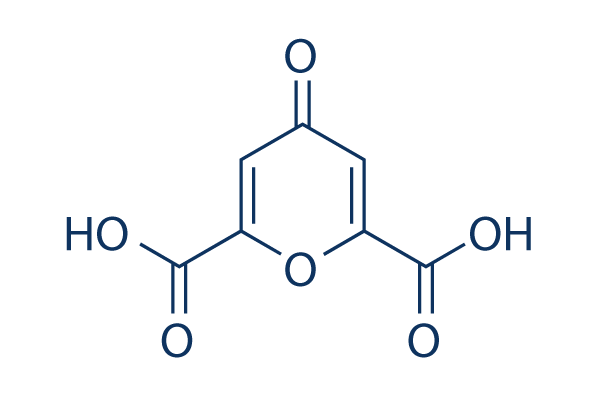
Chelidonic acid Immunology & Inflammation related chemical
Cat.No.S5579
Quality Control
| Related Targets | PD-1/PD-L1 CXCR STING AhR CD markers Interleukins Anti-infection Antioxidant COX Histamine Receptor |
|---|---|
| Other Immunology & Inflammation related Inhibitors | Cl-amidine Bestatin (Ubenimex) Bindarit (AF 2838) Tempol Tranilast GI254023X (GI4023) Sinomenine Geniposidic acid CORM-3 Germacrone |
Solubility
|
In vitro |
DMSO
: 4 mg/mL
(21.72 mM)
|
Molarity Calculator
|
In vivo |
|||||
In vivo Formulation Calculator (Clear solution)
Step 1: Enter information below (Recommended: An additional animal making an allowance for loss during the experiment)
Step 2: Enter the in vivo formulation (This is only the calculator, not formulation. Please contact us first if there is no in vivo formulation at the solubility Section.)
Calculation results:
Working concentration: mg/ml;
Method for preparing DMSO master liquid: mg drug pre-dissolved in μL DMSO ( Master liquid concentration mg/mL, Please contact us first if the concentration exceeds the DMSO solubility of the batch of drug. )
Method for preparing in vivo formulation: Take μL DMSO master liquid, next addμL PEG300, mix and clarify, next addμL Tween 80, mix and clarify, next add μL ddH2O, mix and clarify.
Method for preparing in vivo formulation: Take μL DMSO master liquid, next add μL Corn oil, mix and clarify.
Note: 1. Please make sure the liquid is clear before adding the next solvent.
2. Be sure to add the solvent(s) in order. You must ensure that the solution obtained, in the previous addition, is a clear solution before proceeding to add the next solvent. Physical methods such
as vortex, ultrasound or hot water bath can be used to aid dissolving.
Chemical Information, Storage & Stability
| Molecular Weight | 184.10 | Formula | C7H4O6 |
Storage (From the date of receipt) | 3 years -20°C powder |
|---|---|---|---|---|---|
| CAS No. | 99-32-1 | -- | Storage of Stock Solutions |
|
|
| Synonyms | Jerva acid, Jervaic acid, γ-Pyrone-2,6-dicarboxylic acid | SMILES | C1=C(OC(=CC1=O)C(=O)O)C(=O)O | ||
Read more about storage stability stock solution CAS number SMILES
Mechanism of Action
| Targets/IC50/Ki |
NF-κB
Caspase-1
IL-6
glutamate decarboxylase
|
|---|---|
| In vitro |
Chelidonic acid (also known as chelidonate) is a heterocyclic organic acid. It is a solid with a melting point between 158-160 °C and is soluble in hot water. This compound forms a dihydrate and can be synthesized through various methods, including the oxidation of chelidonine. This chemical exhibits tautomerism and has been studied for its potential biological activities.
|
| In vivo |
Chelidonic acid (also known as chelidonate) is a heterocyclic organic acid. It is a solid with a melting point between 152–153 °C. This compound is classified as an γ-pyrone, a type of compound where a ketone is attached to a carbon-carbon double bond within a six-membered ring. This chemical is found in several plant species, notably in the greater celandine (Chelidonium majus). The molecule can serve as a ligand in coordination chemistry.
|
References |
|
Tech Support
Tel: +1-832-582-8158 Ext:3
If you have any other enquiries, please leave a message.

Products are for research use only. Not for human use. We do not sell to patients.
©Copyright 2013 Selleck Chemicals. All Rights Reserved.