
-
 Australia
-
 Austria
-
 Belgium
-
 Brazil
-
 Canada
-
 China
China
-
 Czech Republic
-
 Denmark
-
 Finland
-
 France
-
 Germany
-
 Greece
-
 Hong Kong
-
 Hungary
-
 Iceland
-
 India
India
-
 Ireland
-
 Israel
-
 Italy
Italy
-
 Japan
Japan
-
 Korea
Korea
-
 Luxembourg
-
 Malaysia
-
 Netherlands
-
 New Zealand
-
 Norway
-
 Poland
-
 Qatar
Qatar
-
 Romania
-
 Saudi Arabia
-
 Singapore
-
 Spain
Spain
-
 Sweden
-
 Switzerland
-
 Taiwan
-
 Turkey
-
 United Kingdom
-
 United States
research use only
Belnacasan (VX-765) Caspase-1 Inhibitor
Cat.No.S2228
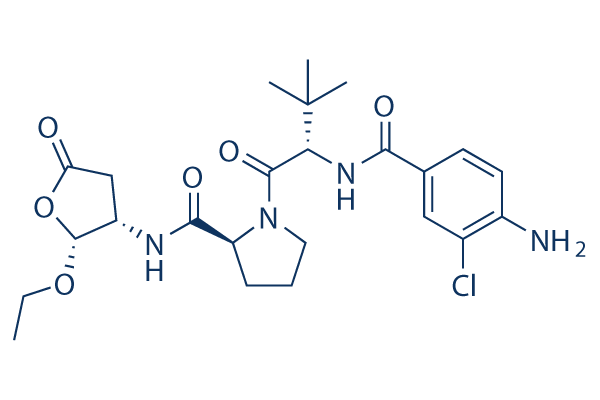
Chemical Structure
Molecular Weight: 509
Quality Control
| Related Targets | Bcl-2 PD-1/PD-L1 Ferroptosis p53 Apoptosis related Synthetic Lethality STAT TNF-alpha Ras KRas |
|---|---|
| Other Caspase Inhibitors | Emricasan (IDN-6556) Z-VAD-FMK Q-VD-Oph Z-DEVD-FMK Z-IETD-FMK Ac-DEVD-CHO Z-LEHD-FMK TFA Z-VAD(OH)-FMK PAC-1 Z-YVAD-FMK |
Solubility
|
In vitro |
DMSO
: 100 mg/mL
(196.46 mM)
Ethanol : 100 mg/mL Water : Insoluble |
Molarity Calculator
|
In vivo |
|||||
In vivo Formulation Calculator (Clear solution)
Step 1: Enter information below (Recommended: An additional animal making an allowance for loss during the experiment)
Step 2: Enter the in vivo formulation (This is only the calculator, not formulation. Please contact us first if there is no in vivo formulation at the solubility Section.)
Calculation results:
Working concentration: mg/ml;
Method for preparing DMSO master liquid: mg drug pre-dissolved in μL DMSO ( Master liquid concentration mg/mL, Please contact us first if the concentration exceeds the DMSO solubility of the batch of drug. )
Method for preparing in vivo formulation: Take μL DMSO master liquid, next addμL PEG300, mix and clarify, next addμL Tween 80, mix and clarify, next add μL ddH2O, mix and clarify.
Method for preparing in vivo formulation: Take μL DMSO master liquid, next add μL Corn oil, mix and clarify.
Note: 1. Please make sure the liquid is clear before adding the next solvent.
2. Be sure to add the solvent(s) in order. You must ensure that the solution obtained, in the previous addition, is a clear solution before proceeding to add the next solvent. Physical methods such
as vortex, ultrasound or hot water bath can be used to aid dissolving.
Chemical Information, Storage & Stability
| Molecular Weight | 509 | Formula | C24H33ClN4O6 |
Storage (From the date of receipt) | |
|---|---|---|---|---|---|
| CAS No. | 273404-37-8 | Download SDF | Storage of Stock Solutions |
|
|
| Synonyms | N/A | Smiles | CCOC1C(CC(=O)O1)NC(=O)C2CCCN2C(=O)C(C(C)(C)C)NC(=O)C3=CC(=C(C=C3)N)Cl | ||
Mechanism of Action
| Features |
A potent and selective inhibitor of interleukin-converting enzyme/caspase-1.
|
|---|---|
| Targets/IC50/Ki |
Caspase-4
(Cell-free assay) <0.6 nM(Ki)
Caspase-1
(Cell-free assay) 0.8 nM(Ki)
|
| In vitro |
Belnacasan (VX-765) is an orally absorbed prodrug of VRT-043198, which exhibits potent inhibition against ICE/caspase-1 and caspase-4 with Ki of 0.8 nM and less than 0.6 nM, respectively. This compound also inhibits IL-1β release from both PBMCs and whole blood with IC50 of 0.67 μM and 1.9 μM, respectively. |
| Kinase Assay |
Protease Enzyme Assays
|
|
Belnacasan (VX-765) enzyme inhibition is assayed by tracking of the rate of hydrolysis of an appropriate substrate labeled with either p-nitroaniline or aminomethyl coumarin (AMC) as follows: ICE/caspase-1, suc-YVAD-p-nitroanilide; caspase-4, Ac-WEHD-AMC; caspase-6, Ac-VEID-AMC; caspase-3, -7, -8, and -9, Ac-DEVD-AMC; and granzyme B, Ac-IEPD-AMC. Enzymes and substrates are incubated in a reaction buffer [10 mM Tris, pH 7.5, 0.1% (w/v) CHAPS, 1 mM dithiothreitol, and 5% (v/v) dimethyl sulfoxide] for 10 minutes at 37 °C. Glycerol is added to the buffer at 8% (v/v) for caspase-3, -6, and -9 and granzyme B to improve stability of enzymes. The rate of substrate hydrolysis is monitored using a fluorometer.
|
|
| In vivo |
In collagen-induced arthritis mouse model, Belnacasan (VX-765) (200 mg/kg) inhibits LPS-induced IL-1β production by about 60%, and results in a dose-dependent, statistically significant reduction in the inflammation scores and effective protection from joint changes. In vivo, it blocks kindling epileptogenesis in rats by preventing IL-1β increase in forebrain astrocytes without significant effect on afterdischarge duration. In the mouse model of acute seizures, this compound (50 mg/kg-200 mg/kg) produces the anticonvulsant effect by delaying the time to onset of the first seizure and decreasing the number of seizures as well as their total duration by average 50% and 64%. In adult rats with genetic absence epilepsy (GAERS), after the 3rd drug injection, it significantly reduces the cumulative duration and number of spike-and-wave discharges (SWDs) by 55% on average by selectively blocking IL-1β biosynthesis. |
References |
|
Applications
| Methods | Biomarkers | Images | PMID |
|---|---|---|---|
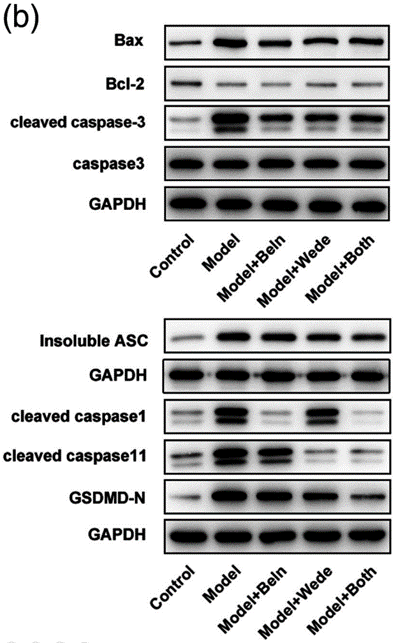
| Western blot | Bax / Bcl-2 / caspase-3 / caspase-1 / caspase-11 / GSDMD-N / GAPDH Cyto c / Tubulin Bid / tBid / Tubulin |
|
32865056 |
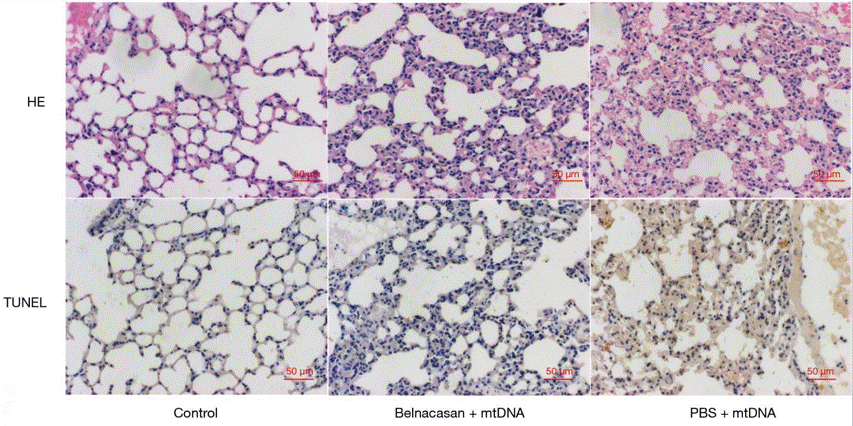
| IHC | HE staining / TUNEL |
|
31903272 |
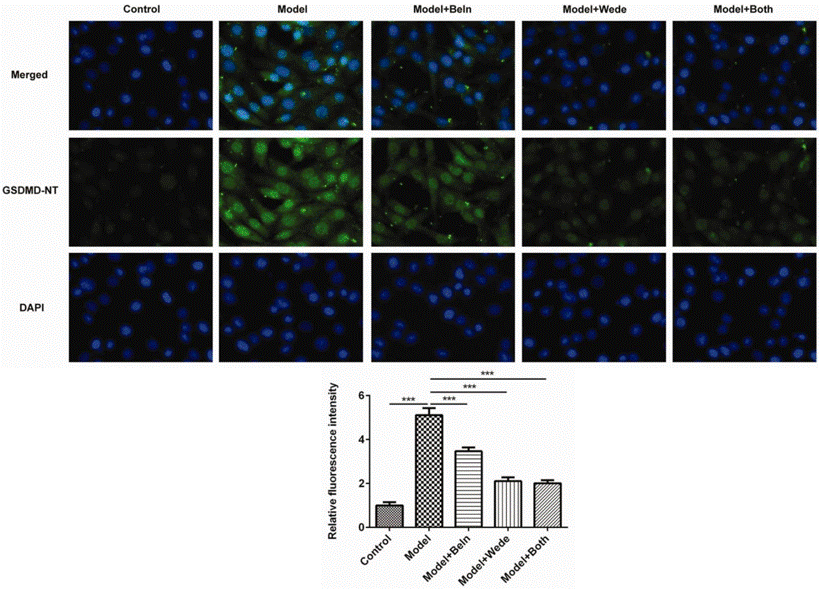
| Immunofluorescence | GSDMD-NT |
|
32865056 |
Clinical Trial Information
(data from https://clinicaltrials.gov, updated on 2024-05-22)
| NCT Number | Recruitment | Conditions | Sponsor/Collaborators | Start Date | Phases |
|---|---|---|---|---|---|
| NCT01501383 | Terminated | Epilepsy |
Vertex Pharmaceuticals Incorporated |
December 2011 | Phase 2 |
Tech Support
Tel: +1-832-582-8158 Ext:3
If you have any other enquiries, please leave a message.
Frequently Asked Questions
Question 1:
The recommended dose is 100mg/kg p.o. in 25% cremophor EL in water. Is it directly soluble at 10mg/ml in 25% cremophor in water? How to formulate this compound for in vivo use in mice?
Answer:
You can prepare 25% cremophor EL in water first and then directly resuspend it in the vehicle. The powder may not be fully dissolved, but the suspension is stable and can be used for gavage feeding.
Signaling Pathway Map

Products are for research use only. Not for human use. We do not sell to patients.
©Copyright 2013 Selleck Chemicals. All Rights Reserved.