
-
 Australia
-
 Austria
-
 Belgium
-
 Brazil
-
 Canada
-
 China
China
-
 Czech Republic
-
 Denmark
-
 Finland
-
 France
-
 Germany
-
 Greece
-
 Hong Kong
-
 Hungary
-
 Iceland
-
 India
India
-
 Ireland
-
 Israel
-
 Italy
Italy
-
 Japan
Japan
-
 Korea
Korea
-
 Luxembourg
-
 Malaysia
-
 Netherlands
-
 New Zealand
-
 Norway
-
 Poland
-
 Qatar
Qatar
-
 Romania
-
 Saudi Arabia
-
 Singapore
-
 Spain
Spain
-
 Sweden
-
 Switzerland
-
 Taiwan
-
 Turkey
-
 United Kingdom
-
 United States
research use only
Levetiracetam (UCB-L059) Calcium Channel inhibitor
Cat.No.S1356
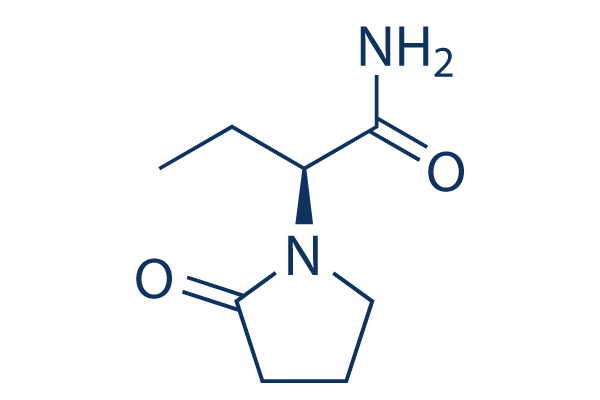
Chemical Structure
Molecular Weight: 170.21
Quality Control
| Related Targets | CFTR CRM1 CD markers AChR Sodium Channel Potassium Channel GABA Receptor TRP Channel ATPase GluR |
|---|---|
| Other Calcium Channel Inhibitors | Bay K 8644 BAPTA-AM Tetrandrine Flunarizine 2HCl Nilvadipine Cilnidipine YM-58483 (BTP2) Imperatorin Ionomycin Manidipine 2HCl |
Solubility
|
In vitro |
DMSO
: 34 mg/mL
(199.75 mM)
Water : 34 mg/mL Ethanol : 34 mg/mL |
Molarity Calculator
|
In vivo |
|||||
In vivo Formulation Calculator (Clear solution)
Step 1: Enter information below (Recommended: An additional animal making an allowance for loss during the experiment)
Step 2: Enter the in vivo formulation (This is only the calculator, not formulation. Please contact us first if there is no in vivo formulation at the solubility Section.)
Calculation results:
Working concentration: mg/ml;
Method for preparing DMSO master liquid: mg drug pre-dissolved in μL DMSO ( Master liquid concentration mg/mL, Please contact us first if the concentration exceeds the DMSO solubility of the batch of drug. )
Method for preparing in vivo formulation: Take μL DMSO master liquid, next addμL PEG300, mix and clarify, next addμL Tween 80, mix and clarify, next add μL ddH2O, mix and clarify.
Method for preparing in vivo formulation: Take μL DMSO master liquid, next add μL Corn oil, mix and clarify.
Note: 1. Please make sure the liquid is clear before adding the next solvent.
2. Be sure to add the solvent(s) in order. You must ensure that the solution obtained, in the previous addition, is a clear solution before proceeding to add the next solvent. Physical methods such
as vortex, ultrasound or hot water bath can be used to aid dissolving.
Chemical Information, Storage & Stability
| Molecular Weight | 170.21 | Formula | C8H14N2O2 |
Storage (From the date of receipt) | |
|---|---|---|---|---|---|
| CAS No. | 102767-28-2 | Download SDF | Storage of Stock Solutions |
|
|
| Synonyms | UCB-L059, SIB-S1 | Smiles | CCC(C(=O)N)N1CCCC1=O | ||
Mechanism of Action
| Targets/IC50/Ki |
Calcium channel
|
|---|---|
| In vitro |
Levetiracetam (UCB-L059) and related compounds bind to SV2A expressed in fibroblasts, indicating that SV2A is sufficient for its binding. This compound irreversibly inhibits the high-voltage-activated (HVA) calcium current by approximately 18% on the average in freshly isolated CA1 hippocampal neurons of rats. It selectively inhibits N-type Ca2+ channels of CA1 pyramidal hippocampal neurons. Levetiracetam also reverses the inhibitory effect of DMCM on GABA-elicited currents in hippocampal neurons.
|
| In vivo |
Levetiracetam (UCB-L059) (17 mg/kg) produces a potent suppression of sound-induced clonic convulsions in mice, and this protective effect is significantly abolished by co-administration of the beta-carboline FG 7142. It exerts potent anticonvulsant activity against both focal and secondarily generalized seizures in fully amygdala-kindled rats, i.e. , a model of temporal lobe epilepsy. This compound (13 mg/kg, 27 mg/kg or 54 mg/kg, i.p.) dose-dependently suppresses the increase in seizure severity and duration induced by repeated amygdala stimulation. It has a relatively short half-life (about 2-3 hours) in rats. Levetiracetam (5.4 mg/kg to 96 mg/kg i.p.) dose-dependently inhibits both wild running and tonic-clonic convulsions in the audiogenic-seizure prone rat. It markedly suppresses spontaneous spike-and-wave discharge (SWD) but leaves the underlying EEG trace normal in the GAERS model of petit mal epilepsy.
|
References |
|
Clinical Trial Information
(data from https://clinicaltrials.gov, updated on 2024-05-22)
| NCT Number | Recruitment | Conditions | Sponsor/Collaborators | Start Date | Phases |
|---|---|---|---|---|---|
| NCT05860153 | Not yet recruiting | Febrile Convulsion |
Assiut University |
June 1 2023 | Not Applicable |
| NCT06403150 | Enrolling by invitation | Status Epilepticus |
Dhaka Medical College |
May 15 2023 | Phase 4 |
| NCT06067412 | Completed | Status Epilepticus |
Shaheed Zulfiqar Ali Bhutto Medical University |
August 1 2022 | Not Applicable |
| NCT04425798 | Unknown status | Glioma|Epilepsy |
Beijing Neurosurgical Institute|Beijing Tiantan Hospital |
May 25 2022 | -- |
| NCT04117425 | Recruiting | Epilepsy in Pregnancy |
Assistance Publique - Hôpitaux de Paris |
April 20 2022 | Not Applicable |
Tech Support
Tel: +1-832-582-8158 Ext:3
If you have any other enquiries, please leave a message.
Signaling Pathway Map

Products are for research use only. Not for human use. We do not sell to patients.
©Copyright 2013 Selleck Chemicals. All Rights Reserved.