
-
 Australia
-
 Austria
-
 Belgium
-
 Brazil
-
 Canada
-
 China
China
-
 Czech Republic
-
 Denmark
-
 Finland
-
 France
-
 Germany
-
 Greece
-
 Hong Kong
-
 Hungary
-
 Iceland
-
 India
India
-
 Ireland
-
 Israel
-
 Italy
Italy
-
 Japan
Japan
-
 Korea
Korea
-
 Luxembourg
-
 Malaysia
-
 Netherlands
-
 New Zealand
-
 Norway
-
 Poland
-
 Qatar
Qatar
-
 Romania
-
 Saudi Arabia
-
 Singapore
-
 Spain
Spain
-
 Sweden
-
 Switzerland
-
 Taiwan
-
 Turkey
-
 United Kingdom
-
 United States
research use only
Onalespib (AT13387) HSP90 Inhibitor
Cat.No.S1163
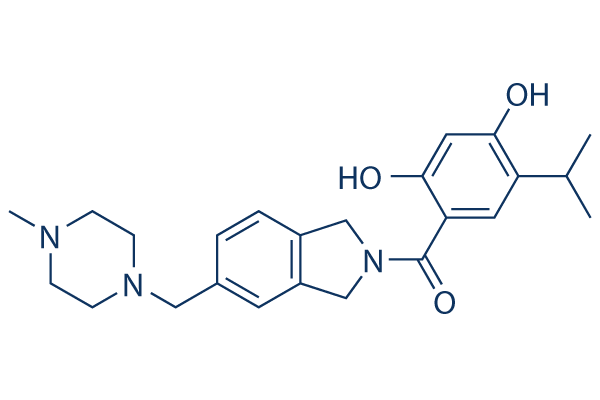
Chemical Structure
Molecular Weight: 409.52
Quality Control
Cell Culture, Treatment & Working Concentration
| Cell Lines | Assay Type | Concentration | Incubation Time | Formulation | Activity Description | PMID |
|---|---|---|---|---|---|---|
| human HCT116 cells | Cytotoxic assay | Cytotoxicity against human HCT116 cells by Alamar blue assay, IC50=0.048 μM | 20662534 | |||
| human HCT116 cells | Function assay | 10 nM | 18 h | Induction of apoptosis in human HCT116 cells assessed as upregulation of Hsp70 level at 10 nM after 18 hrs by immunoblotting | 20662534 | |
| human HCT116 cells | Function assay | 30 nM | 18 h | Induction of apoptosis in human HCT116 cells assessed as reduction of CDK4 level at 30 nM after 18 hrs by immunoblotting | 20662534 | |
| human HCT116 cells | Function assay | 30 nM | 18 h | Induction of apoptosis in human HCT116 cells assessed as reduction of Raf-1 level at 30 nM after 18 hrs by immunoblotting | 20662534 | |
| human HCT116 cells | Proliferation assay | 48 h | Antiproliferative activity against human HCT116 cells after 48 hrs by MTT assay, IC50=0.08 μM | 24763261 | ||
| human SKBR3 cells | Proliferation assay | 48 h | Antiproliferative activity against human SKBR3 cells after 48 hrs by MTT assay, IC50=0.14 μM | 24763261 | ||
| human MCF7 cells | Proliferation assay | 48 h | Antiproliferative activity against human MCF7 cells after 48 hrs by MTT assay, IC50=0.28 μM | 24763261 | ||
| human A231 cells | Proliferation assay | 48 h | Antiproliferative activity against human A231 cells after 48 hrs by MTT assay, IC50=1.01 μM | 24763261 | ||
| GIST430 | Cytotoxicity assay | 7 days | Cytotoxicity against imatinib-resistant human GIST430 cells assessed as decrease in cell viability after 7 days by alamar blue assay, IC50=0.034μM. | 26844689 | ||
| GIST48 | Cytotoxicity assay | 7 days | Cytotoxicity against imatinib-resistant human GIST48 cells assessed as decrease in cell viability after 7 days by alamar blue assay, IC50=0.055μM. | 26844689 | ||
| MCF7 | Antiproliferative assay | 72 hrs | Antiproliferative activity against human MCF7 cells incubated for 72 hrs by MTT assay, IC50=0.032μM. | 29028527 | ||
| SKBR3 | Antiproliferative assay | 72 hrs | Antiproliferative activity against human SKBR3 cells incubated for 72 hrs by MTT assay, IC50=0.045μM. | 29028527 | ||
| TC32 | qHTS assay | qHTS of pediatric cancer cell lines to identify multiple opportunities for drug repurposing: Primary screen for TC32 cells | 29435139 | |||
| DAOY | qHTS assay | qHTS of pediatric cancer cell lines to identify multiple opportunities for drug repurposing: Primary screen for DAOY cells | 29435139 | |||
| SJ-GBM2 | qHTS assay | qHTS of pediatric cancer cell lines to identify multiple opportunities for drug repurposing: Primary screen for SJ-GBM2 cells | 29435139 | |||
| A673 | qHTS assay | qHTS of pediatric cancer cell lines to identify multiple opportunities for drug repurposing: Primary screen for A673 cells | 29435139 | |||
| SK-N-MC | qHTS assay | qHTS of pediatric cancer cell lines to identify multiple opportunities for drug repurposing: Primary screen for SK-N-MC cells | 29435139 | |||
| NB-EBc1 | qHTS assay | qHTS of pediatric cancer cell lines to identify multiple opportunities for drug repurposing: Primary screen for NB-EBc1 cells | 29435139 | |||
| Saos-2 | qHTS assay | qHTS of pediatric cancer cell lines to identify multiple opportunities for drug repurposing: Primary screen for Saos-2 cells | 29435139 | |||
| SK-N-SH | qHTS assay | qHTS of pediatric cancer cell lines to identify multiple opportunities for drug repurposing: Primary screen for SK-N-SH cells | 29435139 | |||
| NB1643 | qHTS assay | qHTS of pediatric cancer cell lines to identify multiple opportunities for drug repurposing: Primary screen for NB1643 cells | 29435139 | |||
| LAN-5 | qHTS assay | qHTS of pediatric cancer cell lines to identify multiple opportunities for drug repurposing: Primary screen for LAN-5 cells | 29435139 | |||
| Rh18 | qHTS assay | qHTS of pediatric cancer cell lines to identify multiple opportunities for drug repurposing: Primary screen for Rh18 cells | 29435139 | |||
| OHS-50 | qHTS assay | qHTS of pediatric cancer cell lines to identify multiple opportunities for drug repurposing: Primary screen for OHS-50 cells | 29435139 | |||
| RD | qHTS assay | qHTS of pediatric cancer cell lines to identify multiple opportunities for drug repurposing: Primary screen for RD cells | 29435139 | |||
| NB1643 | qHTS assay | qHTS of pediatric cancer cell lines to identify multiple opportunities for drug repurposing: Confirmatory screen for NB1643 cells | 29435139 | |||
| A673 | qHTS assay | qHTS of pediatric cancer cell lines to identify multiple opportunities for drug repurposing: Confirmatory screen for A673 cells) | 29435139 | |||
| SK-N-MC | qHTS assay | qHTS of pediatric cancer cell lines to identify multiple opportunities for drug repurposing: Confirmatory screen for SK-N-MC cells | 29435139 | |||
| BT-12 | qHTS assay | qHTS of pediatric cancer cell lines to identify multiple opportunities for drug repurposing: Confirmatory screen for BT-12 cells | 29435139 | |||
| LAN-5 | qHTS assay | qHTS of pediatric cancer cell lines to identify multiple opportunities for drug repurposing: Confirmatory screen for LAN-5 cells | 29435139 | |||
| BT-37 | qHTS assay | qHTS of pediatric cancer cell lines to identify multiple opportunities for drug repurposing: Confirmatory screen for BT-37 cells | 29435139 | |||
| TC32 | qHTS assay | qHTS of pediatric cancer cell lines to identify multiple opportunities for drug repurposing: Confirmatory screen for TC32 cells | 29435139 | |||
| U-2 OS | qHTS assay | qHTS of pediatric cancer cell lines to identify multiple opportunities for drug repurposing: Confirmatory screen for U-2 OS cells | 29435139 | |||
| Rh41 | qHTS assay | qHTS of pediatric cancer cell lines to identify multiple opportunities for drug repurposing: Confirmatory screen for Rh41 cells | 29435139 | |||
| RD | qHTS assay | qHTS of pediatric cancer cell lines to identify multiple opportunities for drug repurposing: Confirmatory screen for RD cells | 29435139 | |||
| Rh18 | qHTS assay | qHTS of pediatric cancer cell lines to identify multiple opportunities for drug repurposing: Confirmatory screen for Rh18 cells | 29435139 | |||
| Rh30 | qHTS assay | qHTS of pediatric cancer cell lines to identify multiple opportunities for drug repurposing: Confirmatory screen for Rh30 cells | 29435139 | |||
| SK-N-SH | qHTS assay | qHTS of pediatric cancer cell lines to identify multiple opportunities for drug repurposing: Confirmatory screen for SK-N-SH cells | 29435139 | |||
| NCI-H3122 | Antiproliferative assay | 72 hrs | Antiproliferative activity against human NCI-H3122 cells after 72 hrs by SRB assay, IC50=0.052μM. | 29698859 | ||
| PANC1 | Function assay | 1 uM | 36 hrs | Inhibition of HSP90alpha in human PANC1 cells assessed as up-regulation of Hsp70 at 1 uM after 36 hrs by Western blot analysis | 30351001 | |
| PANC1 | Function assay | 1 uM | 36 hrs | Inhibition of HSP90alpha in human PANC1 cells assessed as akt degradation at 1 uM after 36 hrs by Western blot analysis | 30351001 | |
| MCF7 | Antiproliferative assay | 72 hrs | Antiproliferative activity against human MCF7 cells after 72 hrs by MTT assay, IC50=0.29μM. | 30784881 | ||
| NCI-H1299 | Antiproliferative assay | 72 hrs | Antiproliferative activity against human NCI-H1299 cells after 72 hrs by MTT assay, IC50=0.37μM. | 30784881 | ||
| A549 | Antiproliferative assay | 72 hrs | Antiproliferative activity against human A549 cells after 72 hrs by MTT assay, IC50=0.44μM. | 30784881 | ||
| Vero E6 | Function assay | 48 hrs | IC50 for antiviral activity against SARS-CoV-2 in the Vero E6 cell line at 48 h by immunofluorescence-based assay (detecting the viral NP protein in the nucleus of the Vero E6 cells), IC50=0.15488μM. | 32353859 | ||
| Click to View More Cell Line Experimental Data | ||||||
Solubility
|
In vitro |
DMSO
: 25 mg/mL
(61.04 mM)
Water : Insoluble Ethanol : Insoluble |
Molarity Calculator
|
In vivo |
|||||
In vivo Formulation Calculator (Clear solution)
Step 1: Enter information below (Recommended: An additional animal making an allowance for loss during the experiment)
Step 2: Enter the in vivo formulation (This is only the calculator, not formulation. Please contact us first if there is no in vivo formulation at the solubility Section.)
Calculation results:
Working concentration: mg/ml;
Method for preparing DMSO master liquid: mg drug pre-dissolved in μL DMSO ( Master liquid concentration mg/mL, Please contact us first if the concentration exceeds the DMSO solubility of the batch of drug. )
Method for preparing in vivo formulation: Take μL DMSO master liquid, next addμL PEG300, mix and clarify, next addμL Tween 80, mix and clarify, next add μL ddH2O, mix and clarify.
Method for preparing in vivo formulation: Take μL DMSO master liquid, next add μL Corn oil, mix and clarify.
Note: 1. Please make sure the liquid is clear before adding the next solvent.
2. Be sure to add the solvent(s) in order. You must ensure that the solution obtained, in the previous addition, is a clear solution before proceeding to add the next solvent. Physical methods such
as vortex, ultrasound or hot water bath can be used to aid dissolving.
Chemical Information, Storage & Stability
| Molecular Weight | 409.52 | Formula | C24H31N3O3 |
Storage (From the date of receipt) | |
|---|---|---|---|---|---|
| CAS No. | 912999-49-6 | Download SDF | Storage of Stock Solutions |
|
|
| Synonyms | N/A | Smiles | CC(C)C1=CC(=C(C=C1O)O)C(=O)N2CC3=C(C2)C=C(C=C3)CN4CCN(CC4)C | ||
Mechanism of Action
| Targets/IC50/Ki |
HSP90
(Cell-free assay) 18 nM
|
|---|---|
| In vitro |
The Kd for Onalespib (AT13387) binding is 0.7 nM. This compares to a Kd of 6.7 nM for the binding of the ansamycin 17-AAG to the same site. The mean stoichiometry of binding for this compound is 1.03. Its inhibition of a number of isolated kinases is also investigated, including CDK1, CDK2, CDK4, FGFR3, PKB-b, JAK2, VEGFR2, PDGFRβ and Aurora B. None of the tested kinases are significantly inhibited at concentrations below 30 μM. It is a potent inhibitor of the proliferation and survival of many different cell lines (such as MES-SA cell line) from a variety of different tumor types. Across a panel of 30 tumor cell lines, it potently inhibits cell proliferation with GI50 values in the range 13–260 nM. The compound also inhibits proliferation of the non-tumorigenic human prostate epithelial cell line PNT2 with a GI50 value of 480 nM.
|
| Kinase Assay |
HSP90 competition isothermal calorimetry
|
|
Kd values for Onalespib (AT13387) binding to HSP90 are determined with a competition Isothermal Calorimetry (ITC) format. ITC experiments are performed on a Micro Cal VP-ITC at 25 °C in a buffer comprising 25 mM Tris, 100 mM NaCl, 1 mM MgCl2 and 1 mM Tris(2-carboxy- ethyl)phosphine at pH 7.4 in order to maintain the higher affinit
|
|
| In vivo |
When given on an intermittent basis, Onalespib (AT13387) could be tolerated at doses of up to 70 mg/kg twice weekly or 90 mg/kg once weekly. Body weight loss in mice does not exceed 20% before recovering in all cases except one, and loss is highest following the second dose. Tumor growth inhibition is similar in NCI-H1975 for both dosing regimens. The maintenance of antitumor effects with such a prolonged off-treatment period is consistent with the extended pharmacodynamic action of this compound observed for mutant EGFR and other biomarkers in vitro and in vivo and the extended retention of it in tumors.
|
References |
|
Applications
| Methods | Biomarkers | Images | PMID |
|---|---|---|---|
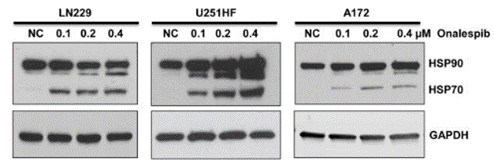
| Western blot | HSP90 / HSP70 EGFR / p-EGFR / AKT / p-AKT / ERK / p-ERK / S6 / p-S6 AXL / c-Myc / p-Mnk1 / Mnk1 / p-eIF4E / eIF4E |
|
28679777 |
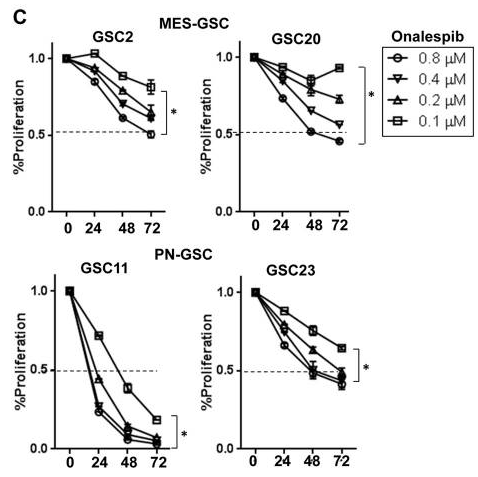
| Growth inhibition assay | Cell viability |
|
28679777 |
Clinical Trial Information
(data from https://clinicaltrials.gov, updated on 2024-05-22)
| NCT Number | Recruitment | Conditions | Sponsor/Collaborators | Start Date | Phases |
|---|---|---|---|---|---|
| NCT02898207 | Completed | Metastatic High Grade Fallopian Tube Serous Adenocarcinoma|Metastatic Malignant Solid Neoplasm|Metastatic Primary Peritoneal Serous Adenocarcinoma|Metastatic Triple-Negative Breast Carcinoma|Platinum-Resistant Fallopian Tube Carcinoma|Platinum-Resistant Ovarian Carcinoma|Platinum-Resistant Primary Peritoneal Carcinoma|Recurrent Breast Carcinoma|Recurrent High Grade Fallopian Tube Serous Adenocarcinoma|Recurrent High Grade Ovarian Serous Adenocarcinoma|Recurrent Primary Peritoneal High Grade Serous Adenocarcinoma|Recurrent Triple-Negative Breast Carcinoma|Refractory Fallopian Tube Serous Adenocarcinoma|Refractory Ovarian Serous Adenocarcinoma|Refractory Primary Peritoneal Serous Adenocarcinoma|Refractory Triple-Negative Breast Carcinoma|Unresectable High Grade Fallopian Tube Serous Adenocarcinoma|Unresectable Malignant Solid Neoplasm|Unresectable Primary Peritoneal Serous Adenocarcinoma |
National Cancer Institute (NCI) |
May 19 2017 | Phase 1 |
Tech Support
Tel: +1-832-582-8158 Ext:3
If you have any other enquiries, please leave a message.
Frequently Asked Questions
Question 1:
How to prepare it for in vivo studies?
Answer:
It can be dissolved in 2% DMSO/30% PEG 300/ddH2O at 10 mg/ml as a clear solution. But after stayed for about 1 hour, the precipitation will goes out. So it is recommended to be prepared before use.
Signaling Pathway Map

Products are for research use only. Not for human use. We do not sell to patients.
©Copyright 2013 Selleck Chemicals. All Rights Reserved.