
-
 Australia
-
 Austria
-
 Belgium
-
 Brazil
-
 Canada
-
 China
China
-
 Czech Republic
-
 Denmark
-
 Finland
-
 France
-
 Germany
-
 Greece
-
 Hong Kong
-
 Hungary
-
 Iceland
-
 India
India
-
 Ireland
-
 Israel
-
 Italy
Italy
-
 Japan
Japan
-
 Korea
Korea
-
 Luxembourg
-
 Malaysia
-
 Netherlands
-
 New Zealand
-
 Norway
-
 Poland
-
 Qatar
Qatar
-
 Romania
-
 Saudi Arabia
-
 Singapore
-
 Spain
Spain
-
 Sweden
-
 Switzerland
-
 Taiwan
-
 Turkey
-
 United Kingdom
-
 United States
research use only
WZ4002 EGFR inhibitor
Cat.No.S1173
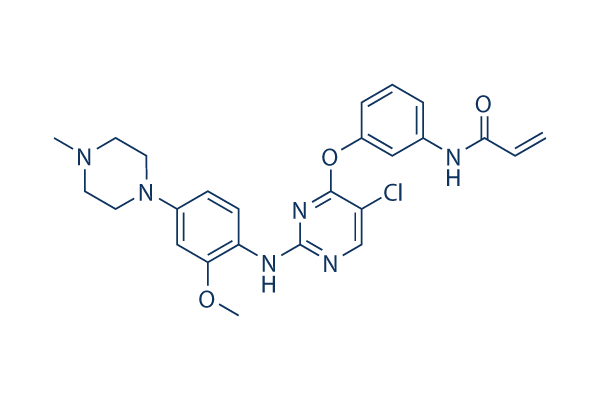
Chemical Structure
Molecular Weight: 494.18
Quality Control
| Related Targets | VEGFR PDGFR FGFR c-Met Src MEK CSF-1R FLT3 HER2 c-Kit |
|---|---|
| Other EGFR Inhibitors | Lazertinib (YH25448) Icotinib Hydrochloride Sunvozertinib AG-490 AG-1478 Canertinib (CI-1033) Genistein Rociletinib (CO-1686) Poziotinib (NOV120101, HM781-36B) PD153035 HCl |
Cell Culture, Treatment & Working Concentration
| Cell Lines | Assay Type | Concentration | Incubation Time | Formulation | Activity Description | PMID |
|---|---|---|---|---|---|---|
| Sf9 cells | Function assay | 60 mins | Inhibition of EGFR L858R mutant (unknown origin) expressed in Sf9 cells pre-incubated for 60 mins before substrate and ATP addition by homogeneous time-resolved FRET assay, IC50=1 nM | |||
| mouse BA/F3 cells | Proliferation assay | Antiproliferative activity against mouse BA/F3 cells transfected with EGFR E746_A750_del/T790M mutant, EC50=2 nM | ||||
| human HCC827 cells | Proliferation assay | 72 h | Antiproliferative activity against human HCC827 cells harboring EGFR del E746-A750 mutant after 72 hrs by MTS assay, IC50=7 nM | |||
| human PC9 cells | Proliferation assay | Antiproliferative activity against growth-resistant human PC9 cells expressing EGFR E746_A750/T790M mutant, EC50=14 nM | ||||
| NCI-H1975 cells | Function assay | 2 h | Inhibition of EGFR L858R/T970M double mutant phosphorylation in human NCI-H1975 cells after 2 hrs by fluorescence assay, IC50=0.023 μM | |||
| human 16HBE cells | Proliferation assay | 72 h | Antiproliferative activity against human 16HBE cells expressing wild type EGFR after 72 hrs by MTT assay, IC50=0.811 μM | |||
| human A431 cells | Cytotoxicity assay | 72 h | Cytotoxicity against human A431 cells overexpressing wild type EGFR assessed as growth inhibition after 72 hrs by MTT assay, IC50=1.108 μM | |||
| human LoVo cells | Function assay | 2 h | Inhibition of wild type EGFR phosphorylation in human LoVo cells after 2 hrs by fluorescence assay, IC50=1.18 μM | |||
| human 16HBE14o- cells | Cytotoxicity assay | 72 h | Cytotoxicity against human 16HBE14o- cells harboring wild type EGFR assessed as growth inhibition after 72 hrs by MTT assay, IC50=1.355 μM | |||
| human BEAS2B cells | Cytotoxicity assay | 72 h | Cytotoxicity against human BEAS2B cells harboring wild type EGFR assessed as growth inhibition after 72 hrs by MTT assay, IC50=1.811 μM | |||
| human A549 cells | Proliferation assay | 72 h | Antiproliferative activity against k-RAS dependent human A549 cells overexpressing WT EGFR after 72 hrs by MTT assay, IC50=2.102 μM | |||
| human HL7702 cells | Proliferation assay | 72 h | Antiproliferative activity against human HL7702 cells expressing wilt type EGFR after 72 hrs by MTS assay, IC50=2.73 μM | |||
| Click to View More Cell Line Experimental Data | ||||||
Solubility
|
In vitro |
DMSO
: 13 mg/mL
(26.3 mM)
Water : Insoluble Ethanol : Insoluble |
Molarity Calculator
|
In vivo |
|||||
In vivo Formulation Calculator (Clear solution)
Step 1: Enter information below (Recommended: An additional animal making an allowance for loss during the experiment)
Step 2: Enter the in vivo formulation (This is only the calculator, not formulation. Please contact us first if there is no in vivo formulation at the solubility Section.)
Calculation results:
Working concentration: mg/ml;
Method for preparing DMSO master liquid: mg drug pre-dissolved in μL DMSO ( Master liquid concentration mg/mL, Please contact us first if the concentration exceeds the DMSO solubility of the batch of drug. )
Method for preparing in vivo formulation: Take μL DMSO master liquid, next addμL PEG300, mix and clarify, next addμL Tween 80, mix and clarify, next add μL ddH2O, mix and clarify.
Method for preparing in vivo formulation: Take μL DMSO master liquid, next add μL Corn oil, mix and clarify.
Note: 1. Please make sure the liquid is clear before adding the next solvent.
2. Be sure to add the solvent(s) in order. You must ensure that the solution obtained, in the previous addition, is a clear solution before proceeding to add the next solvent. Physical methods such
as vortex, ultrasound or hot water bath can be used to aid dissolving.
Chemical Information, Storage & Stability
| Molecular Weight | 494.18 | Formula | C25H27ClN6O3 |
Storage (From the date of receipt) | |
|---|---|---|---|---|---|
| CAS No. | 1213269-23-8 | Download SDF | Storage of Stock Solutions |
|
|
| Synonyms | N/A | Smiles | CN1CCN(CC1)C2=CC(=C(C=C2)NC3=NC=C(C(=N3)OC4=CC=CC(=C4)NC(=O)C=C)Cl)OC | ||
Mechanism of Action
| Targets/IC50/Ki |
EGFR (L858R)
(BaF3 cells) 2 nM
EGFR (L858R/T790M)
(BaF3 cells) 8 nM
|
|---|---|
| In vitro |
WZ4002 inhibits other EGFR genotypes E746_A750 and E746_A750/T790M with IC50 of 2 and 6 nM. Besides, this compound suppresses widetype ERBB2 with an IC50 of 32 nM. It inhibits EGFR, AKT and ERK1/2 phosphorylation in NSCLC cell lines and prevents of EGFR phosphorylation in NIH-3T3 cells expressing different EGFR T790M mutant alleles. For this chemical, kinases that exhibited greater than 95% inhibition relative to the DMSO control at 10 μM are selected for measurement of their dissociation constants. This inhibitor, which possesses an ortho-methoxy group at the C2-aniline substituent, is more selective for EGFR compared to WZ3146. It is 100-fold less effective at inhibiting phosphorylation of WT EGFR compared to the quinazoline inhibitors. Similarly, this compound prevents EGFR kinase activity of recombinant L858R/T790M protein more potently than of WT EGFR, while the opposite is observed with HKI-272 and gefitinib. In addition, the phosphorylated EGFR of Src TKI-resistant H1975 cells, as well as HCC827 cells, is completely suppressed by the third generation EGFR TKI, WZ4002.
|
| Kinase Assay |
EGFR kinase assays
|
|
In vitro inhibitory enzyme kinetic assays using recombinant EGFR L858R/T790M and WT protein and are performed using the ATP/NADH coupled assay system in a 96-well format. WZ4002 is added to determine its inhibitory effects.
|
|
| In vivo |
In a 2-week efficacy study, WZ4002 treatment results in significant tumor regressions compared to vehicle alone in both T790M containing murine models. Treatment with low-dose of this compound, and high-dose of this compound leads to mean decreases in tracer uptake of 26%, and 36%, respectively.
|
References |
|
Tech Support
Tel: +1-832-582-8158 Ext:3
If you have any other enquiries, please leave a message.
Signaling Pathway Map

Products are for research use only. Not for human use. We do not sell to patients.
©Copyright 2013 Selleck Chemicals. All Rights Reserved.