
-
 Australia
-
 Austria
-
 Belgium
-
 Brazil
-
 Canada
-
 China
China
-
 Czech Republic
-
 Denmark
-
 Finland
-
 France
-
 Germany
-
 Greece
-
 Hong Kong
-
 Hungary
-
 Iceland
-
 India
India
-
 Ireland
-
 Israel
-
 Italy
Italy
-
 Japan
Japan
-
 Korea
Korea
-
 Luxembourg
-
 Malaysia
-
 Netherlands
-
 New Zealand
-
 Norway
-
 Poland
-
 Qatar
Qatar
-
 Romania
-
 Saudi Arabia
-
 Singapore
-
 Spain
Spain
-
 Sweden
-
 Switzerland
-
 Taiwan
-
 Turkey
-
 United Kingdom
-
 United States
research use only
Isradipine Calcium Channel inhibitor
Cat.No.S1662
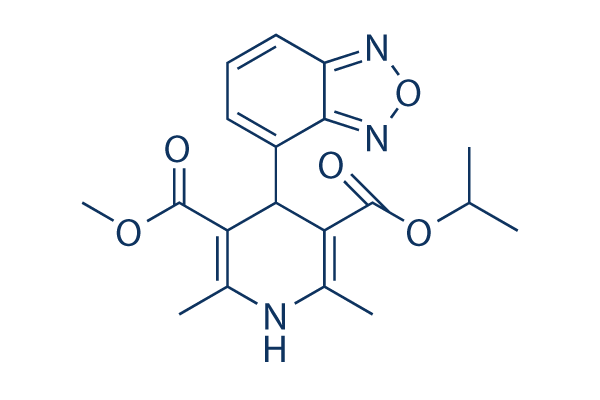
Chemical Structure
Molecular Weight: 371.39
Quality Control
| Related Targets | CFTR CRM1 CD markers AChR Sodium Channel Potassium Channel GABA Receptor TRP Channel ATPase GluR |
|---|---|
| Other Calcium Channel Inhibitors | Bay K 8644 BAPTA-AM Tetrandrine Flunarizine 2HCl Nilvadipine Cilnidipine YM-58483 (BTP2) Imperatorin Ionomycin Manidipine 2HCl |
Solubility
|
In vitro |
DMSO
: 74 mg/mL
(199.25 mM)
Ethanol : 74 mg/mL Water : Insoluble |
Molarity Calculator
|
In vivo |
|||||
In vivo Formulation Calculator (Clear solution)
Step 1: Enter information below (Recommended: An additional animal making an allowance for loss during the experiment)
Step 2: Enter the in vivo formulation (This is only the calculator, not formulation. Please contact us first if there is no in vivo formulation at the solubility Section.)
Calculation results:
Working concentration: mg/ml;
Method for preparing DMSO master liquid: mg drug pre-dissolved in μL DMSO ( Master liquid concentration mg/mL, Please contact us first if the concentration exceeds the DMSO solubility of the batch of drug. )
Method for preparing in vivo formulation: Take μL DMSO master liquid, next addμL PEG300, mix and clarify, next addμL Tween 80, mix and clarify, next add μL ddH2O, mix and clarify.
Method for preparing in vivo formulation: Take μL DMSO master liquid, next add μL Corn oil, mix and clarify.
Note: 1. Please make sure the liquid is clear before adding the next solvent.
2. Be sure to add the solvent(s) in order. You must ensure that the solution obtained, in the previous addition, is a clear solution before proceeding to add the next solvent. Physical methods such
as vortex, ultrasound or hot water bath can be used to aid dissolving.
Chemical Information, Storage & Stability
| Molecular Weight | 371.39 | Formula | C19H21N3O5 |
Storage (From the date of receipt) | |
|---|---|---|---|---|---|
| CAS No. | 75695-93-1 | Download SDF | Storage of Stock Solutions |
|
|
| Synonyms | PN 200-110 | Smiles | CC1=C(C(C(=C(N1)C)C(=O)OC(C)C)C2=CC=CC3=NON=C32)C(=O)OC | ||
Mechanism of Action
| Targets/IC50/Ki |
Calcium channel
|
|---|---|
| In vitro |
Isradipine produces inhibition of both growth cultures and oxygen consumption on epimastigotes of Trypanosoma cruzi Tulahuen strain, at micromolar concentrations. This compound is found to be the most potent derivative in both, in growth cultures (I50 = 20.8 mM) and in vivo oxygen uptake (I50 = 31.1 mM).
|
| In vivo |
Isradipine reduces hypoxia-induced activation of calcium dependent xanthine oxidases, monoamine oxidases, cytosolic phospholipase A(2) and cyclooxygenases (COX-2) along with concomitant decrease in free radical generation and cytochrome c release. This compound prevents hypobaric hypoxia along with augmented neurodegeneration and memory impairment induced increased expression of calpain and caspase 3. It (at the dose of 1 mg/kg three times a day) reduces ethanol intake by over 70% in ethanol-preferring rats, the reduction in ethanol intake is compensated by a proportional increase in water consumption and the inhibitory effect persisted throughout the 5 days of treatment. This chemical significantly reduces the arterial wall collagen contents in both strains, with marked increases in the elastin content in the carotid but not in the aortic wall in spontaneously hypertensive rats. It suppresses the reinforcing properties of morphine and cocaine and may be an effective pharmacotherapy for treatment of cocaine and heroin abuse in mice.
|
References |
|
Clinical Trial Information
(data from https://clinicaltrials.gov, updated on 2024-05-22)
| NCT Number | Recruitment | Conditions | Sponsor/Collaborators | Start Date | Phases |
|---|---|---|---|---|---|
| NCT00753636 | Completed | Parkinson''s Disease |
Northwestern University|Northwestern Memorial Hospital |
April 2008 | Phase 2 |
Tech Support
Tel: +1-832-582-8158 Ext:3
If you have any other enquiries, please leave a message.
Signaling Pathway Map

Products are for research use only. Not for human use. We do not sell to patients.
©Copyright 2013 Selleck Chemicals. All Rights Reserved.