
-
 Argentina
-
 Australia
-
 Austria
-
 Belgium
-
 Brazil
-
 Canada
-
 China
China
-
 Czech Republic
-
 Denmark
-
 Finland
-
 France
-
 Germany
-
 Greece
-
 Hong Kong
-
 Hungary
-
 Iceland
-
 India
India
-
 Ireland
-
 Israel
-
 Italy
Italy
-
 Japan
Japan
-
 Korea
Korea
-
 Luxembourg
-
 Malaysia
-
 Netherlands
-
 New Zealand
-
 Norway
-
 Poland
-
 Portugal
-
 Qatar
Qatar
-
 Romania
-
 Saudi Arabia
-
 Singapore
-
 Spain
Spain
-
 Sweden
-
 Switzerland
-
 Taiwan
-
 Turkey
-
 United Kingdom
-
 United States
research use only
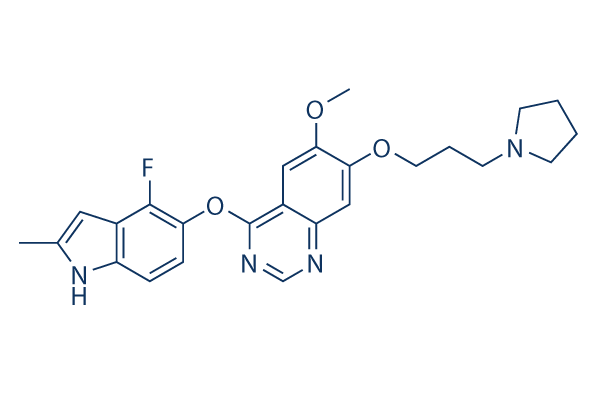
Cediranib (AZD2171) VEGFR inhibitor
Cat.No.S1017
Quality Control
| Related Targets | EGFR FGFR PDGFR c-Met Src MEK CSF-1R FLT3 HER2 c-Kit |
|---|---|
| Other VEGFR Inhibitors | SAR131675 SU 5402 Vatalanib (PTK787) 2HCl Anlotinib (AL3818) Dihydrochloride Linifanib (ABT-869) Apatinib (YN968D1) Apatinib (YN968D1) mesylate Ki8751 Semaxanib (SU5416) ZM 323881 HCl |
Cell Culture, Treatment & Working Concentration
| Cell Lines | Assay Type | Concentration | Incubation Time | Formulation | Activity Description | PMID |
|---|---|---|---|---|---|---|
| HUVEC cell | Proliferation assay | 3 days | Inhibition of VEGF-stimulated HUVEC cell proliferation treated before 2 hrs of VEGF challenge assessed after 3 days by [3H]thymidine incorporation assay, ED50=12 nM | 19101155 | ||
| HeLa | Function assay | 4.5 hrs | Inhibition of Ebolavirus glycoprotein/matrix protein VP40 entry in human HeLa cells after 4.5 hrs beta-lactamase reporter assay, IC50=7.67μM | 29624387 | ||
| DAOY | qHTS assay | qHTS of pediatric cancer cell lines to identify multiple opportunities for drug repurposing: Primary screen for DAOY cells | 29435139 | |||
| SJ-GBM2 | qHTS assay | qHTS of pediatric cancer cell lines to identify multiple opportunities for drug repurposing: Primary screen for SJ-GBM2 cells | 29435139 | |||
| A673 | qHTS assay | qHTS of pediatric cancer cell lines to identify multiple opportunities for drug repurposing: Primary screen for A673 cells | 29435139 | |||
| BT-37 | qHTS assay | qHTS of pediatric cancer cell lines to identify multiple opportunities for drug repurposing: Primary screen for BT-37 cells | 29435139 | |||
| NB-EBc1 | qHTS assay | qHTS of pediatric cancer cell lines to identify multiple opportunities for drug repurposing: Primary screen for NB-EBc1 cells | 29435139 | |||
| Saos-2 | qHTS assay | qHTS of pediatric cancer cell lines to identify multiple opportunities for drug repurposing: Primary screen for Saos-2 cells | 29435139 | |||
| SK-N-SH | qHTS assay | qHTS of pediatric cancer cell lines to identify multiple opportunities for drug repurposing: Primary screen for SK-N-SH cells | 29435139 | |||
| LAN-5 | qHTS assay | qHTS of pediatric cancer cell lines to identify multiple opportunities for drug repurposing: Primary screen for LAN-5 cells | 29435139 | |||
| BT-12 | qHTS assay | qHTS of pediatric cancer cell lines to identify multiple opportunities for drug repurposing: Primary screen for BT-12 cells | 29435139 | |||
| Rh18 | qHTS assay | qHTS of pediatric cancer cell lines to identify multiple opportunities for drug repurposing: Primary screen for Rh18 cells | 29435139 | |||
| OHS-50 | qHTS assay | qHTS of pediatric cancer cell lines to identify multiple opportunities for drug repurposing: Primary screen for OHS-50 cells | 29435139 | |||
| RD | qHTS assay | qHTS of pediatric cancer cell lines to identify multiple opportunities for drug repurposing: Primary screen for RD cells | 29435139 | |||
| MG 63 (6-TG R) | qHTS assay | qHTS of pediatric cancer cell lines to identify multiple opportunities for drug repurposing: Primary screen for MG 63 (6-TG R) cells | 29435139 | |||
| fibroblast cells | qHTS assay | qHTS of pediatric cancer cell lines to identify multiple opportunities for drug repurposing: Primary screen for control Hh wild type fibroblast cells | 29435139 | |||
| Rh30 | qHTS assay | qHTS of pediatric cancer cell lines to identify multiple opportunities for drug repurposing: Primary screen for Rh30 cells | 29435139 | |||
| Rh41 | qHTS assay | qHTS of pediatric cancer cell lines to identify multiple opportunities for drug repurposing: Primary screen for Rh41 cells | 29435139 | |||
| Click to View More Cell Line Experimental Data | ||||||
Solubility
|
In vitro |
DMSO
: 90 mg/mL
(199.77 mM)
Ethanol : 6 mg/mL Water : Insoluble |
Molarity Calculator
|
In vivo |
|||||
In vivo Formulation Calculator (Clear solution)
Step 1: Enter information below (Recommended: An additional animal making an allowance for loss during the experiment)
Step 2: Enter the in vivo formulation (This is only the calculator, not formulation. Please contact us first if there is no in vivo formulation at the solubility Section.)
Calculation results:
Working concentration: mg/ml;
Method for preparing DMSO master liquid: mg drug pre-dissolved in μL DMSO ( Master liquid concentration mg/mL, Please contact us first if the concentration exceeds the DMSO solubility of the batch of drug. )
Method for preparing in vivo formulation: Take μL DMSO master liquid, next addμL PEG300, mix and clarify, next addμL Tween 80, mix and clarify, next add μL ddH2O, mix and clarify.
Method for preparing in vivo formulation: Take μL DMSO master liquid, next add μL Corn oil, mix and clarify.
Note: 1. Please make sure the liquid is clear before adding the next solvent.
2. Be sure to add the solvent(s) in order. You must ensure that the solution obtained, in the previous addition, is a clear solution before proceeding to add the next solvent. Physical methods such
as vortex, ultrasound or hot water bath can be used to aid dissolving.
Chemical Information, Storage & Stability
| Molecular Weight | 450.51 | Formula | C25H27FN4O3 |
Storage (From the date of receipt) | |
|---|---|---|---|---|---|
| CAS No. | 288383-20-0 | Download SDF | Storage of Stock Solutions |
|
|
| Synonyms | NSC-732208 | SMILES | CC1=CC2=C(N1)C=CC(=C2F)OC3=NC=NC4=CC(=C(C=C43)OC)OCCCN5CCCC5 | ||
Read more about storage stability stock solution CAS number SMILES
Mechanism of Action
| Targets/IC50/Ki |
VEGFR2/KDR
(HUVECs) 0.5 nM
c-Kit
(HUVECs) 2 nM
VEGFR3/FLT4
(HUVECs) <=3 nM
VEGFR1/FLT1
(HUVECs) 5 nM
PDGFRβ
(HUVECs) 5 nM
FGFR1
(HUVECs) 26 nM
PDGFRα
(HUVECs) 36 nM
|
|---|---|
| In vitro |
Cediranib (AZD2171) inhibits VEGF-stimulated proliferation with IC50 of 0.4 nM and suppresses PDGF-AA with IC50 of 0.04 μM in MG63 cell lines. It has been shown to block Flt1-associated kinase with IC50 of 5 nM and VEGF-C and VEGF-D receptor Flt-4 with IC50 less than 3 nM. In addition, the IC50 values for inhibition of c-Kit and PDGFRβ tyrosine kinase are 2 nM and 5 nM respectively. Furthermore, no inhibition of enzyme activity is observed when 10 μM of this compound is assayed with 100 μM ATP against AMPK, Chk1 Akt/PKB and others. Micromolar concentrations are needed to prevent tumor cell proliferation in vitro.
|
| Kinase Assay |
Kinase inhibition
|
|
Cediranib (AZD2171) is dissolved in DMSO at a concentration of 10 mM. All enzyme assays are run at, or just below, the respective Km for ATP (0.2 - 30 μM). The inhibitory activity of this compound is determined against a range of recombinant tyrosine kinases [KDR, Flt-1, Flt-4, c-Kit, PDGFRα, PDGFRβ, CSF-1R, Flt-3, FGFR1, Src, Abl, epidermal growth factor receptor (EGFR), ErbB2, Aurora A, and Aurora B] using ELISA. Selectivity versus CDK2 and CDK4 serine/threonine kinases is examined using scintillation proximity assays with a retinoblastoma substrate and [γ-sup>33P]ATP. Activity of it is compared to MAPK kinase (MEK), which shows dual specificity. It is determined using a MAPK substrate, [γ-33P]ATP, and paper capture/scintillation counting.
|
|
| In vivo |
Cediranib (AZD2171) even suppresses tubule sprouting at subnanomolar concentrations and inhibits VEGF-induced angiogenesis. This compound causes hypertrophy in bone growth plate and prevents luteal development in ovary. These are physiological processes that are dependent upon angiogenesis. It shows broad spectrum activity in human tumor models at doses that are well tolerated. Besides, it causes regression of vascular tissues in human lung tumor xenografts.
|
References |
|
Applications
| Methods | Biomarkers | Images | PMID |
|---|---|---|---|
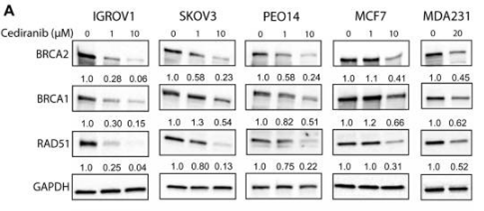
| Western blot | BRCA2 / BRCA1 / RAD51 p-VEGFR1 / p-VEGFR3 / p-AKT / p-ERK |
|
31092693 |
Clinical Trial Information
(data from https://clinicaltrials.gov, updated on 2026-03-05)
| NCT Number | Recruitment | Conditions | Sponsor/Collaborators | Start Date | Phases |
|---|---|---|---|---|---|
| NCT04090567 | RECRUITING | Advanced Breast Carcinoma; Anatomic Stage III Breast Cancer AJCC v8; Anatomic Stage IIIA Breast Cancer AJCC v8; Anatomic Stage IIIB Breast Cancer AJCC v8; Anatomic Stage IIIC Breast Cancer AJCC v8; Anatomic Stage IV Breast Cancer AJCC v8; Germline BRCA1 Gene Mutation; Germline BRCA2 Gene Mutation; HER2/Neu Negative; Metastatic Breast Carcinoma; Prognostic Stage III Breast Cancer AJCC v8; Prognostic Stage IIIA Breast Cancer AJCC v8; Prognostic Stage IIIB Breast Cancer AJCC v8; Prognostic Stage IIIC Breast Cancer AJCC v8; Prognostic Stage IV Breast Cancer AJCC v8 |
M.D. Anderson Cancer Center |
2020-07-28 | PHASE2 |
| NCT02484404 | ACTIVE_NOT_RECRUITING | Colorectal Neoplasms; Breast Neoplasms |
National Cancer Institute (NCI) |
2015-06-29 | PHASE1; PHASE2 |
| NCT03851614 | ACTIVE_NOT_RECRUITING | Mismatch Repair Proficient Colorectal Cancer; Pancreatic Adenocarcinoma; Leiomyosarcoma |
University Health Network, Toronto |
2019-04-08 | PHASE2 |
| NCT03741426 | UNKNOWN | Renal Cell Cancer |
CCTU- Cancer Theme |
2020-07-27 | PHASE2 |
| NCT04487587 | ACTIVE_NOT_RECRUITING | Cervical Cancer |
The Clatterbridge Cancer Centre NHS Foundation Trust |
2018-10-09 | PHASE2 |
| NCT07648745 | COMPLETED | Bowel Obstruction; Ovarian Cancer; Fallopian Tube Cancer; Primary Peritoneal Cancer |
Prof Gordon Jayson |
2018-05-14 | PHASE2 |
Read more about Clinical Trials
Tech Support
Tel: +1-832-582-8158 Ext:3
If you have any other enquiries, please leave a message.
Signaling Pathway Map

Products are for research use only. Not for human use. We do not sell to patients.
©Copyright 2013 Selleck Chemicals. All Rights Reserved.