
- Bioactive Compounds
- By Signaling Pathways
- PI3K/Akt/mTOR
- Epigenetics
- Methylation
- Immunology & Inflammation
- Protein Tyrosine Kinase
- Angiogenesis
- Apoptosis
- Autophagy
- ER stress & UPR
- JAK/STAT
- MAPK
- Cytoskeletal Signaling
- Cell Cycle
- TGF-beta/Smad
- Compound Libraries
- Antibodies
- Bioreagents
- qPCR
- 2x SYBR Green qPCR Master Mix
- 2x SYBR Green qPCR Master Mix(Low ROX)
- 2x SYBR Green qPCR Master Mix(High ROX)
- Protein Assay
- Protein A/G Magnetic Beads for IP
- Anti-Flag magnetic beads
- Anti-Flag Affinity Gel
- Anti-Myc magnetic beads
- Anti-HA magnetic beads
- Poly FLAG Peptide lyophilized powder
- Protease Inhibitor Cocktail
- Protease Inhibitor Cocktail (EDTA-Free, 100X in DMSO)
- Phosphatase Inhibitor Cocktail (2 Tubes, 100X)
- Cell Biology
- Cell Counting Kit-8 (CCK-8)
- Animal Experiment
- Mouse Direct PCR Kit (For Genotyping)
- New Products
- Contact Us
-
 Australia
-
 Austria
-
 Belgium
-
 Brazil
-
 Canada
-
 China
China
-
 Czech Republic
-
 Denmark
-
 Finland
-
 France
-
 Germany
-
 Greece
-
 Hong Kong
-
 Hungary
-
 Iceland
-
 India
India
-
 Ireland
-
 Israel
-
 Italy
Italy
-
 Japan
Japan
-
 Korea
Korea
-
 Luxembourg
-
 Malaysia
-
 Netherlands
-
 New Zealand
-
 Norway
-
 Poland
-
 Qatar
Qatar
-
 Romania
-
 Saudi Arabia
-
 Singapore
-
 Spain
Spain
-
 Sweden
-
 Switzerland
-
 Taiwan
-
 Turkey
-
 United Kingdom
-
 United States
-
 Other Countries

KRN 633
KRN 633 is an ATP-competitive inhibitor of VEGFR1/2/3 with IC50 of 170 nM/160 nM/125 nM, weakly inhibits PDGFR-α/β and c-Kit, does not block the phosphorylation of FGFR-1, EGFR or c-Met in cell.
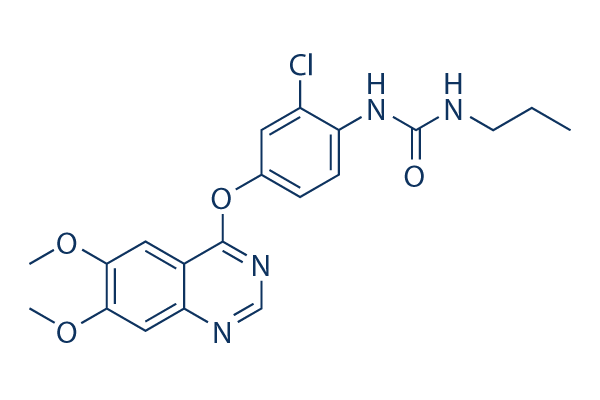
KRN 633 Chemical Structure
CAS: 286370-15-8
Selleck's KRN 633 has been cited by 6 Publications
1 Customer Review
Purity & Quality Control
Batch:
Purity:
99.01%
99.01
KRN 633 Related Products
Signaling Pathway
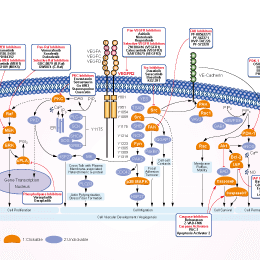
Choose Selective VEGFR Inhibitors
Biological Activity
| Description | KRN 633 is an ATP-competitive inhibitor of VEGFR1/2/3 with IC50 of 170 nM/160 nM/125 nM, weakly inhibits PDGFR-α/β and c-Kit, does not block the phosphorylation of FGFR-1, EGFR or c-Met in cell. | |||||||||||
|---|---|---|---|---|---|---|---|---|---|---|---|---|
| Targets |
|
| In vitro | ||||
| In vitro | KRN 633, a novel quinazoline urea derivative, strongly inhibits VEGFR1, VEGFR2 and VEGFR3 receptors with IC50 values of 170 nM, 160 nM and 125 nM respectively. It shows lower inhibitory activity towards non-RTKs, such as PDGF receptor (PDGFRα and β, c-Kit, breast tumor kinase, and tunica interna endothelial cell kinase tyrosine kinases (IC50 = 965, 9850, 4330, 9200, and 9900 nM, respectively). KRN 633 potently inhibits ligand VEGF induced phosphorylation of VEGFR2 in HUVECs with an IC50 of 1.16 nM. KRN 633 also inhibits VEGF-dependent, but not bFGF-dependent, phosphorylation of the MAP kinases in endothelial cells, with IC50 values of 3.51 nM and 6.08 nM for ERK1 and ERK2, respectively. KRN633 has also been shown to inhibit the VEGF-driven proliferation of HUVECs with an IC50 of 14.9 nM, but it only suppresses FGF-driven proliferation at 3 μM weakly. [1] KRN 633 inhibits hypoxia-induced transcriptional activation of HIF-1α in a concentration-dependent manner with an IC50 of 3.79 μM, through the inhibition of both Akt and ERK phosphorylation signaling pathways. [2] | |||
|---|---|---|---|---|
| Kinase Assay | Cell-Free Kinase Assays | |||
| Cell-free kinase assays are done to obtain IC50 values against a variety of recombinant VEGF receptors. KRN633 is tested at concentrations varying from 0.3 nM to 10 μM. All assays are done in quadruplicate with 1 μM ATP. | ||||
| Cell Research | Cell lines | A549, Ls174T, DU145, HT29, LNCap and PC-3 cell lines | ||
| Concentrations | Dissolved in DMSO, final concentrations 0.01 to 10 μM | |||
| Incubation Time | 96 hours | |||
| Method | Cancer cells are plated in media containig 10% FBS and antibiotics, at densities known to permit exponential growth over the assay period. The cells are cultured for 24 hours before adding KRN633 (0.01 to 10 μM) or just the vehicle (0.1% DMSO in medium) and then grown for a further 96 hours. Cell viability is measured using WST-1 reagent. | |||
| In Vivo | ||
| In vivo | Although not cytotoxic to various cancer cells in vitro, KRN633 exhibits excellent antitumor activity in vivo due to its inhibitory effect on tumor vessel formation and vascular permeability. Once-daily administration of KRN633 at 100 mg/kg/d produces significant tumor growth inhibition in A549, LC-6-LCK, HT29, Ls174T, LNCap and Du145 cells while twice-daily administration of KRN633 at 100 mg/kg induces ~90% growth inhibition of HT29 tumors. [1] Treatment of mid-pregnancy mice with KRN 633 (300 mg/kg, p.o.) reduces the blood supply to fetal tissues due to diminished vascularization in both placenta and fetal organs and consequently increases the risk of induction of intrauterine growth restriction (IUGR). [3] | |
|---|---|---|
| Animal Research | Animal Models | A549, Ls174T, HT29, DU145, LNCap, PC-3 cells and LC-6-JCK are established in athymic mice (BALB/cA, Jcl-nu) and athymic rats (F344/N, Jcl-rnu), respectively. |
| Dosages | 20-100 mg/kg | |
| Administration | Gavage once daily | |
Chemical Information & Solubility
| Molecular Weight | 416.86 | Formula | C20H21ClN4O4 |
| CAS No. | 286370-15-8 | SDF | Download KRN 633 SDF |
| Smiles | CCCNC(=O)NC1=C(C=C(C=C1)OC2=NC=NC3=CC(=C(C=C32)OC)OC)Cl | ||
| Storage (From the date of receipt) | |||
|
In vitro |
DMSO : 9 mg/mL ( (21.58 mM); Moisture-absorbing DMSO reduces solubility. Please use fresh DMSO.) Water : Insoluble Ethanol : Insoluble |
Molecular Weight Calculator |
|
In vivo Add solvents to the product individually and in order. |
In vivo Formulation Calculator |
||||
Preparing Stock Solutions
Molarity Calculator
In vivo Formulation Calculator (Clear solution)
Step 1: Enter information below (Recommended: An additional animal making an allowance for loss during the experiment)
mg/kg
g
μL
Step 2: Enter the in vivo formulation (This is only the calculator, not formulation. Please contact us first if there is no in vivo formulation at the solubility Section.)
% DMSO
%
% Tween 80
% ddH2O
%DMSO
%
Calculation results:
Working concentration: mg/ml;
Method for preparing DMSO master liquid: mg drug pre-dissolved in μL DMSO ( Master liquid concentration mg/mL, Please contact us first if the concentration exceeds the DMSO solubility of the batch of drug. )
Method for preparing in vivo formulation: Take μL DMSO master liquid, next addμL PEG300, mix and clarify, next addμL Tween 80, mix and clarify, next add μL ddH2O, mix and clarify.
Method for preparing in vivo formulation: Take μL DMSO master liquid, next add μL Corn oil, mix and clarify.
Note: 1. Please make sure the liquid is clear before adding the next solvent.
2. Be sure to add the solvent(s) in order. You must ensure that the solution obtained, in the previous addition, is a clear solution before proceeding to add the next solvent. Physical methods such
as vortex, ultrasound or hot water bath can be used to aid dissolving.
Tech Support
Answers to questions you may have can be found in the inhibitor handling instructions. Topics include how to prepare stock solutions, how to store inhibitors, and issues that need special attention for cell-based assays and animal experiments.
Tel: +1-832-582-8158 Ext:3
If you have any other enquiries, please leave a message.
* Indicates a Required Field
Tags: buy KRN 633 | KRN 633 supplier | purchase KRN 633 | KRN 633 cost | KRN 633 manufacturer | order KRN 633 | KRN 633 distributor



Products are for research use only. Not for human use. We do not sell to patients.
©Copyright 2013 Selleck Chemicals. All Rights Reserved.