
-
 Argentina
-
 Australia
-
 Austria
-
 Belgium
-
 Brazil
-
 Canada
-
 China
China
-
 Czech Republic
-
 Denmark
-
 Finland
-
 France
-
 Germany
-
 Greece
-
 Hong Kong
-
 Hungary
-
 Iceland
-
 India
India
-
 Ireland
-
 Israel
-
 Italy
Italy
-
 Japan
Japan
-
 Korea
Korea
-
 Luxembourg
-
 Malaysia
-
 Netherlands
-
 New Zealand
-
 Norway
-
 Poland
-
 Portugal
-
 Qatar
Qatar
-
 Romania
-
 Saudi Arabia
-
 Singapore
-
 Spain
Spain
-
 Sweden
-
 Switzerland
-
 Taiwan
-
 Turkey
-
 United Kingdom
-
 United States
research use only
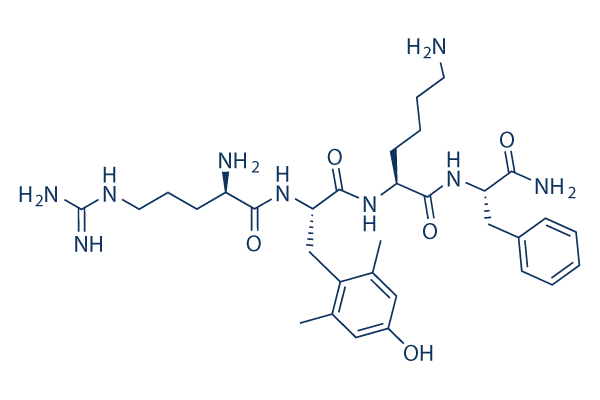
Elamipretide (SS-31, MTP-131) Antioxidant peptide
Cat.No.S9803
Quality Control
Solubility
|
In vitro |
Water : 100 mg/mL |
Molarity Calculator
|
In vivo |
|||||
In vivo Formulation Calculator (Clear solution)
Step 1: Enter information below (Recommended: An additional animal making an allowance for loss during the experiment)
Step 2: Enter the in vivo formulation (This is only the calculator, not formulation. Please contact us first if there is no in vivo formulation at the solubility Section.)
Calculation results:
Working concentration: mg/ml;
Method for preparing DMSO master liquid: mg drug pre-dissolved in μL DMSO ( Master liquid concentration mg/mL, Please contact us first if the concentration exceeds the DMSO solubility of the batch of drug. )
Method for preparing in vivo formulation: Take μL DMSO master liquid, next addμL PEG300, mix and clarify, next addμL Tween 80, mix and clarify, next add μL ddH2O, mix and clarify.
Method for preparing in vivo formulation: Take μL DMSO master liquid, next add μL Corn oil, mix and clarify.
Note: 1. Please make sure the liquid is clear before adding the next solvent.
2. Be sure to add the solvent(s) in order. You must ensure that the solution obtained, in the previous addition, is a clear solution before proceeding to add the next solvent. Physical methods such
as vortex, ultrasound or hot water bath can be used to aid dissolving.
Chemical Information, Storage & Stability
| Molecular Weight | 639.79 | Formula | C32H49N9O5 |
Storage (From the date of receipt) | 3 years -20°C powder |
|---|---|---|---|---|---|
| CAS No. | 736992-21-5 | -- | Storage of Stock Solutions |
|
|
| Synonyms | D-Arg-Dmt-Lys-Phe-NH2 | SMILES | CC1=C(CC(NC(=O)C(N)CCCNC(N)=N)C(=O)NC(CCCCN)C(=O)NC(CC2=CC=CC=C2)C(N)=O)C(=CC(=C1)O)C | ||
Read more about storage stability stock solution CAS number SMILES
Mechanism of Action
| Targets/IC50/Ki |
cytochrome c peroxidase
|
|---|---|
| In vitro |
Elamipretide (SS-31, MTP-131) binds with high affinity to cardiolipin, an anionic phospholipid expressed on the inner mitochondrial membrane that is required for cristae formation. In addition, the complex of this compound with cardiolipin inhibits cytochrome c peroxidase activity, which catalyzes cardiolipin peroxidation and results in mitochondrial damage during ischemia, by protecting its heme iron. |
| In vivo |
Pretreatment of rats with Elamipretide (SS-31, MTP-131) protects cristae membranes during renal ischemia and prevents mitochondrial swelling. Prompt recovery of ATP on reperfusion leads to rapid repair of ATP-dependent processes, such as restoration of the actin cytoskeleton and cell polarity. Rapid recovery of ATP also inhibits apoptosis, protects tubular barrier function, and mitigates renal dysfunction. |
References |
|
Clinical Trial Information
(data from https://clinicaltrials.gov, updated on 2026-07-13)
| NCT Number | Recruitment | Conditions | Sponsor/Collaborators | Start Date | Phases |
|---|---|---|---|---|---|
| NCT07531251 | RECRUITING | Barth Syndrome |
Stealth BioTherapeutics Inc. |
2026-07-02 | PHASE4 |
| NCT06373731 | ACTIVE_NOT_RECRUITING | Age Related Macular Degeneration (ARMD) |
Stealth BioTherapeutics Inc. |
2024-05-30 | PHASE3 |
| NCT07275424 | RECRUITING | Aging, Healthy |
David Marcinek |
2025-11-26 | PHASE2 |
| NCT05162768 | COMPLETED | Mitochondrial Myopathies; Mitochondrial Pathology; Mitochondrial DNA Mutation; Mitochondrial Diseases; Mitochondrial DNA Deletion; Mitochondrial DNA Depletion; Mitochondrial Metabolism Defect; Mitochondrial Complex I Deficiency |
Stealth BioTherapeutics Inc. |
2022-04-29 | PHASE3 |
| NCT05168774 | COMPLETED | Friedreich Ataxia |
Children's Hospital of Philadelphia |
2022-03-03 | PHASE1; PHASE2 |
| NCT03891875 | COMPLETED | Age-related Macular Degeneration |
Stealth BioTherapeutics Inc. |
2019-03-27 | PHASE2 |
Read more about Clinical Trials
Tech Support
Tel: +1-832-582-8158 Ext:3
If you have any other enquiries, please leave a message.

Products are for research use only. Not for human use. We do not sell to patients.
©Copyright 2013 Selleck Chemicals. All Rights Reserved.