
-
 Argentina
-
 Australia
-
 Austria
-
 Belgium
-
 Brazil
-
 Canada
-
 China
China
-
 Czech Republic
-
 Denmark
-
 Finland
-
 France
-
 Germany
-
 Greece
-
 Hong Kong
-
 Hungary
-
 Iceland
-
 India
India
-
 Ireland
-
 Israel
-
 Italy
Italy
-
 Japan
Japan
-
 Korea
Korea
-
 Luxembourg
-
 Malaysia
-
 Netherlands
-
 New Zealand
-
 Norway
-
 Poland
-
 Qatar
Qatar
-
 Romania
-
 Saudi Arabia
-
 Singapore
-
 Spain
Spain
-
 Sweden
-
 Switzerland
-
 Taiwan
-
 Turkey
-
 United Kingdom
-
 United States
Bcl-2 Inhibitors
| Cat.No. | Product Name | Information | Product Use Citations | Product Validations |
|---|---|---|---|---|
| S8643 | AZD5991 | AZD5991 is a macrocyclic MCL-1 inhibitor with sub-nanomolar affinity for MCL-1 (Ki = 0.13 nM). The binding affinity of AZD5991 is about 25-fold lower for mouse Mcl-1 vs. human Mcl-1 but only four-fold lower for rat Mcl-1. |
|
|
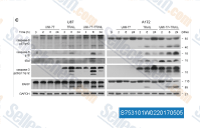
| S7531 | UMI-77 | UMI-77 is a selective Mcl-1 inhibitor with Ki of 490 nM, showing selectivity over other members of Bcl-2 family. |
|
|
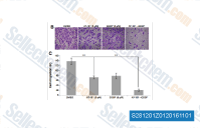
| S2812 | (R)-(-)-Gossypol (AT-101) acetic acid | (R)-(-)-Gossypol (AT-101) acetic acid, the R-(-) enantiomer of Gossypol acetic acid, binds with Bcl-2, Bcl-xL and Mcl-1 with Ki of 0.32 μM, 0.48 μM and 0.18 μM in cell-free assays; does not inhibit BIR3 domain and BID. AT-101 simultaneously triggers apoptosis and a cytoprotective type of autophagy. Phase 2. |
|
|
| E2926 | A-1155463 | A-1155463 is a highly potent and selective BCL-XL inhibitor with EC50 of 65 nM in H146 cells. |
|
|
| S8836 | MIK665 (S64315) | MIK665 (S64315) is an inhibitor of induced myeloid leukemia cell differentiation protein Mcl-1 with Ki value of 1.2 nM and has potential pro-apoptotic and antineoplastic activities. |
|
|
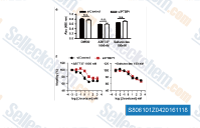
| S8061 | Sabutoclax | Sabutoclax (BI-97C1) is a pan-Bcl-2 inhibitor, including Bcl-xL, Bcl-2, Mcl-1 and Bfl-1 with IC50 of 0.31 μM, 0.32 μM, 0.20 μM and 0.62 μM, respectively. |
|
|
| S7100 | WEHI-539 | WEHI-539 has high affinity (IC50=1.1 nM) and selectivity for BCL-XL and potently kills cells by selectively antagonizing its prosurvival activity. This compound has more than a 400-fold higher affinity for BCL-XL versus other prosurvival BCL-2 family members. |
|
|
| S8865 | BAI1 | BAI1 is a direct allosteric inhibitor of BAX with a dissociation constant (Kd) of 15.0 ± 4 μM. |
|
|
| S6709 | Obatoclax (GX15-070) |
Obatoclax (GX15-070) is an antagonist of Bcl-2 with an Ki of 0.22 μM in a cell-free assay, can assist in overcoming MCL-1 mediated resistance to apoptosis. |
|
|
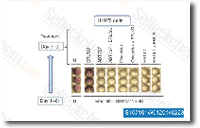
| S1071 | HA14-1 | HA14-1 is a non-peptidic ligand of a Bcl-2 surface pocket with IC50 of ~9 μM. |
|
|
| S7105 | BAM7 | BAM 7 is a direct and selective activator of proapoptotic Bax with EC50 of 3.3 μM. |
|
|
| S8759 | S55746 | S55746 (S 055746,BCL201) is a novel, orally active BCL-2 specific inhibitor (Ki = 1.3 nM) with poor affinity for BCL-XL and no significant binding to MCL-1, BFL-1 (BCL2A1/A1). The selectivity of this compound for BCL-2 versus BCL-XL ranges from ~70 to 400 folds. |
|
|
| S8650 | BTSA1 | BTSA1 is a pharmacologically optimized BAX activator that binds with high affinity and specificity to the N-terminal activation site and induces conformational changes to BAX leading to BAX-mediated apoptosis. It effectively promotes apoptosis in leukemia cell lines and patient samples while sparing healthy cells. |
|
|
| S2448 | Gambogic Acid | Gambogic Acid (Guttatic Acid, Guttic Acid, Beta-Guttiferrin) activates caspases with EC50 of 0.78-1.64 μM and competitively inhibits Bcl-XL, Bcl-2, Bcl-W, Bcl-B, Bfl-1 and Mcl-1 with IC50 of 1.47, 1.21, 2.02, 0.66, 1.06 and 0.79 μM, respectively. |
|
|
| S7126 | Marinopyrrole A (Maritoclax) | Maritoclax (Marinopyrrole A) is a selective Mcl-1 antagonist that binds to Mcl-1, but not Bcl-XL, and targets it for proteasomal degradation. This compound disrupts the interaction between Bim and Mcl-1 with an IC50 of 10.1 μM. |
|
|
| S7849 | BDA-366 | BDA-366 is a small-molecule Bcl2-BH4 domain antagonist and binds BH4 with high affinity and selectivity. It directly binds to Bcl2 with high binding affinity (Ki =3.3 ± 0.73 nM). |
|
|
| S8199 | Ruxotemitide (LTX 315) | Ruxotemitide (LTX 315) is the oncolytic peptide that kills cancer cells through Bax/Bak-regulated mitochondrial membrane permeabilization. |
|
|
| E0011 | Linderalactone | Linderalactone inhibits human lung cancer growth by modulating the expression of apoptosis-related proteins (Bax and Bcl-2) with an IC50 of 15 µM in A-549 cells. This compound induces G2/M cell cycle arrest and could also suppress the JAK/STAT signalling pathway. It can be isolated from Radix linderae. |
|
|
| S0563 | 10-Deacetyl-7-xylosyl paclitaxel | 10-Deacetyl-7-xylosyl paclitaxel (10-Deacetyl-7-xylosyltaxol, 7-xylosyl-10-deacetylpaclitaxel), a derivative of paclitaxel and naturally occurring xyloside isolated from Taxus chinensis, causes significant mitotic arrest in PC-3 cells followed by up-regulating expression of pro-apoptotic Bax and Bad protein, as well as down-regulating expression of anti-apoptotic Bcl-2 and Bcl-XL , which leads to a disturbance of the mitochondrial membrane permeability and to the activation of caspase-9. |
|
|
| S8758 | VU661013 | VU661013 is a novel, potent, selective MCL1 inhibitor with Ki of 97 ± 30 pM of human MCL-1 in a TR-FRET assay. However, VU661013 does not significantly inhibit BCL-xL or BCL-2 with Ki > 40 μM or = 0.73 μM. VU661013 de-stabilizes BIM/MCL-1 association, leads to apoptosis in AML. |
|
|
| E3037 | Solanum lyratum Extract | Solanum lyratum Extract (300 μg/ml) increases Bax levels and decreases Bcl-2 levels, which cause the loss of mitochondrial membrane potential (Δæm) followed by cytochrome C release and caspase-9 and -3 activation, finally leading to apoptosis. This compound also promotes p53 and p27, but decreases the levels of cyclin B1 thus causing S-phase arrest. | ||
| S9970 | APG-2575 (lisaftoclax) | APG-2575 (lisaftoclax) is a Bcl-2 selective inhibitor with IC50 value of 2 nM. | ||
| E6887New | MBoIN179 | MBoIN179 is a small-molecule modulator that disrupts the transmembrane-domain interaction between the anti-apoptotic protein MCL1 and the pro-apoptotic protein BOK. By releasing BOK from MCL1-mediated sequestration, MBoIN179 promotes BOK-dependent oligomerization and mitochondrial outer-membrane permeabilization, thereby inducing apoptotic cell death. | ||
| E8278 | WH244 | WH244 is a second-generation PROTAC that selectively degrades the anti-apoptotic proteins BCL-xL and BCL-2 with a DC50 of 0.6 nM for BCL-xL and 7.4 nM for BCL-2. | ||
| S3243 | Zeaxanthin | Zeaxanthin, the carotenoid alcohol participates in the xanthophyll cycle, activates the extrinsic apoptosis pathway which induces apoptosis on uveal melanoma cells with IC50 value 40.8 µM. | ||
| S9276 | Alisol B | Alisol B, a triterpene from Alismatis rhizoma, induces Bax up-regulation and nuclear translocation, the activation of initiator caspase-8 and caspase-9, and executor caspase-3, suggesting the involvement of both extrinsic and intrinsic apoptosis pathways. | ||
| E1510 | Sonrotoclax (BGB-11417) | Sonrotoclax(BGB-11417) is a highly potent, orally active and selective inhibitor of Bcl2. Sonrotoclax demonstrates increased potency along with in vitro and in vivo inhibitory activity against both WT Bcl-2 and the G101V mutant. Bcl-xL Sonrotoclax has effective cell killing effect against a variety of lymphoma and leukemia cell lines. | ||
| S5600 | Flavokawain A | Flavokawain A, extracted from kava, is an apoptotic inducers and anticarcinogenic agent. This compound can down-regulation of antiapoptotic proteins, such as XIAP, survivin, and Bcl-xL, thereby changing the balance between apoptotic and antiapoptotic molecules and then induce cell death in tumor cells. | ||
| S8177 | BH3I-1 | BH3I-1 is a Bcl-XL-BH3 domain interaction inhibitor with Ki of 2.4 μM (by fluorescence polarization ).This compound is a selective inhibitor of Bcl-2 family proteins. | ||
| S8924 | DT2216 | DT2216 is a potent and selective degrader of BCL-XL based on PROTAC technology. DT2216 inhibits various BCL-XL-dependent leukemia and cancer cells but considerably less toxic to platelets. | ||
| S6004 | CCI-007 | CCI-007 is a novel small molecule with cytotoxic activity against infant leukemia with MLL rearrangements. | ||
| E6732New | Mesutoclax | Mesutoclax (ICP-248) (Compound 5) is a potent, orally bioavailable, and selective inhibitor of BCL-2 with an IC50 of 1.54 nM demonstrating weak activity against BCL-XL with an IC50 > 1000 nM. | ||
| S8550 | Tapotoclax (AMG-176) | Tapotoclax (AMG-176) is a potent, selective, and orally bioavailable macrocyclic inhibitor of MCL1 with a Ki of 0.13 nM. It induces a potent apoptosis in models of hematologic malignancies. | ||
| E2663 | BT2 | BT2 is a novel branched-chain α-ketoacid dehydrogenase complex kinase (BDK) inhibitor wieh an IC50 of 3.19 μM. | ||
| E5962 | BRD-810 | BRD-810 is a potent and highly selective inhibitor of MCL1. BRD-810 targets the BH3-binding pocket of MCL1 and blocks the capturing of pro-apoptotic proteins, thereby rapidly triggering caspase activation in MCL1-dependent cells. It demonstrates potent anti-tumor effects in both hematologic malignancies and solid tumor models. | ||
| E3020 | Hedyotic Diffusa Extract | Hedyotic Diffusa Extract is extracted from Hedyotic diffusa, of which polysaccharides inhibit the growth of CNE2 cells in a dose-and-time-dependent way, the mechanism may involve induction of cell apoptosis, which is associated with the activation of Bax and caspase-3 protein and the down-regulation of Bcl-2 protein expression. | ||
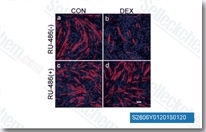
| S2606 | Mifepristone (RU-486) | Mifepristone is a remarkably active antagonist of progesterone receptor and glucocorticoid receptor with IC50 of 0.2 nM and 2.6 nM, respectively. Mifepristone promotes cell autophagy and apoptosis, decreases Bcl-2 level and increases Beclin1 level, accompanied by weakened interaction between Bcl-2 and Beclin1.Mifepristone (RU486) can be used to induce animal models of Spontaneous Abortion. |
|
|
| S2271 | Berberine chloride | Berberine chloride is a quaternary ammonium salt from the group of isoquinoline alkaloids. This compound activates caspase 3 and caspase 8, cleavage of poly ADP-ribose polymerase (PARP) and the release of cytochrome c. It decreases the expression of c-IAP1, Bcl-2 and Bcl-XL. This chemical induces apoptosis with sustained phosphorylation of JNK and p38 MAPK, as well as generation of the ROS. It is a dual topoisomerase I and II inhibitor. It is also a potential autophagy modulator. |
|
|
| S8820 | Unesbulin (PTC596) | Unesbulin (PTC596) is a second-generation BMI-1 inhibitor that accelerates BMI-1 degradation. This compound downregulates MCL-1 and induces p53-independent mitochondrial apoptosis. IC50 values at 72 hours ranged from 68 to 340 nM in mantle cell lymphoma (MCL) cell lines. |
|
|
| S3275 | Senkyunolide I | Senkyunolide I (SEI, SENI) is an orally active compound isolated from Ligusticum chuanxiong with analgesic, anti-migraine, neuroprotective, anti-oxidation and anti-apoptosis activities. This compound up-regulates the phosphorylation of Erk1/2 and induces Nrf2 nuclear translocation with enhanced HO-1 and NQO1 expressions. It also promotes the ratio of Bcl-2/Bax and inhibits the expressions of cleaved caspase 3 and caspase 9. |
|
|
| S6852 | Gossypol | Gossypol (BL 193) is an orally-active polyphenol isolated from cotton seeds and roots. This compound is a potent inhibitor of 5α-reductase 1 and 3α-hydroxysteroid dehydrogenase with IC50 of 3.33 μM and 0.52 μM in cell-free assay, respectively. It also inhibits the binding of BH3 peptide to Bcl protein with IC50 of 0.4 μM and 10 μM for Bcl-XL and Bcl-2, respectively. This chemical induces apoptosis and cell growth inhibition in various cancer cells. |
|
|
| S3238 | Resibufogenin | Resibufogenin (Bufogenin, Recibufogenin), a component of huachansu with anticancer effect, triggers necroptosis through upregulating receptor-interacting protein kinase 3 (RIP3) and phosphorylating mixed lineage kinase domain-like protein at Ser358. This compound exerts cytotoxic effect by inducing reactive oxygen species (ROS) accumulation. It induces apoptosis and caspase-3 and caspase-8 activity. This chemical increases Bax/Bcl-2 expression, and suppresses cyclin D1, cyclin E, PI3K, p-AKT, p-GSK3β and β-catenin protein expression. |
|
|
| S5967 | Berberine chloride hydrate | Berberine (Natural Yellow 18) chloride hydrate is a quaternary ammonium salt from the group of isoquinoline alkaloids. Berberine activates caspase 3 and caspase 8, cleavage of poly ADP-ribose polymerase (PARP) and the release of cytochrome c. Berberine chloride decreases the expression of c-IAP1, Bcl-2 and Bcl-XL. Berberine chloride induces apoptosis with sustained phosphorylation of JNK and p38 MAPK, as well as generation of the ROS. Berberine chloride is a dual topoisomerase I and II inhibitor. Berberine chloride is also a potential autophagy modulator. |
|
|
| E0124 | Chelerythrine |
Chelerythrine (Toddaline, Broussonpapyrine) is a potent, selective antagonist of PKC with an IC50 of 0.66 μM. This compound also inhibits the BclXL-Bak BH3 peptide binding with an IC50 of 1.5 μM. It shows antitumor, antidiabetic and anti-inflammatory activity. |
|
|
| S3224 | Cinobufagin | Cinobufagin (Cinobufagine), an active ingredient of Venenum Bufonis, inhibits tumor development. This compound increases ATM and Chk2 and decreases CDC25C, CDK1, and cyclin B. It inhibits PI3K, AKT and Bcl-2 while increases levels of cleaved caspase-9 and caspase-3. Thus, this chemical induces cell cycle arrest at the G2/M phase and apoptosis. |
|
|
| S3267 | Nicotiflorin (Kaempferol-3-O-rutinoside) | Nicotiflorin (Kaempferol-3-O-rutinoside), a flavonoid extracted from Carthamus tinctorius, alters the shape and structure of injured neurons, decreases the number of apoptotic cells, down-regulates expression of p-JAK2, p-STAT3, caspase-3, and Bax and decreases Bax immunoredactivity, and increases Bcl-2 protein expression and immunoreactivity. |
|
|
| S9665 | Motixafortide (BL-8040, BKT140) | Motixafortide (BL-8040, BKT140, TF 14016, 4-fluorobenzoyl, 4F-benzoyl-TN14003, T140) is an antagonist of CXCR4 with IC50 of ~1 nM. BL-8040 induces the apoptosis of AML blasts by down-regulating ERK, BCL-2, MCL-1 and cyclin-D1 via altered miR-15a/16-1 expression. |
|
|
| S5550 | Ethyl gallate | Ethyl gallat (Phyllemblin, gallic acid ethyl ester), which could be found naturally in a variety of plant sources, is a food additive with antimicrobial activity. Ethyl gallat activates the death receptor-dependent pathway of apoptosis by enhancing the expression of caspases-8, -9, and -3 and the Bcl-2 interacting domain (Bid). |
|
|
| S6895 | TCPOBOP | TCPOBOP is a constitutive androstane receptor (CAR) agonist. This compound attenuates Fas-induced murine liver injury by altering Bcl-2 proteins. | ||
| S3245 | Nodakenetin | Nodakenetin (NANI), a plant-derived coumarin isolated from Angelica decursiva, inhibits α-glucosidase, PTP1B, rat lens aldose reductase (RLAR), AChE, BChE, and β-site amyloid precursor protein cleaving enzyme 1 (BACE1). This compound alters the protein expression of Bax and Bcl-2, and prompts mitochondrial apoptosis. It exhibits anti-tumor activity. | ||
| E2354 | Valepotriate | Valepotriate, an unstable iridoid isolated from Valeriana jatamansi Jones, has anti-epileptic by significantly increasing the expression of GABAA, glutamic acid decarboxylase 65, and Bcl-2 and reduce the expression of caspase-3. | ||
| E2028 | Humanin | Humanin (human) (1-24-Protein humanin (human)), a small mitochondrial-derived cytoprotective polypeptide encoded by mtDNA, exhibits protective effects in several cell types against cellular stress conditions and apoptosis through regulating various signaling mechanisms, such as JAK/STAT pathway and interaction of BCL-2 family of protein. | ||

Products are for research use only. Not for human use. We do not sell to patients.
©Copyright 2013 Selleck Chemicals. All Rights Reserved.