
-
 Australia
-
 Austria
-
 Belgium
-
 Brazil
-
 Canada
-
 China
China
-
 Czech Republic
-
 Denmark
-
 Finland
-
 France
-
 Germany
-
 Greece
-
 Hong Kong
-
 Hungary
-
 Iceland
-
 India
India
-
 Ireland
-
 Israel
-
 Italy
Italy
-
 Japan
Japan
-
 Korea
Korea
-
 Luxembourg
-
 Malaysia
-
 Netherlands
-
 New Zealand
-
 Norway
-
 Poland
-
 Qatar
Qatar
-
 Romania
-
 Saudi Arabia
-
 Singapore
-
 Spain
Spain
-
 Sweden
-
 Switzerland
-
 Taiwan
-
 Turkey
-
 United Kingdom
-
 United States
research use only
VE-821 ATR Inhibitor
Cat.No.S8007
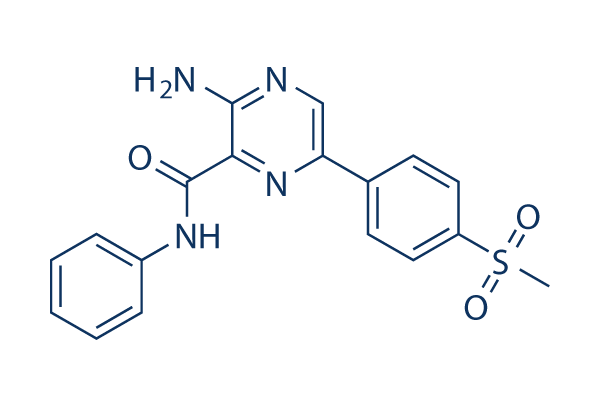
Chemical Structure
Molecular Weight: 368.41
Quality Control
| Related Targets | HDAC PARP DNA-PK WRN DNA/RNA Synthesis Topoisomerase PPAR Sirtuin Casein Kinase eIF |
|---|---|
| Other ATM/ATR Inhibitors | Ceralasertib (AZD6738) AZD1390 Berzosertib (VE-822) Lartesertib (M4076) Camonsertib (RP-3500) KU-60019 KU-55933 AZ20 AZD0156 Mirin |
Cell Culture, Treatment & Working Concentration
| Cell Lines | Assay Type | Concentration | Incubation Time | Formulation | Activity Description | PMID |
|---|---|---|---|---|---|---|
| U2OS | Growth Inhibition Assay | IC50~0.8 μM | 25593184 | |||
| SAOS2 | Growth Inhibition Assay | IC50~0.8 μM | 25593184 | |||
| CAL72 | Growth Inhibition Assay | IC50~0.8 μM | 25593184 | |||
| NOS1 | Growth Inhibition Assay | IC50~0.8 μM | 25593184 | |||
| HUO9 | Growth Inhibition Assay | IC50~0.8 μM | 25593184 | |||
| MG63 | Growth Inhibition Assay | IC50~9 μM | 25593184 | |||
| SJSA1 | Growth Inhibition Assay | IC50~9 μM | 25593184 | |||
| MDA-MB-231 | Cytotoxicity Assay | 1/3/10 μM | 1 h | potentiates the cytotoxicity of both camptothecin and LMP-400 | 25269479 | |
| HT-29 | Cytotoxicity Assay | 1/3/10 μM | 1 h | potentiates the cytotoxicity of both camptothecin and LMP-400 | 25269479 | |
| HCT-116 p53+/+ | Cytotoxicity Assay | 1/3/10 μM | 1 h | potentiates the cytotoxicity of both camptothecin and LMP-400 | 25269479 | |
| HCT-116 p53-/- | Cytotoxicity Assay | 1/3/10 μM | 1 h | potentiates the cytotoxicity of both camptothecin and LMP-400 | 25269479 | |
| TF-1 | Growth Inhibition Assay | 0.011–8 μM | 96 h | enhances the antiproliferative effects of MK1775 | 24179152 | |
| HEL | Growth Inhibition Assay | 0.011–8 μM | 96 h | enhances the antiproliferative effects of MK1775 | 24179152 | |
| THP-1 | Growth Inhibition Assay | 0.011–8 μM | 96 h | enhances the antiproliferative effects of MK1775 | 24179152 | |
| HL-60 | Function Assay | 10 mM | 0.5 h | reduces phosphorylation of Chk1 at serine 345 | 23934411 | |
| OVCAR-8 | Function Assay | 1 µM | 24 h | abrogates chemotherapy-induced cell cycle arrest | 23548269 | |
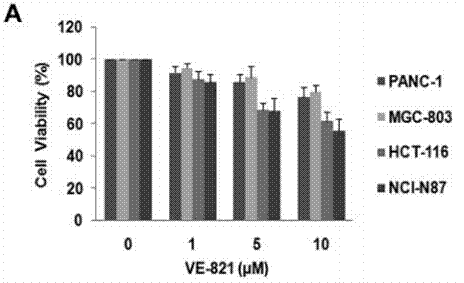
| PANC-1 | Growth Inhibition Assay | 0.11-9 μM | 1 h | inhibits the cell viability in a dose- dependent manner | 22825331 | |
| MiaPaCa | Growth Inhibition Assay | 0.11-9 μM | 1 h | inhibits the cell viability in a dose- dependent manner | 22825331 | |
| PSN-1 | Growth Inhibition Assay | 0.11-9 μM | 1 h | inhibits the cell viability in a dose- dependent manner | 22825331 | |
| K562 | Apoptosis assay | 10 uM | 48 hrs | Induction of apoptosis in human K562 cells assessed as gammaH2AX/53BP1 levels at 10 uM after 48 hrs by DAPI staining based immunofluorescence microscopy in presence of 25 to 250 pM (-)-lomaiviticin A | 27177826 | |
| SJ-GBM2 | qHTS assay | qHTS of pediatric cancer cell lines to identify multiple opportunities for drug repurposing: Primary screen for SJ-GBM2 cells | 29435139 | |||
| SK-N-MC | qHTS assay | qHTS of pediatric cancer cell lines to identify multiple opportunities for drug repurposing: Primary screen for SK-N-MC cells | 29435139 | |||
| MDCK | Cytotoxicity assay | 500 nM | 1 hr | Cytotoxicity against MDCK cells expressing carbonic anhydrase 9 assessed as reduction in cell viability at 500 nM pretreated for 1 hr followed by 2 Gy irradiation under normoxic condition by Alamar blue assay | 27823879 | |
| MDCK | Cytotoxicity assay | 500 nM | 1 hr | Cytotoxicity against MDCK cells expressing carbonic anhydrase 9 assessed as reduction in cell viability at 500 nM pretreated for 1 hr followed by 4 Gy irradiation under anoxic condition by Alamar blue assay | 27823879 | |
| MDCK | Cytotoxicity assay | 500 nM | 72 hrs | Cytotoxicity against MDCK cells expressing carbonic anhydrase 9 assessed as reduction in cell viability at 500 nM pretreated for 72 hrs followed by 72 hrs incubation under normoxic condition by Alamar blue assay | 27823879 | |
| MDCK | Cytotoxicity assay | 500 nM | 72 hrs | Cytotoxicity against MDCK cells expressing carbonic anhydrase 9 assessed as reduction in cell viability at 500 nM after 72 hrs under anoxic condition by Alamar blue assay | 27823879 | |
| Click to View More Cell Line Experimental Data | ||||||
Solubility
|
In vitro |
DMSO
: 74 mg/mL
(200.86 mM)
Water : Insoluble Ethanol : Insoluble |
Molarity Calculator
|
In vivo |
|||||
In vivo Formulation Calculator (Clear solution)
Step 1: Enter information below (Recommended: An additional animal making an allowance for loss during the experiment)
Step 2: Enter the in vivo formulation (This is only the calculator, not formulation. Please contact us first if there is no in vivo formulation at the solubility Section.)
Calculation results:
Working concentration: mg/ml;
Method for preparing DMSO master liquid: mg drug pre-dissolved in μL DMSO ( Master liquid concentration mg/mL, Please contact us first if the concentration exceeds the DMSO solubility of the batch of drug. )
Method for preparing in vivo formulation: Take μL DMSO master liquid, next addμL PEG300, mix and clarify, next addμL Tween 80, mix and clarify, next add μL ddH2O, mix and clarify.
Method for preparing in vivo formulation: Take μL DMSO master liquid, next add μL Corn oil, mix and clarify.
Note: 1. Please make sure the liquid is clear before adding the next solvent.
2. Be sure to add the solvent(s) in order. You must ensure that the solution obtained, in the previous addition, is a clear solution before proceeding to add the next solvent. Physical methods such
as vortex, ultrasound or hot water bath can be used to aid dissolving.
Chemical Information, Storage & Stability
| Molecular Weight | 368.41 | Formula | C18H16N4O3S |
Storage (From the date of receipt) | |
|---|---|---|---|---|---|
| CAS No. | 1232410-49-9 | Download SDF | Storage of Stock Solutions |
|
|
| Synonyms | ATR inhibitor IV | Smiles | CS(=O)(=O)C1=CC=C(C=C1)C2=CN=C(C(=N2)C(=O)NC3=CC=CC=C3)N | ||
Mechanism of Action
| Targets/IC50/Ki |
ATR
(Cell-free assay) 13 nM(Ki)
|
|---|---|
| In vitro |
VE-821(ATR inhibitor IV) shows excellent selectivity for ATR with minimal cross-reactivity against the related PIKKs ATM, DNA-PK, mTOR and PI3K (Kis of 16 μM, 2.2 μM, >1 μM and 3.9 μM, respectively. This compound alone commits a large fraction of cancer cell populations to death, but it only reversibly limits cell cycle progression in normal cells, with minimal death or long-term detrimental effects. This chemical inhibits H2AX cell growth with IC50 of 800 nM. |
| Kinase Assay |
Kinase inhibition
|
|
The ability of compounds to inhibit ATR, ATM or DNAPK kinase activity is tested using a radiometric-phosphate incorporation assay. A stock solution is prepared consisting of the appropriate buffer, kinase, and target peptide. To this is added the compound of interest, at varying concentrations in DMSO to a final DMSO concentration of 7%. Assays are initiated by addition of an appropriate [γ-33P]ATP solution and incubated at 25 ℃. Assays are stopped, after the desired time course, by addition of phosphoric acid and ATP to a final concentration of 100 mM and 0.66μM, respectively. Peptides are captured on a phosphocellulose membrane, prepared as per manufacturer
|
|
| In vivo |
VE-821(ATR inhibitor IV) is a potent and selective ATP competitive inhibitor of ATR. |
References |
|
Applications
| Methods | Biomarkers | Images | PMID |
|---|---|---|---|
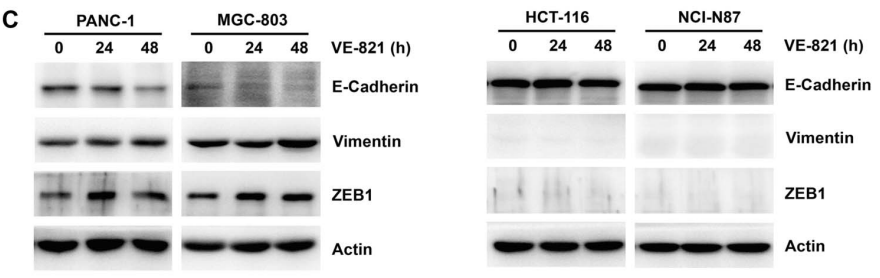
| Western blot | E-cadherin / Vimentin / ZEB1 Vimentin p-AKT / AKT / p-ERK / ERK |
|
29157079 |
| Growth inhibition assay | Cell viability |
|
29157079 |
Tech Support
Tel: +1-832-582-8158 Ext:3
If you have any other enquiries, please leave a message.
Signaling Pathway Map

Products are for research use only. Not for human use. We do not sell to patients.
©Copyright 2013 Selleck Chemicals. All Rights Reserved.