
-
 Argentina
-
 Australia
-
 Austria
-
 Belgium
-
 Brazil
-
 Canada
-
 China
China
-
 Czech Republic
-
 Denmark
-
 Finland
-
 France
-
 Germany
-
 Greece
-
 Hong Kong
-
 Hungary
-
 Iceland
-
 India
India
-
 Ireland
-
 Israel
-
 Italy
Italy
-
 Japan
Japan
-
 Korea
Korea
-
 Luxembourg
-
 Malaysia
-
 Netherlands
-
 New Zealand
-
 Norway
-
 Poland
-
 Qatar
Qatar
-
 Romania
-
 Saudi Arabia
-
 Singapore
-
 Spain
Spain
-
 Sweden
-
 Switzerland
-
 Taiwan
-
 Turkey
-
 United Kingdom
-
 United States
research use only
Aripiprazole 5-HT Receptor agonist
Cat.No.S1975
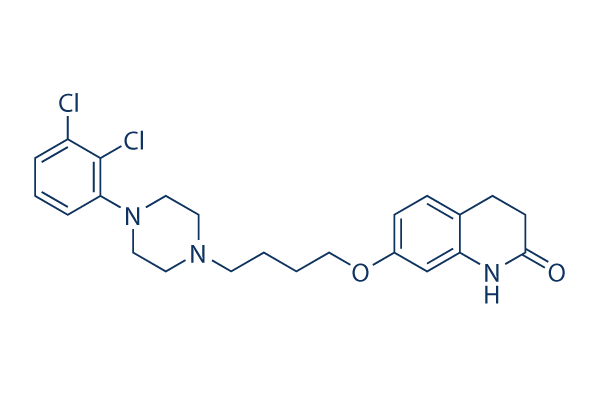
Chemical Structure
Molecular Weight: 448.39
Quality Control
Solubility
|
In vitro |
DMSO
: 90 mg/mL
(200.71 mM)
Water : Insoluble Ethanol : Insoluble |
Molarity Calculator
|
In vivo |
|||||
In vivo Formulation Calculator (Clear solution)
Step 1: Enter information below (Recommended: An additional animal making an allowance for loss during the experiment)
Step 2: Enter the in vivo formulation (This is only the calculator, not formulation. Please contact us first if there is no in vivo formulation at the solubility Section.)
Calculation results:
Working concentration: mg/ml;
Method for preparing DMSO master liquid: mg drug pre-dissolved in μL DMSO ( Master liquid concentration mg/mL, Please contact us first if the concentration exceeds the DMSO solubility of the batch of drug. )
Method for preparing in vivo formulation: Take μL DMSO master liquid, next addμL PEG300, mix and clarify, next addμL Tween 80, mix and clarify, next add μL ddH2O, mix and clarify.
Method for preparing in vivo formulation: Take μL DMSO master liquid, next add μL Corn oil, mix and clarify.
Note: 1. Please make sure the liquid is clear before adding the next solvent.
2. Be sure to add the solvent(s) in order. You must ensure that the solution obtained, in the previous addition, is a clear solution before proceeding to add the next solvent. Physical methods such
as vortex, ultrasound or hot water bath can be used to aid dissolving.
Chemical Information, Storage & Stability
| Molecular Weight | 448.39 | Formula | C23H27Cl2N3O2 |
Storage (From the date of receipt) | |
|---|---|---|---|---|---|
| CAS No. | 129722-12-9 | Download SDF | Storage of Stock Solutions |
|
|
| Synonyms | OPC-14597 | Smiles | C1CC(=O)NC2=C1C=CC(=C2)OCCCCN3CCN(CC3)C4=C(C(=CC=C4)Cl)Cl | ||
Mechanism of Action
| Targets/IC50/Ki |
5-HT1A
4.2 nM(Ki)
|
|---|---|
| In vitro |
Aripiprazole binds with high affinity to both the G protein-coupled and uncoupled states of receptors. This compound potently activates D2 receptor-mediated inhibition of cAMP accumulation. It has highest affinity for h5-HT(2B)-, hD(2L)-, and hD(3)-dopamine receptors, but also has significant affinity (5-30 nM) for several other 5-HT receptors (5-HT(1A), 5-HT(2A), 5-HT(7)), as well as alpha(1A)-adrenergic and hH(1)-histamine receptors. This chemical has less affinity (30-200 nM) for other G protein-coupled receptors, including the 5-HT(1D), 5-HT(2C), alpha(1B)-, alpha(2A)-, alpha(2B)-, alpha(2C)-, beta(1)-, and beta(2)-adrenergic, and H(3)-histamine receptors. It is an inverse agonist at 5-HT(2B) receptors and displays partial agonist actions at 5-HT(2A), 5-HT(2C), D(3), and D(4) receptors.
|
| In vivo |
Aripiprazole reduces extracellular 5-HIAA concentrations in the medial prefrontal cortex and striatum of drug-naive rats, but not in chronic this compound-pretreated rats. This compound, 0.1 mg/kg and 0.3 mg/kg, significantly increases dopamine release in the hippocampus of rats. This chemical, 0.3 mg/kg, slightly but significantly increases dopamine release in the medial prefrontal cortex but not in the nucleus accumbens. This compound, 3.0 mg/kg and 10 mg/kg, significantly decreases dopamine release in the nucleus accumbens but not the medical prefrontal cortex. This chemical, 0.3 mg/kg, transiently potentiates haloperidol (0.1 mg/kg)-induced dopamine release in the medial prefrontal cortex but inhibited that in the nucleus accumbens.
|
References |
|
Clinical Trial Information
(data from https://clinicaltrials.gov, updated on 2024-05-22)
| NCT Number | Recruitment | Conditions | Sponsor/Collaborators | Start Date | Phases |
|---|---|---|---|---|---|
| NCT06060886 | Not yet recruiting | Schizophrenia|Treatment-resistant Schizophrenia|Side Effect|Lipid Metabolism Disorders|Diabetes|NAFLD|Psychosis |
Consorcio Centro de Investigación Biomédica en Red (CIBER)|Instituto de Salud Carlos III |
November 1 2023 | Phase 4 |
| NCT05322031 | Unknown status | Schizophrenia|Myelin Degeneration|Cognition Disorder |
Fondazione IRCCS Ca'' Granda Ospedale Maggiore Policlinico |
January 1 2022 | Phase 4 |
| NCT04907279 | Unknown status | Schizophrenia|Schizo Affective Disorder|Bipolar I Disorder |
Otsuka Canada Pharmaceutical Inc.|Lundbeck Canada Inc. |
November 1 2021 | -- |
| NCT04030143 | Completed | Schizophrenia|Bipolar I Disorder |
Otsuka Pharmaceutical Development & Commercialization Inc. |
August 1 2019 | Phase 1|Phase 2 |
| NCT03881449 | Unknown status | Schizophrenia|Major Depressive Disorder|Bi-Polar Disorder|Schizo Affective Disorder |
Durham VA Medical Center|Otsuka Pharmaceutical Development and Commercialization Inc. |
April 4 2019 | Phase 4 |
| NCT03854409 | Completed | Schizophrenia|Bipolar I Disorder |
Otsuka Pharmaceutical Development & Commercialization Inc.|PRA Health Sciences|H. Lundbeck A/S |
January 31 2019 | Phase 1 |
Tech Support
Tel: +1-832-582-8158 Ext:3
If you have any other enquiries, please leave a message.
Signaling Pathway Map

Products are for research use only. Not for human use. We do not sell to patients.
©Copyright 2013 Selleck Chemicals. All Rights Reserved.