
-
 Argentina
-
 Australia
-
 Austria
-
 Belgium
-
 Brazil
-
 Canada
-
 China
China
-
 Czech Republic
-
 Denmark
-
 Finland
-
 France
-
 Germany
-
 Greece
-
 Hong Kong
-
 Hungary
-
 Iceland
-
 India
India
-
 Ireland
-
 Israel
-
 Italy
Italy
-
 Japan
Japan
-
 Korea
Korea
-
 Luxembourg
-
 Malaysia
-
 Netherlands
-
 New Zealand
-
 Norway
-
 Poland
-
 Qatar
Qatar
-
 Romania
-
 Saudi Arabia
-
 Singapore
-
 Spain
Spain
-
 Sweden
-
 Switzerland
-
 Taiwan
-
 Turkey
-
 United Kingdom
-
 United States
research use only
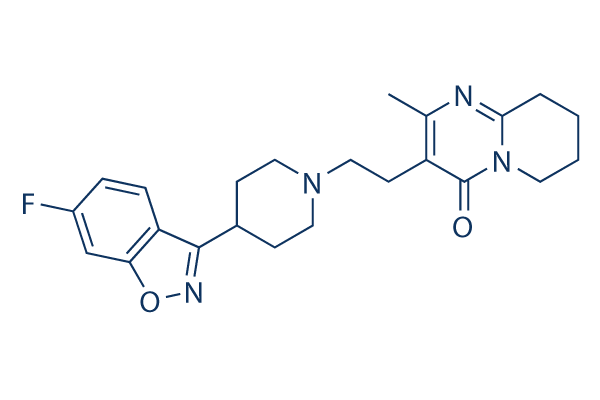
Risperidone 5-HT Receptor antagonist
Cat.No.S1615
Quality Control
Solubility
|
In vitro |
Ethanol : 4 mg/mL
DMSO
: 3 mg/mL
(7.3 mM)
Water : Insoluble |
Molarity Calculator
|
In vivo |
|||||
In vivo Formulation Calculator (Clear solution)
Step 1: Enter information below (Recommended: An additional animal making an allowance for loss during the experiment)
Step 2: Enter the in vivo formulation (This is only the calculator, not formulation. Please contact us first if there is no in vivo formulation at the solubility Section.)
Calculation results:
Working concentration: mg/ml;
Method for preparing DMSO master liquid: mg drug pre-dissolved in μL DMSO ( Master liquid concentration mg/mL, Please contact us first if the concentration exceeds the DMSO solubility of the batch of drug. )
Method for preparing in vivo formulation: Take μL DMSO master liquid, next addμL PEG300, mix and clarify, next addμL Tween 80, mix and clarify, next add μL ddH2O, mix and clarify.
Method for preparing in vivo formulation: Take μL DMSO master liquid, next add μL Corn oil, mix and clarify.
Note: 1. Please make sure the liquid is clear before adding the next solvent.
2. Be sure to add the solvent(s) in order. You must ensure that the solution obtained, in the previous addition, is a clear solution before proceeding to add the next solvent. Physical methods such
as vortex, ultrasound or hot water bath can be used to aid dissolving.
Chemical Information, Storage & Stability
| Molecular Weight | 410.48 | Formula | C23H27FN4O2 |
Storage (From the date of receipt) | |
|---|---|---|---|---|---|
| CAS No. | 106266-06-2 | Download SDF | Storage of Stock Solutions |
|
|
| Synonyms | R-64766 | SMILES | CC1=C(C(=O)N2CCCCC2=N1)CCN3CCC(CC3)C4=NOC5=C4C=CC(=C5)F | ||
Read more about storage stability stock solution CAS number SMILES
Mechanism of Action
| Targets/IC50/Ki |
5-HT2A
0.17 nM(Ki)
α2c-adrenergic receptor
1.3 nM(Ki)
D2 receptor
3.57 nM(Ki)
D3 receptor
3.6 nM(Ki)
D2L Receptor
4.16 nM(Ki)
D4 receptor
4.66 nM(Ki)
D2S Receptor
4.73 nM(Ki)
α1A-adrenergic receptor
5 nM(Ki)
5-HT7
6.6 nM(Ki)
α1B-adrenergic receptor
9 nM(Ki)
5-HT2C
12 nM(Ki)
5-HT1B
14.9 nM(Ki)
α2a-adrenergic receptor
16.5 nM(Ki)
H1 receptor
20.1 nM(Ki)
5-HT2B
61.9 nM(Ki)
5-HT1D
84.6 nM(Ki)
α2b-adrenergic receptor
108 nM(Ki)
H2 receptor
120 nM(Ki)
5-HT5A
206 nM(Ki)
5-HT5A
206 nM(Ki)
D1 receptor
244 nM(Ki)
D5 receptor
290 nM(Ki)
|
|---|---|
| In vitro |
Risperidone binds to both DA and serotonin (5HT) receptors, particularly in the neurons of striatal and limbic structures. This compound significantly affects brain nerve growth factor (NGF) level suggesting that it influences the turnover of endogenous growth factors. It significantly decreases BDNF concentrations in frontal cortex, occipital cortex and hippocampus and decreases or increases TrkB receptors in selected brain structures. This chemical significantly increases D(2) binding in medial prefrontal cortex by 34% in rat forebrain regions. It produces even greater up-regulation of D(4) receptors in CPu (37%), NAc (32%), and HIP (37%) in rat forebrain regions. This compound significantly inhibits the production of NO and proinflammatory cytokines by activated microglia. It (1-50 mM) significantly enhances the intracellular accumulation of Rh123 in Caco-2 cells by inhibiting P-gp activity with an IC(50) value of 5.87 mM. |
| In vivo |
Risperidone does not significantly affect bodyweight gain (BWG), food intake(FI), glucose tolerance or leptin levels, even though prolactin and corticosterone are significantly elevated in male rats. This compound significantly increases BWG and FI in female rats. It (0.05 mg/kg) increases food intake and leptin gene expression in white adipose tissue (WAT), but the rate of bodyweight gain is not affected in rats. This compound (0.5 mg/kg) causes a reduction in bodyweight gain, as well as enhanced Ucp1 gene expression in BAT and serum prolactin concentrations in rats. |
References |
|
Clinical Trial Information
(data from https://clinicaltrials.gov, updated on 2026-05-26)
| NCT Number | Recruitment | Conditions | Sponsor/Collaborators | Start Date | Phases |
|---|---|---|---|---|---|
| NCT07152184 | NOT_YET_RECRUITING | Patient With Schizophrenia Spectrum Disorder; NLM Classification WM 203, Psychology:Schizophrenic Psychology; Schizophrenia Spectrum and Other Psychotic Disorders |
University Hospital, Strasbourg, France |
2026-10-01 | PHASE2 |
| NCT06969755 | RECRUITING | Schizophenia Disorder |
Northwell Health |
2024-09-04 | PHASE4 |
| NCT07483294 | RECRUITING | Psychosis; Acute |
Northwell Health |
2025-11-01 | PHASE4 |
| NCT07665073 | NOT_YET_RECRUITING | Bipolar 1 Disorder |
Pakistan Institute of Medical Sciences |
2027-06 | PHASE4 |
| NCT07490353 | RECRUITING | Depression - Major Depressive Disorder; Anhedonia |
Medical University of Vienna |
2025-11-01 | PHASE1 |
| NCT07047651 | ACTIVE_NOT_RECRUITING | Treatment Resistant Schizophrenia; Treatment Resistant Bipolar Disorder |
Dr. Stavroula Rakitzi |
2025-06-04 | PHASE4 |
Read more about Clinical Trials
Tech Support
Tel: +1-832-582-8158 Ext:3
If you have any other enquiries, please leave a message.
Signaling Pathway Map

Products are for research use only. Not for human use. We do not sell to patients.
©Copyright 2013 Selleck Chemicals. All Rights Reserved.