
-
 Argentina
-
 Australia
-
 Austria
-
 Belgium
-
 Brazil
-
 Canada
-
 China
China
-
 Czech Republic
-
 Denmark
-
 Finland
-
 France
-
 Germany
-
 Greece
-
 Hong Kong
-
 Hungary
-
 Iceland
-
 India
India
-
 Ireland
-
 Israel
-
 Italy
Italy
-
 Japan
Japan
-
 Korea
Korea
-
 Luxembourg
-
 Malaysia
-
 Netherlands
-
 New Zealand
-
 Norway
-
 Poland
-
 Portugal
-
 Qatar
Qatar
-
 Romania
-
 Saudi Arabia
-
 Singapore
-
 Spain
Spain
-
 Sweden
-
 Switzerland
-
 Taiwan
-
 Turkey
-
 United Kingdom
-
 United States
research use only
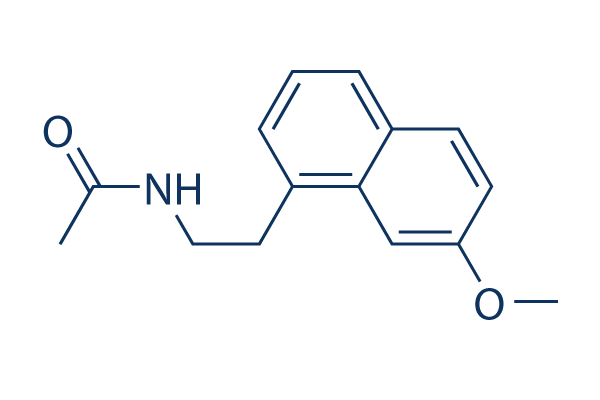
Agomelatine (S20098) 5-HT Receptor antagonist
Cat.No.S1243
Quality Control
Cell Culture, Treatment & Working Concentration
| Cell Lines | Assay Type | Concentration | Incubation Time | Formulation | Activity Description | PMID |
|---|---|---|---|---|---|---|
| HEK 293 | Function assay | Binding affinity for human Melatonin receptor type 1A stably transfected in human embryonic kidney cells (HEK 293) using 2-[125I]iodomelatonin as radioligand, Ki=6e-05 μM | ||||
| CHO cells | Function assay | 120 mins | Displacement of [125I]iodomelatonin form human MT1 receptor expressed in CHO cells after 120 mins, Ki=0.1 nM | |||
| CHO-Galpha16 cells | Function assay | 20 mins | Binding affinity to rat MT1 receptor expressed in CHO-Galpha16 cells assessed as Ca2+ mobilization after 20 mins by FLIPR assay, EC50=2.1 nM | |||
| Click to View More Cell Line Experimental Data | ||||||
Solubility
|
In vitro |
DMSO
: 48 mg/mL
(197.28 mM)
Ethanol : 48 mg/mL Water : Insoluble |
Molarity Calculator
|
In vivo |
|||||
In vivo Formulation Calculator (Clear solution)
Step 1: Enter information below (Recommended: An additional animal making an allowance for loss during the experiment)
Step 2: Enter the in vivo formulation (This is only the calculator, not formulation. Please contact us first if there is no in vivo formulation at the solubility Section.)
Calculation results:
Working concentration: mg/ml;
Method for preparing DMSO master liquid: mg drug pre-dissolved in μL DMSO ( Master liquid concentration mg/mL, Please contact us first if the concentration exceeds the DMSO solubility of the batch of drug. )
Method for preparing in vivo formulation: Take μL DMSO master liquid, next addμL PEG300, mix and clarify, next addμL Tween 80, mix and clarify, next add μL ddH2O, mix and clarify.
Method for preparing in vivo formulation: Take μL DMSO master liquid, next add μL Corn oil, mix and clarify.
Note: 1. Please make sure the liquid is clear before adding the next solvent.
2. Be sure to add the solvent(s) in order. You must ensure that the solution obtained, in the previous addition, is a clear solution before proceeding to add the next solvent. Physical methods such
as vortex, ultrasound or hot water bath can be used to aid dissolving.
Chemical Information, Storage & Stability
| Molecular Weight | 243.3 | Formula | C15H17NO2 |
Storage (From the date of receipt) | |
|---|---|---|---|---|---|
| CAS No. | 138112-76-2 | Download SDF | Storage of Stock Solutions |
|
|
| Synonyms | Valdoxan, Melitor, Thymanax,S20098 | SMILES | CC(=O)NCCC1=CC=CC2=C1C=C(C=C2)OC | ||
Read more about storage stability stock solution CAS number SMILES
Mechanism of Action
| Targets/IC50/Ki |
5-HT2C
|
|---|---|
| In vitro |
In rats subjected to chronic footshock stress, Agomelatine (S20098) completely normalizes stress-affected cell survival and partly reverses reduced doublecortin expression in the hippocampus. |
| In vivo |
Agomelatine (S20098) is effective in reversing the transgenic mouse behavioural changes noted in the Porsolt forced swim test as well as in the elevated plus maze. It also markedly accelerates readjustment of circadian cycles of temperature and activity following an induced phase shift. This compound enhances cell proliferation and neurogenesis in the ventral hippocampus (VH) of adult rats, a region pertinent to mood disorders. It increases the ratio of mature vs immature neurons and enhances neurite outgrowth of granular cells in adult rats, suggesting an acceleration of maturation. Agomelatine also activates several cellular signals (extracellular signal-regulated kinase1/2, protein kinase B, and glycogen synthase kinase 3beta) known to be modulated by antidepressants and implicated in the control of proliferation/survival. It enhances the time devoted to active social interaction in unfamiliar pairs of rats exposed to a novel environment. The compound increases cell proliferation and neurogenesis in the ventral dentate gyrus of rats, a region notably implicated in response to emotion, which is consistent with its antidepressant-anxiolytic properties. It increases survival of newly formed neurons in the entire dentate gyrus of rats. |
References |
|
Clinical Trial Information
(data from https://clinicaltrials.gov, updated on 2025-06-10)
| NCT Number | Recruitment | Conditions | Sponsor/Collaborators | Start Date | Phases |
|---|---|---|---|---|---|
| NCT07011693 | NOT_YET_RECRUITING | Major Depressive Disorder (MDD) |
Xinyu Zhou |
2025-06-20 | PHASE4 |
| NCT05426304 | UNKNOWN | Depression; Acute Ischemic Stroke |
First Affiliated Hospital, Sun Yat-Sen University |
2022-10-01 | PHASE4 |
| NCT06120543 | Not yet recruiting | Polymorphism Genetic|Depression|CYP1A2 Polymorphism|CYP2C9 Polymorphism|Polymerase Chain Reaction|Plasma Concentration |
Affiliated Hospital of Nantong University |
2023-10-31 | -- |
| NCT05646264 | UNKNOWN | Schizophrenia; Negative Symptoms in Schizophrenia |
Shanghai Mental Health Center |
2023-01-01 | PHASE4 |
| NCT04589143 | COMPLETED | Major Depressive Disorder |
Central South University |
2020-10-01 | PHASE4 |
| NCT05323994 | Recruiting | Depression|COVID-19 |
Servier Russia |
2022-04-19 | -- |
Read more about Clinical Trials
Tech Support
Tel: +1-832-582-8158 Ext:3
If you have any other enquiries, please leave a message.
Signaling Pathway Map

Products are for research use only. Not for human use. We do not sell to patients.
©Copyright 2013 Selleck Chemicals. All Rights Reserved.