
-
 Argentina
-
 Australia
-
 Austria
-
 Belgium
-
 Brazil
-
 Canada
-
 China
China
-
 Czech Republic
-
 Denmark
-
 Finland
-
 France
-
 Germany
-
 Greece
-
 Hong Kong
-
 Hungary
-
 Iceland
-
 India
India
-
 Ireland
-
 Israel
-
 Italy
Italy
-
 Japan
Japan
-
 Korea
Korea
-
 Luxembourg
-
 Malaysia
-
 Netherlands
-
 New Zealand
-
 Norway
-
 Poland
-
 Portugal
-
 Qatar
Qatar
-
 Romania
-
 Saudi Arabia
-
 Singapore
-
 Spain
Spain
-
 Sweden
-
 Switzerland
-
 Taiwan
-
 Turkey
-
 United Kingdom
-
 United States
Proteasome Inhibitors
Other Proteases Related Inhibitors
Isoform-selective Products
| Cat.No. | Product Name | Information | Product Use Citations | Product Validations |
|---|---|---|---|---|
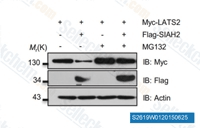
| S2619 | MG132 | MG132 ((S,R,S)-(-)-MG132, Z-Leu-D-Leu-Leu-al) is a potent proteasome (ChTL, TL, and PGPH) inhibitor. This compound also inhibits calpain (IC50=1.2 μM). It can be used to induce animal models of Parkinson’s disease. |
|
|
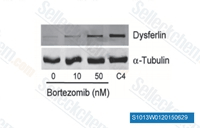
| S1013 | Bortezomib | Bortezomib is a potent 20S proteasome inhibitor with Ki of 0.6 nM. It exhibits favorable selectivity towards tumor cells over normal cells. This compound inhibits NF-κB and induces ERK phosphorylation to suppress cathepsin B and inhibit the catalytic process of autophagy in ovarian cancer and other solid tumors. |
|
|
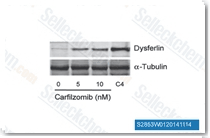
| S2853 | PR-171 (Carfilzomib) | Carfilzomib (PR-171) is an irreversible proteasome inhibitor with IC50 of <5 nM in ANBL-6 cells, displayed preferential in vitro inhibitory potency against the ChT-L activity in the β5 subunit, but little or no effect on the PGPH and T-L activities. Carfilzomib activates prosurvival autophagy and induces cell apoptosis. |
|
|
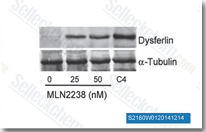
| S2180 | MLN2238 (Ixazomib) | Ixazomib (MLN2238) inhibits the chymotrypsin-like proteolytic (β5) site of the 20S proteasome with IC50 and Ki of 3.4 nM and 0.93 nM in cell-free assays, respectively, also inhibits the caspase-like (β1) and trypsin-like (β2) proteolytic sites, with IC50 of 31 and 3500 nM. Ixazomib (MLN2238) induces autophagy. Phase 3. |
|
|
| S7038 | Epoxomicin (BU-4061T) | Epoxomicin (BU-4061T, Aids010837) is a selective proteasome inhibitor with anti-inflammatory activity, which primarily inhibits the CH-L activity of the 20S proteasome, while T-L and PGPH catalytic activities are also inhibited at 100- and 1000-fold reduced rate. This compound promotes apoptosis and can be used to induce animal models of Parkinson's Disease. |
|

|
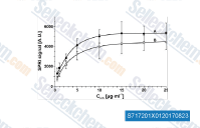
| S7172 | ONX-0914 (PR-957) | ONX-0914 (PR-957) is a potent and selective immunoproteasome inhibitor, and this compound shows minimal cross-reactivity for the constitutive proteasome in a cell-free assay. |
|
|
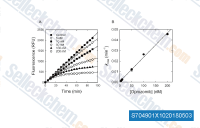
| S7049 | Oprozomib | Oprozomib is an orally bioavailable inhibitor for CT-L activity of 20S proteasome β5/LMP7 with IC50 of 36 nM/82 nM. Phase 1/2. |
|
|
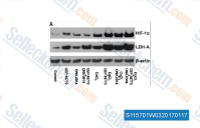
| S1157 | Delanzomib | Delanzomib is an orally active inhibitor of the chymotrypsin-like activity of proteasome with IC50 of 3.8 nM, with only marginal inhibition of the tryptic and peptidylglutamyl activities of the proteosome. Phase 1/2. |
|
|
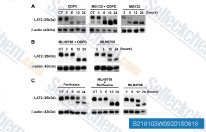
| S2181 | Ixazomib Citrate (MLN9708) Analogue | Ixazomib Citrate (MLN9708) Analogue is the analogue of Ixazomib Citrate (MLN9708) from WO2016165677A1. Ixazomib Citrate (MLN9708) immediately hydrolyzed to Ixazomib (MLN2238), the biologically active form, on exposure to aqueous solutions or plasma. Ixazomib (MLN2238) inhibits the chymotrypsin-like proteolytic (β5) site of the 20S proteasome with IC50/Ki of 3.4 nM/0.93 nM in cell-free assays, less potent to β1 and little activity to β2. Ixazomib (MLN2238) induces autophagy. Phase 3. |
|
|
| S4432 | Ixazomib Citrate (MLN9708) | Ixazomib Citrate (MLN9708) is a prodrug of Ixazomib (MLN2238), which is a selective, orally bioavailable inhibitor of 20S proteasome that inhibits the chymotrypsin-like proteolytic (β5) site with IC50 of 3.4 nM and Ki of 0.93 nM, respectively. Ixazomib (MLN2238) also inhibits caspase-like (β1) and trypsin-like (β2) proteolytic sites with IC50 of 31 nM and 3500 nM, respectively. |
|
|
Signaling Pathway Map

Products are for research use only. Not for human use. We do not sell to patients.
©Copyright 2013 Selleck Chemicals. All Rights Reserved.