
-
 Australia
-
 Austria
-
 Belgium
-
 Brazil
-
 Canada
-
 China
China
-
 Czech Republic
-
 Denmark
-
 Finland
-
 France
-
 Germany
-
 Greece
-
 Hong Kong
-
 Hungary
-
 Iceland
-
 India
India
-
 Ireland
-
 Israel
-
 Italy
Italy
-
 Japan
Japan
-
 Korea
Korea
-
 Luxembourg
-
 Malaysia
-
 Netherlands
-
 New Zealand
-
 Norway
-
 Poland
-
 Qatar
Qatar
-
 Romania
-
 Saudi Arabia
-
 Singapore
-
 Spain
Spain
-
 Sweden
-
 Switzerland
-
 Taiwan
-
 Turkey
-
 United Kingdom
-
 United States
research use only
Lomerizine 2HCl Calcium Channel inhibitor
Cat.No.S4084
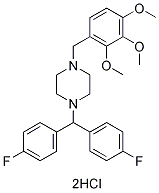
Chemical Structure
Molecular Weight: 541.46
Quality Control
| Related Targets | CFTR CRM1 CD markers AChR Sodium Channel Potassium Channel GABA Receptor TRP Channel ATPase GluR |
|---|---|
| Other Calcium Channel Inhibitors | Bay K 8644 BAPTA-AM Tetrandrine Flunarizine 2HCl Nilvadipine Cilnidipine YM-58483 (BTP2) Ionomycin Imperatorin Manidipine 2HCl |
Solubility
|
In vitro |
DMSO
: 8 mg/mL
(14.77 mM)
Ethanol : 3 mg/mL Water : Insoluble |
Molarity Calculator
|
In vivo |
|||||
In vivo Formulation Calculator (Clear solution)
Step 1: Enter information below (Recommended: An additional animal making an allowance for loss during the experiment)
Step 2: Enter the in vivo formulation (This is only the calculator, not formulation. Please contact us first if there is no in vivo formulation at the solubility Section.)
Calculation results:
Working concentration: mg/ml;
Method for preparing DMSO master liquid: mg drug pre-dissolved in μL DMSO ( Master liquid concentration mg/mL, Please contact us first if the concentration exceeds the DMSO solubility of the batch of drug. )
Method for preparing in vivo formulation: Take μL DMSO master liquid, next addμL PEG300, mix and clarify, next addμL Tween 80, mix and clarify, next add μL ddH2O, mix and clarify.
Method for preparing in vivo formulation: Take μL DMSO master liquid, next add μL Corn oil, mix and clarify.
Note: 1. Please make sure the liquid is clear before adding the next solvent.
2. Be sure to add the solvent(s) in order. You must ensure that the solution obtained, in the previous addition, is a clear solution before proceeding to add the next solvent. Physical methods such
as vortex, ultrasound or hot water bath can be used to aid dissolving.
Chemical Information, Storage & Stability
| Molecular Weight | 541.46 | Formula | C27H30F2N2O3.2HCl |
Storage (From the date of receipt) | |
|---|---|---|---|---|---|
| CAS No. | 101477-54-7 | Download SDF | Storage of Stock Solutions |
|
|
| Synonyms | KB-2796 | Smiles | COC1=C(C(=C(C=C1)CN2CCN(CC2)C(C3=CC=C(C=C3)F)C4=CC=C(C=C4)F)OC)OC.Cl.Cl | ||
Mechanism of Action
| Targets/IC50/Ki |
L-type calcium channel
T-type calcium channel
|
|---|---|
| In vitro |
Lomerizine (0.1 μM and 1 μM) significantly reduces glutamate-induced neurotoxicity in rat cultured retinal neurons. Lomerizine (1 μM) also exhibits protective effects against both the N-methyl-D-aspartate and kainate induced types of neurotoxicity in rat cultured retinal neurons.
|
| In vivo |
Lomerizine (0.1 mg/kg and 1 mg/kg, i.v.) prior to ischemia and again immediately after reperfusion dose-dependently reduces the retinal damage in rat retina. Lomerizine (30 mg/kg, oral) reduces secondary necrosis at 2 weeks and secondary caspase-3 expression at 3 weeks in adult Piebald-Virol-Glaxo (PVG) rats. Lomerizine (30 mg/kg, oral) reduces morphological disruption, oxidative stress and phosphacan expression, and limits early increases in macrophage numbers in female PVG Hooded rats. Lomerizine (30 mg/kg, oral) protects RGCs from secondary death at 4 weeks but does not fully restore behavioural function (optokinetic nystagmus) in female PVG Hooded rats. Lomerizine (0.1 mg/kg or 0.3 mg/kg) significantly increases blood flow in the rabbit retina and optic nerve head (ONH), but blood flow changed little in the choroid or iris-ciliary body. Lomerizine (0.1 and 0.3 mg/kg, i.v.) significantly increases tissue blood flow in the optic nerve head and the putative blood flow in the long posterior ciliary artery with smaller reduction of blood pressure (0.3 mg/kg, i.v.) and without change in heart rate in rabbit. Lomerizine (0.1 and 0.3 mg/kg, i.v.) inhibits the hypoperfusion in the optic nerve head of rabbit.
|
References |
|
Tech Support
Tel: +1-832-582-8158 Ext:3
If you have any other enquiries, please leave a message.
Signaling Pathway Map

Products are for research use only. Not for human use. We do not sell to patients.
©Copyright 2013 Selleck Chemicals. All Rights Reserved.