
-
 Australia
-
 Austria
-
 Belgium
-
 Brazil
-
 Canada
-
 China
China
-
 Czech Republic
-
 Denmark
-
 Finland
-
 France
-
 Germany
-
 Greece
-
 Hong Kong
-
 Hungary
-
 Iceland
-
 India
India
-
 Ireland
-
 Israel
-
 Italy
Italy
-
 Japan
Japan
-
 Korea
Korea
-
 Luxembourg
-
 Malaysia
-
 Netherlands
-
 New Zealand
-
 Norway
-
 Poland
-
 Qatar
Qatar
-
 Romania
-
 Saudi Arabia
-
 Singapore
-
 Spain
Spain
-
 Sweden
-
 Switzerland
-
 Taiwan
-
 Turkey
-
 United Kingdom
-
 United States
research use only
Rabusertib (LY2603618) CHK1 Inhibitor
Cat.No.S2626
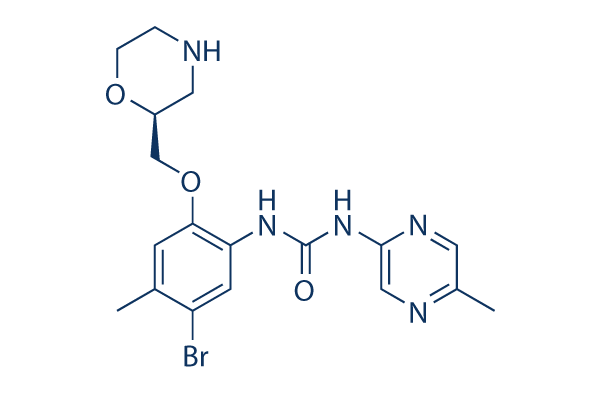
Chemical Structure
Molecular Weight: 436.3
Quality Control
Cell Culture, Treatment & Working Concentration
| Cell Lines | Assay Type | Concentration | Incubation Time | Formulation | Activity Description | PMID |
|---|---|---|---|---|---|---|
| BT474 | Kinase assay | 1 μM | DMSO | inhibits P-CHK1 levels | 23917378 | |
| MCF7 | Kinase assay | 1 μM | DMSO | inhibits P-CHK1 levels | 23917378 | |
| Hela | Kinase assay | 3300 nM | DMSO | inhibits Chk1 activity | 24114124 | |
| Calu6 | Kinase assay | 3300 nM | DMSO | inhibits Chk1 activity | 24114124 | |
| A549 | Function assay | ~10 μM | DMSO | induces cell cycle arrest | 24928205 | |
| H1299 | Function assay | ~10 μM | DMSO | induces cell cycle arrest | 24928205 | |
| A549 | Function assay | ~20 μM | DMSO | activates DNA damage sensor kinases | 24928205 | |
| H1299 | Function assay | ~20 μM | DMSO | activates DNA damage sensor kinases | 24928205 | |
| A549 | Apoptosis assay | ~20 μM | DMSO | induces apoptosis | 24928205 | |
| H1299 | Apoptosis assay | ~20 μM | DMSO | induces apoptosis | 24928205 | |
| A549 | Cytoxicity assay | ~20 μM | DMSO | induces autophagy | 24928205 | |
| H1299 | Cytoxicity assay | ~20 μM | DMSO | induces autophagy | 24928205 | |
| A549 | Function assay | ~20 μM | DMSO | increases JNK and p38 MAPK phosphorylation | 24928205 | |
| H1299 | Function assay | ~20 μM | DMSO | increases JNK and p38 MAPK phosphorylation | 24928205 | |
| OHS-50 | qHTS assay | qHTS of pediatric cancer cell lines to identify multiple opportunities for drug repurposing: Primary screen for OHS-50 cells | 29435139 | |||
| SJ-GBM2 | qHTS assay | qHTS of pediatric cancer cell lines to identify multiple opportunities for drug repurposing: Primary screen for SJ-GBM2 cells | 29435139 | |||
| SK-N-MC | qHTS assay | qHTS of pediatric cancer cell lines to identify multiple opportunities for drug repurposing: Primary screen for SK-N-MC cells | 29435139 | |||
| NB-EBc1 | qHTS assay | qHTS of pediatric cancer cell lines to identify multiple opportunities for drug repurposing: Primary screen for NB-EBc1 cells | 29435139 | |||
| LAN-5 | qHTS assay | qHTS of pediatric cancer cell lines to identify multiple opportunities for drug repurposing: Primary screen for LAN-5 cells | 29435139 | |||
| Click to View More Cell Line Experimental Data | ||||||
Solubility
|
In vitro |
DMSO
: 22 mg/mL
(50.42 mM)
Water : Insoluble Ethanol : Insoluble |
Molarity Calculator
|
In vivo |
|||||
In vivo Formulation Calculator (Clear solution)
Step 1: Enter information below (Recommended: An additional animal making an allowance for loss during the experiment)
Step 2: Enter the in vivo formulation (This is only the calculator, not formulation. Please contact us first if there is no in vivo formulation at the solubility Section.)
Calculation results:
Working concentration: mg/ml;
Method for preparing DMSO master liquid: mg drug pre-dissolved in μL DMSO ( Master liquid concentration mg/mL, Please contact us first if the concentration exceeds the DMSO solubility of the batch of drug. )
Method for preparing in vivo formulation: Take μL DMSO master liquid, next addμL PEG300, mix and clarify, next addμL Tween 80, mix and clarify, next add μL ddH2O, mix and clarify.
Method for preparing in vivo formulation: Take μL DMSO master liquid, next add μL Corn oil, mix and clarify.
Note: 1. Please make sure the liquid is clear before adding the next solvent.
2. Be sure to add the solvent(s) in order. You must ensure that the solution obtained, in the previous addition, is a clear solution before proceeding to add the next solvent. Physical methods such
as vortex, ultrasound or hot water bath can be used to aid dissolving.
Chemical Information, Storage & Stability
| Molecular Weight | 436.3 | Formula | C18H22BrN5O3 |
Storage (From the date of receipt) | |
|---|---|---|---|---|---|
| CAS No. | 911222-45-2 | Download SDF | Storage of Stock Solutions |
|
|
| Synonyms | IC-83 | Smiles | CC1=CC(=C(C=C1Br)NC(=O)NC2=NC=C(N=C2)C)OCC3CNCCO3 | ||
Mechanism of Action
| Targets/IC50/Ki |
Chk1
(Cell-free assay) 7 nM
|
|---|---|
| In vitro |
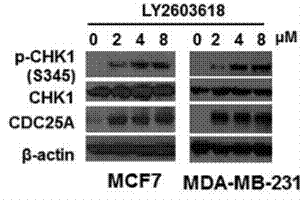
Chk1 is an ATP-dependent serine-threonine kinase and a key component in the DNA replication-monitoring checkpoint system activated by double-stranded breaks (DSBs). Chk1 contributes to all currently defined cell cycle checkpoints, including G1/S, intra-S-phase, G2/M, and the mitotic spindle checkpoint. By inhibiting the activity of chk1, this compound prevents the repair of DNA caused by DNA-damaging agents, thus potentiating the antitumor efficacies of various chemotherapeutic agents. However, preclinical data involving this compound has not been published until now. Inhibition of Chk1 is predicted to enhance the effects of antimetabolites. This chemical treatment impairs DNA synthesis, increases DNA damage (via mitotic defects), induces apoptosis, and has synergistic activity, especially in p53 mutant tumor cells. |
| In vivo |
In xenograft models, this compound delays tumor growth when given in combination. |
References |
|
Applications
| Methods | Biomarkers | Images | PMID |
|---|---|---|---|
| Western blot | p-Chk1 / Chk1 / CDC25A PARP / CF-PARP / p-CDC25C / p-CDK1 / p-CDK2 |
|
29326282 |
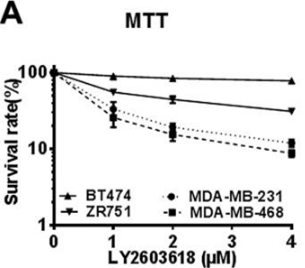
| Growth inhibition assay | Cell viability |
|
29326282 |
Clinical Trial Information
(data from https://clinicaltrials.gov, updated on 2024-05-22)
| NCT Number | Recruitment | Conditions | Sponsor/Collaborators | Start Date | Phases |
|---|---|---|---|---|---|
| NCT01341457 | Completed | Solid Tumors |
Eli Lilly and Company |
May 2011 | Phase 1 |
| NCT01296568 | Completed | Advanced Cancer |
Eli Lilly and Company |
February 2011 | Phase 1 |
| NCT01139775 | Completed | Non Small Cell Lung Cancer |
Eli Lilly and Company |
February 2011 | Phase 1|Phase 2 |
| NCT00988858 | Completed | Non Small Cell Lung Cancer |
Eli Lilly and Company |
November 2009 | Phase 2 |
| NCT00839332 | Completed | Pancreatic Neoplasms |
Eli Lilly and Company |
February 2009 | Phase 1|Phase 2 |
Tech Support
Tel: +1-832-582-8158 Ext:3
If you have any other enquiries, please leave a message.
Signaling Pathway Map

Products are for research use only. Not for human use. We do not sell to patients.
©Copyright 2013 Selleck Chemicals. All Rights Reserved.