
-
 Argentina
-
 Australia
-
 Austria
-
 Belgium
-
 Brazil
-
 Canada
-
 China
China
-
 Czech Republic
-
 Denmark
-
 Finland
-
 France
-
 Germany
-
 Greece
-
 Hong Kong
-
 Hungary
-
 Iceland
-
 India
India
-
 Ireland
-
 Israel
-
 Italy
Italy
-
 Japan
Japan
-
 Korea
Korea
-
 Luxembourg
-
 Malaysia
-
 Netherlands
-
 New Zealand
-
 Norway
-
 Poland
-
 Portugal
-
 Qatar
Qatar
-
 Romania
-
 Saudi Arabia
-
 Singapore
-
 Spain
Spain
-
 Sweden
-
 Switzerland
-
 Taiwan
-
 Turkey
-
 United Kingdom
-
 United States
research use only
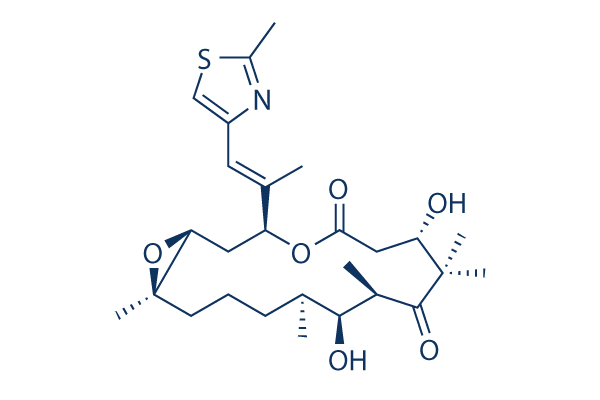
Patupilone (Epothilone B) Microtubule Associated inhibitor
Cat.No.S1364
Quality Control
| Related Targets | Akt Wnt/beta-catenin PKC HSP ROCK Integrin Bcr-Abl Actin FAK Kinesin |
|---|---|
| Other Microtubule Associated Inhibitors | Nocodazole CW069 Combretastatin A4 Lexibulin (CYT997) Epothilone A ABT-751 (E7010) Cucurbitacin B TRx0237 (LMTX) mesylate DM1 (Mertansine) Vindesine sulfate |
Cell Culture, Treatment & Working Concentration
| Cell Lines | Assay Type | Concentration | Incubation Time | Formulation | Activity Description | PMID |
|---|---|---|---|---|---|---|
| human LC-2-ad cell | Growth inhibition assay | Inhibition of human LC-2-ad cell growth in a cell viability assay, IC50=3.77e-06 μM | ||||
| human A431 cell | Growth inhibition assay | Inhibition of human A431 cell growth in a cell viability assay, IC50=9.86e-06 μM | ||||
| human SW1710 cell | Growth inhibition assay | Inhibition of human SW1710 cell growth in a cell viability assay, IC50=2.14e-05 μM | ||||
| human Daoy cell | Growth inhibition assay | Inhibition of human Daoy cell growth in a cell viability assay, IC50=2.73e-05 μM | ||||
| human BFTC-905 cell | Growth inhibition assay | Inhibition of human BFTC-905 cell growth in a cell viability assay, IC50=4.99e-05 μM | ||||
| human A375 cell | Growth inhibition assay | Inhibition of human A375 cell growth in a cell viability assay, IC50=5e-05 μM | ||||
| human RKO cell | Growth inhibition assay | Inhibition of human RKO cell growth in a cell viability assay, IC50=6.47e-05 μM | ||||
| human KYSE-510 cell | Growth inhibition assay | Inhibition of human KYSE-510 cell growth in a cell viability assay, IC50=7.38e-05 μM | ||||
| human HLE cell | Growth inhibition assay | Inhibition of human HLE cell growth in a cell viability assay, IC50=8.26e-05 μM | ||||
| human MCF7 cell | Growth inhibition assay | Inhibition of human MCF7 cell growth in a cell viability assay, IC50=8.66e-05 μM | ||||
| human 786-0 cell | Growth inhibition assay | Inhibition of human 786-0 cell growth in a cell viability assay, IC50=0.11 nM | ||||
| human TE-8 cell | Growth inhibition assay | Inhibition of human TE-8 cell growth in a cell viability assay, IC50=0.111 nM | ||||
| ovarian carcinoma 1A9 cell | Growth inhibition assay | Inhibitory concentration against ovarian carcinoma 1A9 cell growth | ||||
| human PANC-03-27 cell | Growth inhibition assay | Inhibition of human PANC-03-27 cell growth in a cell viability assay, IC50=0.132 μM | ||||
| human VMRC-RCZ cell | Growth inhibition assay | Inhibition of human VMRC-RCZ cell growth in a cell viability assay, IC50=0.136 μM | ||||
| human IGROV-1 cell | Growth inhibition assay | Inhibition of human IGROV-1 cell growth in a cell viability assay, IC50=0.156 μM | ||||
| human MG-63 cell | Growth inhibition assay | Inhibition of human MG-63 cell growth in a cell viability assay, IC50=0.165 μM | ||||
| human SIG-M5 cell | Growth inhibition assay | Inhibition of human SIG-M5 cell growth in a cell viability assay, IC50=0.169 μM | ||||
| human NCI-H650 cell | Growth inhibition assay | Inhibition of human NCI-H650 cell growth in a cell viability assay, IC50=0.17 μM | ||||
| human PSN1 cell | Growth inhibition assay | Inhibition of human PSN1 cell growth in a cell viability assay, IC50=0.173 μM | ||||
| human PA-1 cell | Growth inhibition assay | Inhibition of human PA-1 cell growth in a cell viability assay, IC50=0.174 μM | ||||
| KB-8511 cells | Growth inhibition assay | 72 h | Concentration required to inhibit the growth of human epidermoid carcinoma cells KB-8511 by 50 percent (72 hr exposure), IC50=0.18 μM | |||
| KB-31 cells | Growth inhibition assay | 72 h | Concentration required to inhibit the growth of human epidermoid carcinoma cells KB-31 by 50 percent (72 hr exposure) | |||
| human BHY cell | Growth inhibition assay | Inhibition of human BHY cell growth in a cell viability assay, IC50=0.195 nM | ||||
| human BB30-HNC cell | Growth inhibition assay | Inhibition of human BB30-HNC cell growth in a cell viability assay, IC50=0.201 μM | ||||
| human HOS cell | Growth inhibition assay | Inhibition of human HOS cell growth in a cell viability assay, IC50=0.215 μM | ||||
| human 639-V cell | Growth inhibition assay | Inhibition of human 639-V cell growth in a cell viability assay, IC50=0.218 μM | ||||
| human ES1 cell | Growth inhibition assay | Inhibition of human ES1 cell growth in a cell viability assay, IC50=0.221 μM | ||||
| human TE-15 cell | Growth inhibition assay | Inhibition of human TE-15 cell growth in a cell viability assay, IC50=0.225 μM | ||||
| human LXF-289 cell | Growth inhibition assay | Inhibition of human LXF-289 cell growth in a cell viability assay, IC50=0.277 μM | ||||
| human CAL-12T cell | Growth inhibition assay | Inhibition of human CAL-12T cell growth in a cell viability assay, IC50=0.239 μM | ||||
| human T84 cell | Growth inhibition assay | Inhibition of human T84 cell growth in a cell viability assay, IC50=0.24 μM | ||||
| human KYSE-450 cell | Growth inhibition assay | Inhibition of human KYSE-450 cell growth in a cell viability assay, IC50=0.267 μM | ||||
| human LCLC-103H cell | Growth inhibition assay | Inhibition of human LCLC-103H cell growth in a cell viability assay, IC50=0.31 nM | ||||
| human NCI-H810 cell | Growth inhibition assay | Inhibition of human NCI-H810 cell growth in a cell viability assay, IC50=0.322 μM | ||||
| human HUTU-80 cell | Growth inhibition assay | Inhibition of human HUTU-80 cell growth in a cell viability assay, IC50=0.328 μM | ||||
| human NCI-H460 cell | Growth inhibition assay | Inhibition of human NCI-H460 cell growth in a cell viability assay, IC50=0.333 μM | ||||
| human HGC-27 cell | Growth inhibition assay | Inhibition of human HGC-27 cell growth in a cell viability assay, IC50=0.338 μM | ||||
| human HSC-2 cell | Growth inhibition assay | Inhibition of human HSC-2 cell growth in a cell viability assay, IC50=0.363 nM | ||||
| human IA-LM cell | Growth inhibition assay | Inhibition of human IA-LM cell growth in a cell viability assay, IC50=0.393 μM | ||||
| human HMV-II cell | Growth inhibition assay | Inhibition of human HMV-II cell growth in a cell viability assay, IC50=0.394 μM | ||||
| human COLO-679 cell | Growth inhibition assay | Inhibition of human COLO-679 cell growth in a cell viability assay, IC50=0.394 μM | ||||
| human NCI-H2122 cell | Growth inhibition assay | Inhibition of human NCI-H2122 cell growth in a cell viability assay, IC50=0.41 μM | ||||
| human CAL-39 cell | Growth inhibition assay | Inhibition of human CAL-39 cell growth in a cell viability assay, IC50=0.411 μM | ||||
| human SW954 cell | Growth inhibition assay | Inhibition of human SW954 cell growth in a cell viability assay, IC50=0.436 μM | ||||
| human LCLC-97TM1 cell | Growth inhibition assay | Inhibition of human LCLC-97TM1 cell growth in a cell viability assay, IC50=0.444 μM | ||||
| human KYSE-270 cell | Growth inhibition assay | Inhibition of human KYSE-270 cell growth in a cell viability assay, IC50=0.445 μM | ||||
| human NB13 cell | Growth inhibition assay | Inhibition of human NB13 cell growth in a cell viability assay, IC50=0.447 μM | ||||
| human SK-LMS-1 cell | Growth inhibition assay | Inhibition of human SK-LMS-1 cell growth in a cell viability assay, IC50=0.646 μM | ||||
| human SW620 cell | Growth inhibition assay | Inhibition of human SW620 cell growth in a cell viability assay, IC50=0.648 μM | ||||
| human HCT-15 cell | Growth inhibition assay | Inhibition of human HCT-15 cell growth in a cell viability assay, IC50=0.717 μM | ||||
| human DU-145 cell | Growth inhibition assay | Inhibition of human DU-145 cell growth in a cell viability assay, IC50=0.721 μM | ||||
| human ST486 cell | Growth inhibition assay | Inhibition of human ST486 cell growth in a cell viability assay, IC50=0.721 μM | ||||
| human A427 cell | Growth inhibition assay | Inhibition of human A427 cell growth in a cell viability assay, IC50=0.828 μM | ||||
| human HT-1080 cell | Growth inhibition assay | Inhibition of human HT-1080 cell growth in a cell viability assay, IC50=0.842 μM | ||||
| human NCI-H2009 cell | Growth inhibition assay | Inhibition of human NCI-H2009 cell growth in a cell viability assay, IC50=0.862 μM | ||||
| human SK-LU-1 cell | Growth inhibition assay | Inhibition of human SK-LU-1 cell growth in a cell viability assay, IC50=0.866 μM | ||||
| human SCC-4 cell | Growth inhibition assay | Inhibition of human SCC-4 cell growth in a cell viability assay, IC50=0.877 μM | ||||
| human NCI-H1299 cell | Growth inhibition assay | Inhibition of human NCI-H1299 cell growth in a cell viability assay, IC50=0.88 μM | ||||
| human NH-12 cell | Growth inhibition assay | Inhibition of human NH-12 cell growth in a cell viability assay, IC50=0.891 μM | ||||
| human SK-UT-1 cell | Growth inhibition assay | Inhibition of human SK-UT-1 cell growth in a cell viability assay, IC50=0.892 μM | ||||
| human Bel7402 | Proliferation assay | 72 h | Antiproliferative activity against human Bel7402 after 72 hrs by CellTiter Glo assay, IC50=0.9 μM | |||
| human A388 cell | Growth inhibition assay | Inhibition of human A388 cell growth in a cell viability assay, IC50=0.94 μM | ||||
| human SW982 cell | Growth inhibition assay | Inhibition of human SW982 cell growth in a cell viability assay, IC50=0.999 μM | ||||
| Click to View More Cell Line Experimental Data | ||||||
Solubility
|
In vitro |
DMSO
: 102 mg/mL
(200.91 mM)
Ethanol : 102 mg/mL Water : Insoluble |
Molarity Calculator
|
In vivo |
|||||
In vivo Formulation Calculator (Clear solution)
Step 1: Enter information below (Recommended: An additional animal making an allowance for loss during the experiment)
Step 2: Enter the in vivo formulation (This is only the calculator, not formulation. Please contact us first if there is no in vivo formulation at the solubility Section.)
Calculation results:
Working concentration: mg/ml;
Method for preparing DMSO master liquid: mg drug pre-dissolved in μL DMSO ( Master liquid concentration mg/mL, Please contact us first if the concentration exceeds the DMSO solubility of the batch of drug. )
Method for preparing in vivo formulation: Take μL DMSO master liquid, next addμL PEG300, mix and clarify, next addμL Tween 80, mix and clarify, next add μL ddH2O, mix and clarify.
Method for preparing in vivo formulation: Take μL DMSO master liquid, next add μL Corn oil, mix and clarify.
Note: 1. Please make sure the liquid is clear before adding the next solvent.
2. Be sure to add the solvent(s) in order. You must ensure that the solution obtained, in the previous addition, is a clear solution before proceeding to add the next solvent. Physical methods such
as vortex, ultrasound or hot water bath can be used to aid dissolving.
Chemical Information, Storage & Stability
| Molecular Weight | 507.68 | Formula | C27H41NO6S |
Storage (From the date of receipt) | |
|---|---|---|---|---|---|
| CAS No. | 152044-54-7 | Download SDF | Storage of Stock Solutions |
|
|
| Synonyms | EPO906 | SMILES | CC1CCCC2(C(O2)CC(OC(=O)CC(C(C(=O)C(C1O)C)(C)C)O)C(=CC3=CSC(=N3)C)C)C | ||
Read more about storage stability stock solution CAS number SMILES
Mechanism of Action
| Targets/IC50/Ki |
Tubulin
(Cell-free assay) 1.8 μM(EC0.01)
|
|---|---|
| In vitro |
Patupilone (Epothilone B) shows better activity than Epothilone A, with an EC0.01 of 1.8 μM. It potently inhibits cell proliferation in HCT116 cells, with IC50 of 0.8 nM. This compound induces mitotic arrest and displays cytotoxicity in KB3-1, KBV-1, Hela, and Hs578T cells, with IC50 of 3 nM to 92 nM. It competes with Taxol in binding to microtubules, with IC50 of 3.3 μM. In MCF-7 cells overexpressing GFP-α-tubulin, it (3.5 nM) efficiently blocks microtubule dynamics. Meanwhile, it induces mitotic arrest with IC50 of 3.5 nM. In multiple myeloma (MM) cells, including RPMI 8226, U266, MM.1S, LR5, and MR20, it directly suppresses proliferation with IC50 of 1 nM to 10 nM. Similarly, it (10 nM) also induces cell cycle arrest and apoptosis. A recent study reveals that, in ovarian cancer Hey cells, it (5 nM–100 nM) enhances surface epithelial cell adhesion antigen (EpCAM), without affecting the transcription or the total cellular level of EpCAM. |
| Kinase Assay |
Tubulin polymerization assay
|
|
Calf brain microtubule proteins (MTP) are purified, which includes approximately 15%–20% microtubule associated proteins. The buffer (MES buffer) used for the Epothilone B-microtubule studies contains 0.1 M 2-morpholinoethanesulfonic acid (MES), 1 mM EGTA and 0.5 mM MgCl2 at pH 6.6. Samples for electron microscopy are placed on carbon-over-Parlodion-coated grids (300 mesh) and negatively stained with 2% uranyl acetate. Microtubule assembly in the presence or absence of Patupilone (Epothilone B) is monitored spectrophotometrically by using a spectrophotometer equipped with a thermostatically regulated liquid circulator. The temperature is held at 35 °C and changes in turbidity (representative of polymer mass) are monitored at 350 nm. Effective concentration (EC0.01), defined as the interpolated concentration capable of inducing an initial slope of 0.01 OD/min rate, is calculated using the formula EC0.01 = concentration/slope and expressed as the mean with standard deviation obtained from three different concentrations.
|
|
| In vivo |
In a mouse xenograft model of RPMI 8226 cells, Patupilone (Epothilone B) (2.5 mg/kg–4 mg/kg) prolongs survival and suppresses tumor growth. Similarly, this compound at the same dose also inhibits tumor growth in mouse xenograft models of prostate cancer cells, including DU145 and PC3. |
References |
|
Clinical Trial Information
(data from https://clinicaltrials.gov, updated on 2019-11-21)
| NCT Number | Recruitment | Conditions | Sponsor/Collaborators | Start Date | Phases |
|---|---|---|---|---|---|
| NCT00924066 | TERMINATED | Cervical Carcinoma; Cervical Adenocarcinoma; Cervical Adenosquamous Carcinoma; Cervical Carcinoma, Non-SquamousType |
National Cancer Institute (NCI) |
2008-11 | PHASE2 |
| NCT00411528 | COMPLETED | Metastatic Hormone Refractory Prostate Cancer |
Novartis Pharmaceuticals |
2006-09 | PHASE2 |
| NCT00450866 | COMPLETED | Breast Cancer; Metastatic Cancer |
David Peereboom, MD |
2007-01 | PHASE2 |
| NCT00496600 | COMPLETED | Refractory Malignancy |
University of Medicine and Dentistry of New Jersey |
2007-07 | PHASE1 |
| NCT00715013 | COMPLETED | Recurrent Glioblastoma Planned for Reoperation |
University of Zurich |
2008-07 | PHASE1; PHASE2 |
| NCT00426582 | COMPLETED | Advanced Solid Tumors |
Novartis Pharmaceuticals |
2006-08 | PHASE1 |
Read more about Clinical Trials
Tech Support
Tel: +1-832-582-8158 Ext:3
If you have any other enquiries, please leave a message.
Signaling Pathway Map

Products are for research use only. Not for human use. We do not sell to patients.
©Copyright 2013 Selleck Chemicals. All Rights Reserved.