
-
 Argentina
-
 Australia
-
 Austria
-
 Belgium
-
 Brazil
-
 Canada
-
 China
China
-
 Czech Republic
-
 Denmark
-
 Finland
-
 France
-
 Germany
-
 Greece
-
 Hong Kong
-
 Hungary
-
 Iceland
-
 India
India
-
 Ireland
-
 Israel
-
 Italy
Italy
-
 Japan
Japan
-
 Korea
Korea
-
 Luxembourg
-
 Malaysia
-
 Netherlands
-
 New Zealand
-
 Norway
-
 Poland
-
 Portugal
-
 Qatar
Qatar
-
 Romania
-
 Saudi Arabia
-
 Singapore
-
 Spain
Spain
-
 Sweden
-
 Switzerland
-
 Taiwan
-
 Turkey
-
 United Kingdom
-
 United States
research use only
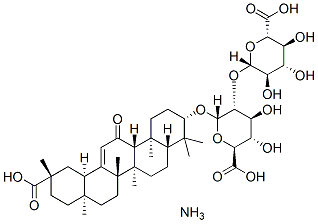
Ammonium Glycyrrhizinate Dehydrogenase inhibitor
Cat.No.S2376
Quality Control
Solubility
|
In vitro |
DMSO
: 100 mg/mL
(119.05 mM)
Water : 5 mg/mL Ethanol : Insoluble |
Molarity Calculator
|
In vivo |
|||||
In vivo Formulation Calculator (Clear solution)
Step 1: Enter information below (Recommended: An additional animal making an allowance for loss during the experiment)
Step 2: Enter the in vivo formulation (This is only the calculator, not formulation. Please contact us first if there is no in vivo formulation at the solubility Section.)
Calculation results:
Working concentration: mg/ml;
Method for preparing DMSO master liquid: mg drug pre-dissolved in μL DMSO ( Master liquid concentration mg/mL, Please contact us first if the concentration exceeds the DMSO solubility of the batch of drug. )
Method for preparing in vivo formulation: Take μL DMSO master liquid, next addμL PEG300, mix and clarify, next addμL Tween 80, mix and clarify, next add μL ddH2O, mix and clarify.
Method for preparing in vivo formulation: Take μL DMSO master liquid, next add μL Corn oil, mix and clarify.
Note: 1. Please make sure the liquid is clear before adding the next solvent.
2. Be sure to add the solvent(s) in order. You must ensure that the solution obtained, in the previous addition, is a clear solution before proceeding to add the next solvent. Physical methods such
as vortex, ultrasound or hot water bath can be used to aid dissolving.
Chemical Information, Storage & Stability
| Molecular Weight | 839.96 | Formula | C42H62O16.NH3 |
Storage (From the date of receipt) | |
|---|---|---|---|---|---|
| CAS No. | 1407-03-0 | Download SDF | Storage of Stock Solutions |
|
|
| Synonyms | AMGZ, Glycyram, Glycyrrhizin ammonium salt, Glycyrrhizic acid ammonium salt | SMILES | CC1(C2CCC3(C(C2(CCC1OC4C(C(C(C(O4)C(=O)O)O)O)OC5C(C(C(C(O5)C(=O)O)O)O)O)C)C(=O)C=C6C3(CCC7(C6CC(CC7)(C)C(=O)O)C)C)C)C.N | ||
Read more about storage stability stock solution CAS number SMILES
Mechanism of Action
| Targets/IC50/Ki |
11-beta-hydroxysteroid dehydrogenases
|
|---|---|
| In vitro |
Ammonium glycyrrhizinate (AG) prepared from glycyrrhizin dramatically protects AGS cells from H(2)O(2)-induced damage as measured by the integrity of actin cytoskeleton. This compound also inhibits FeSO(4)-induced reactive oxygen radicals in a dose-dependent manner, suggesting the role for it as a free radical scavenger.
|
| In vivo |
Ammonium glycyrrhizinate (28 mg/kg) leads to changes in the activity of some enzymes in the brain, the development of parenchymatous dystrophy of the liver which changed to acidophilic necrosis attended with signs of regeneration in mice and rats model. This compound-loaded nonionic surfactant vesicles (NSVs) decreases edema and nociceptive responses when compared with this compound alone and empty NSVs in mice model. It up-regulates interleukin-10 (IL-10) level and down-regulates the tumor neurosis factor-α (TNF-α) level and inhibits the cyclic adenosine monophosphate-phosphodiesterase (cAMP-PDE) activity in the lung tissue of mice. This compound-loaded non-ionic surfactant vesicles shows no toxicity, good skin tolerability and are able to improve the drug anti-inflammatory activity in mice. It significantly decreases triglyceride, cholesterol, low density lipoprotein (LDL) and very low density lipoprotein (VLDL) levels in rats. This chemical increases high density lipoprotein (HDL) levels increased in rats.
|
References |
|
Clinical Trial Information
(data from https://clinicaltrials.gov, updated on 2024-05-22)
| NCT Number | Recruitment | Conditions | Sponsor/Collaborators | Start Date | Phases |
|---|---|---|---|---|---|
| NCT02939144 | Completed | Apparent Mineralocorticoid Excess |
The Royal Wolverhampton Hospitals NHS Trust |
2016-11 | Not Applicable |
Read more about Clinical Trials
Tech Support
Tel: +1-832-582-8158 Ext:3
If you have any other enquiries, please leave a message.
Signaling Pathway Map

Products are for research use only. Not for human use. We do not sell to patients.
©Copyright 2013 Selleck Chemicals. All Rights Reserved.