
-
 Argentina
-
 Australia
-
 Austria
-
 Belgium
-
 Brazil
-
 Canada
-
 China
China
-
 Czech Republic
-
 Denmark
-
 Finland
-
 France
-
 Germany
-
 Greece
-
 Hong Kong
-
 Hungary
-
 Iceland
-
 India
India
-
 Ireland
-
 Israel
-
 Italy
Italy
-
 Japan
Japan
-
 Korea
Korea
-
 Luxembourg
-
 Malaysia
-
 Netherlands
-
 New Zealand
-
 Norway
-
 Poland
-
 Qatar
Qatar
-
 Romania
-
 Saudi Arabia
-
 Singapore
-
 Spain
Spain
-
 Sweden
-
 Switzerland
-
 Taiwan
-
 Turkey
-
 United Kingdom
-
 United States
research use only
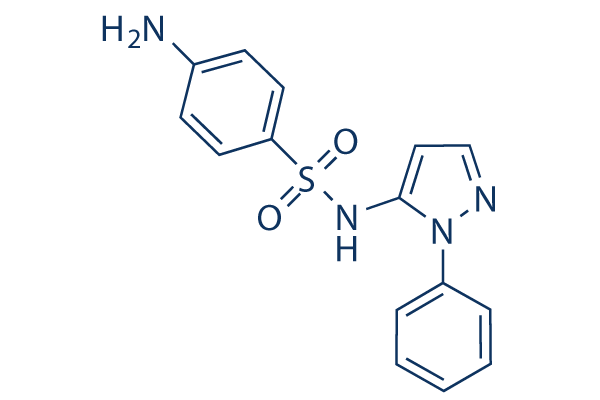
Sulfaphenazole P450 (e.g. CYP17) inhibitor
Cat.No.S3673
Quality Control
| Related Targets | Dehydrogenase HSP Transferase PDE phosphatase PPAR Vitamin Carbohydrate Metabolism Mitochondrial Metabolism Casein Kinase |
|---|---|
| Other P450 (e.g. CYP17) Inhibitors | Apigenin Baicalein Naringenin Diosmetin Alizarin Sodium Danshensu Naringin Benzbromarone Orteronel Isosilybin |
Solubility
|
In vitro |
DMSO
: 63 mg/mL
(200.4 mM)
Ethanol : 20 mg/mL Water : Insoluble |
Molarity Calculator
|
In vivo |
|||||
In vivo Formulation Calculator (Clear solution)
Step 1: Enter information below (Recommended: An additional animal making an allowance for loss during the experiment)
Step 2: Enter the in vivo formulation (This is only the calculator, not formulation. Please contact us first if there is no in vivo formulation at the solubility Section.)
Calculation results:
Working concentration: mg/ml;
Method for preparing DMSO master liquid: mg drug pre-dissolved in μL DMSO ( Master liquid concentration mg/mL, Please contact us first if the concentration exceeds the DMSO solubility of the batch of drug. )
Method for preparing in vivo formulation: Take μL DMSO master liquid, next addμL PEG300, mix and clarify, next addμL Tween 80, mix and clarify, next add μL ddH2O, mix and clarify.
Method for preparing in vivo formulation: Take μL DMSO master liquid, next add μL Corn oil, mix and clarify.
Note: 1. Please make sure the liquid is clear before adding the next solvent.
2. Be sure to add the solvent(s) in order. You must ensure that the solution obtained, in the previous addition, is a clear solution before proceeding to add the next solvent. Physical methods such
as vortex, ultrasound or hot water bath can be used to aid dissolving.
Chemical Information, Storage & Stability
| Molecular Weight | 314.36 | Formula | C15H14N4O2S |
Storage (From the date of receipt) | |
|---|---|---|---|---|---|
| CAS No. | 526-08-9 | Download SDF | Storage of Stock Solutions |
|
|
| Synonyms | Depocid, Depotsulfonamide, Plisulfan, Raziosulfa | SMILES | C1=CC=C(C=C1)N2C(=CC=N2)NS(=O)(=O)C3=CC=C(C=C3)N | ||
Read more about storage stability stock solution CAS number SMILES
Mechanism of Action
| Targets/IC50/Ki |
CYP2C9
(Cell-free assay) 0.3 μM(Ki)
|
|---|---|
| In vitro |
Cystamine is a transglutaminase (TGase) inhibitor. In addition to TGase inhibition, cystamine is able to replenish glutathione and to inhibit caspase activity. The inhibitory capacity of cystamine in vitro is largely affected by the extent of the reduced form of the molecule. Nonetheless, cystamine inhibits in situ TGase activity decidedly stronger than cysteamine.
|
| In vivo |
Treatment with cystamine results in prolonged survival and decreased abnormal movements in a murine model of HD(Huntington's disease). Cystamine does not cross the blood brain barrier. Cystamine treatment normalizes transglutaminase and GGEL levels in R6/2 mice. cystamine has significant efficacy in improving the neurological and neuropathological phenotype observed in the R6/2 transgenic model of HD and strongly suggests that Tgase plays a role in HD.
|
References |
|
Tech Support
Tel: +1-832-582-8158 Ext:3
If you have any other enquiries, please leave a message.
Signaling Pathway Map

Products are for research use only. Not for human use. We do not sell to patients.
©Copyright 2013 Selleck Chemicals. All Rights Reserved.