
-
 Argentina
-
 Australia
-
 Austria
-
 Belgium
-
 Brazil
-
 Canada
-
 China
China
-
 Czech Republic
-
 Denmark
-
 Finland
-
 France
-
 Germany
-
 Greece
-
 Hong Kong
-
 Hungary
-
 Iceland
-
 India
India
-
 Ireland
-
 Israel
-
 Italy
Italy
-
 Japan
Japan
-
 Korea
Korea
-
 Luxembourg
-
 Malaysia
-
 Netherlands
-
 New Zealand
-
 Norway
-
 Poland
-
 Portugal
-
 Qatar
Qatar
-
 Romania
-
 Saudi Arabia
-
 Singapore
-
 Spain
Spain
-
 Sweden
-
 Switzerland
-
 Taiwan
-
 Turkey
-
 United Kingdom
-
 United States
Wnt/beta-catenin Inhibitors
| Cat.No. | Product Name | Information | Product Use Citations | Product Validations |
|---|---|---|---|---|
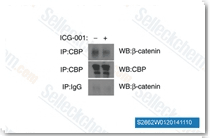
| S2662 | ICG-001 | ICG-001 antagonizes Wnt/β-catenin/TCF-mediated transcription and specifically binds to CREB-binding protein (CBP) with IC50 of 3 μM, but is not the related transcriptional coactivator p300. ICG-001 induces apoptosis. |
|
|
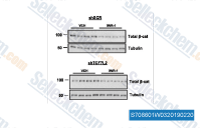
| S7086 | IWR-1-endo | IWR-1-endo (endo-IWR 1, IWR-1) is a Wnt pathway inhibitor with IC50 of 180 nM in L-cells expressing Wnt3A, induces Axin2 protein levels and promotes β-catenin phosphorylation by stabilizing Axin-scaffolded destruction complexes. |
|
|
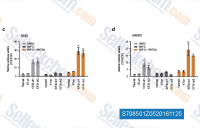
| S7085 | IWP-2 | IWP-2 is an inhibitor of Wnt processing and secretion with IC50 of 27 nM in a cell-free assay, selective blockage of Porcn-mediated Wnt palmitoylation, does not affect Wnt/β-catenin in general and displays no effect against Wnt-stimulated cellular responses. IWP-2 specifically inhibits CK1δ. |
|
|
| S8429 | PNU-74654 | PNU-74654 disrupts the Wnt signaling pathway via inhibition of the interaction (KD50=450 nM) between β-catenin and Tcf4. |
|
|
| S8474 | LF3 | LF3 is a specific inhibitor of canonical Wnt signaling by disrupting the interaction between β-catenin and TCF4 with an IC50 less than 2 μM. |
|
|
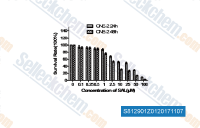
| S8129 | Salinomycin (Procoxacin) | Salinomycin, traditionally used as an anti-coccidial drug, has recently been shown to possess anti-cancer and anti-cancer stem cell (CSC) effects. |
|
|
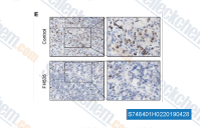
| S7484 | FH535 | FH535 is a Wnt/β-catenin signaling inhibitor and also a dual PPARγ and PPARδ antagonist. |
|
|
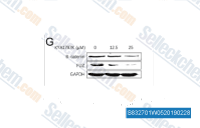
| S8327 | KYA1797K | KYA1797K is a highly potent and selective Wnt/β-catenin inhibitor with IC50 of 0.75 µM (TOPflash assay). |
|
|
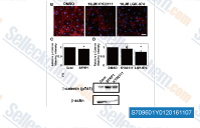
| S7096 | KY02111 | KY02111 promotes differentiation of hPSCs to cardiomyocytes by inhibiting Wnt signaling, may act downstream of APC and GSK3β. |
|
|
| S6901 | MSAB | MSAB is a selective inhibitor of Wnt/β-catenin signaling that binds to β-catenin, promoting its degradation, and specifically downregulates Wnt/β-catenin target genes. This compound shows potent anti-tumor effects. |
|
|
| S8761 | Adavivint (SM04690) | Adavivint (SM04690, Lorecivivint) is a potent and specific inhibitor of canonical Wnt signaling with an EC50 of 19.5 nM for inhibiting the TCF/LEF reporter. This compound is ∼150- to 500-fold more potent than other known Wnt inhibitors across multiple cellular assays. |
|
|
| S3842 | Isoquercitrin | Isoquercitrin (Hirsutrin, 3-Glucosylquercetin, Quercetin 3-o-glucopyranoside), a flavonoid compound with anticancer activity isolated from Bidens bipinnata L, is an inhibitor of Wnt/β-catenin that acts downstream of the β-catenin nuclear translocation. |
|
|
| S7981 | CCT251545 | CCT251545 is a potent, orally bioavailable inhibitor of WNT signaling with IC50 of 5 nM in 7dF3 cells. This compound also acts as a selective chemical probe for exploring the role of CDK8 and CDK19 in human disease. |
|
|
| S8704 | iCRT14 | iCRT14 is a β-catenin/Tcf inhibitor with a Ki value of 54 ± 5.2 μM in homogeneous fluorescence polarization (FP) assay. |
|
|
| S8248 | IQ-1 | IQ-1 enables Wnt/β-catenin-driven expansion of mouse ESCs and prevents spontaneous differentiation, Maintains embryonic stem cell (ESC) pluripotency in Wnt3a-treated cells and prevents PP2A/Nkd interaction. |
|
|
| S6745 | JW55 | JW55 is a potent and selective inhibitor of the canonical Wnt pathway that functions via inhibition of the PARP domain of tankyrase 1 and tankyrase 2 (TNKS1/2). |
|
|
| S9965 | M435-1279 | M435-1279 is a UBE2T inhibitor, inhibiting the Wnt/β-catenin signaling pathway hyperactivation through blocking UBE2T-mediated degradation of RACK1. |
|
|
| S8233 | Prodigiosin | Prodigiosin is a natural red pigment produced by numerous bacterial species which can inhibit Wnt/β-catenin pathway. |
|
|
| S9416 | Triptonide | Triptonide, isolated from the roots of Tripterygium wilfordii, can effectively inhibit canonical Wnt/β-catenin signaling by targeting the downstream C-terminal transcription domain of β-catenin or a nuclear component associated with β-catenin. It is also an antineoplastic agent, an anti-inflammatory agent and an immunosuppressive agent. |
|
|
| E1731 | JW74 | JW74 is a specific inhibitor of the canonical Wnt signaling with IC50 790 nM in the ST-Luc assay. It inhibit the growth of tumor cells in both mouse xenograft model of colorectal cancer and in ApcMin mice. |
|
|
| E0033 | IWP-4 |
IWP-4 is a potent Wnt/β-catenin signaling pathway inhibitor with an IC50 of 25 nM. |
|
|
| E1486 | Zamaporvint (RXC004) | Zamaporvint (RXC004) is an orally active and selective inhibitor of Wnt. This compound targets membrane-bound o-acyltransferase Porcupine and inhibits Wnt ligand palmitoylation, secretion, and pathway activation. It exhibits potent antiproliferative effects in Wnt ligand-dependent colorectal and pancreatic cell lines and possesses multiple antitumor mechanisms. | ||
| E0769 | Ginsenoside Rh4 | Ginsenoside Rh4 is an important active ingredient of traditional Chinese medicine ginseng, which has been shown to inhibit Wnt/β-Catenin, JAK2/STAT3, TGF-β/Smad2/3 and other signaling pathways. | ||
| E6057 | Pamidronate disodium pentahydrate | Pamidronate disodium pentahydrate is a nitrogen-containing bisphosphonate and used to prevent bone loss due to steroid use like glucocorticoid-induced low bone mineral density in children or to inhibit calcium release from bone by impairing osteoclast-mediated bone resorption. It also inhibits the Wnt/β-catenin signaling pathway that controls osteogenic differentiation in bone marrow mesenchymal stem cells (BMMSCs). | ||
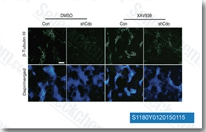
| S1180 | XAV-939 | XAV-939 (NVP-XAV939) selectively inhibits Wnt/β-catenin-mediated transcription through tankyrase1/2 inhibition with IC50 of 11 nM/4 nM in cell-free assays, regulates axin levels and does not affect CRE, NF-κB or TGF-β. |
|
|
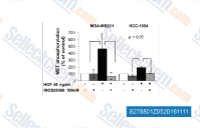
| S2788 | Capmatinib (INC280) | Capmatinib is a novel, ATP-competitive inhibitor of c-MET with IC50 of 0.13 nM in a cell-free assay, inactive against RONβ, as well as EGFR and HER-3. Capmatinib (INCB28060) inhibits Wnt/β-catenin and EMT signaling pathways and induces apoptosis in diffuse gastric cancer positive for c-MET amplification. Phase 1. |
|
|
| S8392 | NCB-0846 | NCB-0846 is a novel, orally small-molecule Wnt inhibitor that inhibits TNIK (TRAF2 and NCK-Interacting Kinase, MAP4K7) with an IC50 value of 21 nM. |
|
|
| S6898 | RCM-1 | RCM-1 is a nontoxic inhibitor of Forkhead box M1 (FOXM1) that suppresses goblet cell metaplasia and prevents IL-13 and STAT6 signaling in allergen-exposed mice. This compound decreases carcinogenesis and nuclear β-catenin. |
|
|
| S3238 | Resibufogenin | Resibufogenin (Bufogenin, Recibufogenin), a component of huachansu with anticancer effect, triggers necroptosis through upregulating receptor-interacting protein kinase 3 (RIP3) and phosphorylating mixed lineage kinase domain-like protein at Ser358. This compound exerts cytotoxic effect by inducing reactive oxygen species (ROS) accumulation. It induces apoptosis and caspase-3 and caspase-8 activity. This chemical increases Bax/Bcl-2 expression, and suppresses cyclin D1, cyclin E, PI3K, p-AKT, p-GSK3β and β-catenin protein expression. |
|
|
| E1348 | E7386 | E-7386 is a selective inhibitor which inhibits interaction between CBP/beta-catenin with IC50 value of 0.0484 μM in HEK293 cells. |
|
|
| S7490 | WIKI4 | WIKI4 is a novel Tankyrase inhibitor with IC50 of 15 nM for TNKS2, and leads to inhibition of Wnt/beta-catenin signaling. |
|
|
| S5554 | Lanatoside C | Lanatoside C is a cardiac glycoside with antiviral and anti-tumor activity. This compound induces G2/M cell cycle arrest and induces autophagy and apoptosis via attenuating MAPK, Wnt, JAK-STAT, and PI3K/AKT/mTOR signaling pathways. |
|
|
| E2376 | KY-05009 | KY-05009 is an ATP-competitive Traf2- and Nck-interacting kinase (TNIK) inhibitor with a Ki of 100 nM, which inhibits the protein expression of TNIK and transcriptional activity of Wnt target genes and induces apoptosis in cancer cells. |
|
|
| E1069 | M2912 | M2912 (MSC2504877) is a very potent TNKS1/TNKS2 inhibitor (IC50=0.6 nM for TNKS1) with exquisite selectivity over other PARP family enzymes and favorable compound properties. This inhibitor potently modulates the Wnt/β-catenin pathway by elevating the levels of axin2 (EC50=17 nM) and tankyrase in DLD1 cells in a dose-dependent manner resulting in reduced cellular Wnt reporter activity. | ||

Products are for research use only. Not for human use. We do not sell to patients.
©Copyright 2013 Selleck Chemicals. All Rights Reserved.