
-
 Argentina
-
 Australia
-
 Austria
-
 Belgium
-
 Brazil
-
 Canada
-
 China
China
-
 Czech Republic
-
 Denmark
-
 Finland
-
 France
-
 Germany
-
 Greece
-
 Hong Kong
-
 Hungary
-
 Iceland
-
 India
India
-
 Ireland
-
 Israel
-
 Italy
Italy
-
 Japan
Japan
-
 Korea
Korea
-
 Luxembourg
-
 Malaysia
-
 Netherlands
-
 New Zealand
-
 Norway
-
 Poland
-
 Portugal
-
 Qatar
Qatar
-
 Romania
-
 Saudi Arabia
-
 Singapore
-
 Spain
Spain
-
 Sweden
-
 Switzerland
-
 Taiwan
-
 Turkey
-
 United Kingdom
-
 United States
Wnt/beta-catenin Activators
| Cat.No. | Product Name | Information | Product Use Citations | Product Validations |
|---|---|---|---|---|
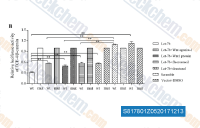
| S8178 | BML-284 Hydrochloride (Wnt agonist 1, AMBMP) | BML-284 (Wnt agonist 1) is a cell permeable Wnt signaling pathway activator, which induces β-catenin- and TCF-dependent transcriptional activity with EC50 of 0.7 μM. |
|
|
| S3630 | Methyl Vanillate | Methyl Vanillate, one of the ingredients in Hovenia dulcis Thunb, activates the Wnt/β-catenin pathway and induces osteoblast differentiation in vitro. |
|
|
| E4800 | BML-284 | BML-284 (Wnt Agonist) is a potent and cell-permeable activator of Wnt signaling that induces TCF-dependent transcriptional activity with an EC50 value of 0.7 µM. This compound also acts as an agonist of β-catenin that effectively activates direct Wnt-β-catenin signaling to induce adipocyte dedifferentiation while circumventing the apoptotic effect in the hypertonic treatment. | ||
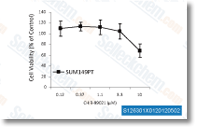
| S1263 | CHIR-99021 (Laduviglusib) | Laduviglusib (CHIR-99021, CT99021) is a GSK-3α and GSK-3β inhibitor with IC50 values of 10 nM and 6.7 nM, respectively. It does not exhibit cross-reactivity against cyclin-dependent kinases (CDKs) and shows a 350-fold selectivity toward GSK-3β compared to CDKs. This compound functions as a Wnt/β-catenin activator and induces autophagy. |
|
|
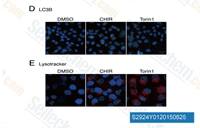
| S2924 | Laduviglusib (CHIR-99021) Hydrochloride | Laduviglusib (CHIR-99021; CT99021) HCl is hydrochloride of CHIR-99021, which is a GSK-3α/β inhibitor with IC50 of 10 nM/6.7 nM; CHIR-99021 shows greater than 500-fold selectivity for GSK-3 versus its closest homologs Cdc2 and ERK2. CHIR-99021 is a potent pharmacological activators of the Wnt/beta-catenin signaling pathway. CHIR-99021 significantly rescues light-induced autophagy and augments GR, RORα and autophagy-related proteins. |
|
|
| S7954 | CP21R7 | CP21R7 is a potent and selective GSK-3β inhibitor that can potently activate canonical Wnt signalling. |
|
|
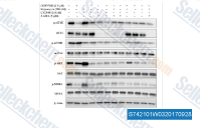
| S7421 | CGP 57380 | CGP 57380 is a potent MNK1 inhibitor with IC50 of 2.2 μM, exhibiting no inhibitory activity on p38, JNK1, ERK1 and -2, PKC, or c-Src-like kinases. This compound upregulates β-catenin and potentiates radiation-induced apoptosis. |
|
|
| S7914 | ISX-9 (Isoxazole 9) | Isoxazole 9 (Isx-9) is a synthetic promotor of adult neurogenesis by triggering neuronal differentiation of adult neural stem/precursor cells (NSPCs). Isoxazole 9 (Isx-9) activates multiple pathways including TGF-β induced epithelial–mesenchymal transition (EMT) signaling, canonical and non-canonical Wnt signaling at different stages of cardiac differentiation. |
|
|
| S3223 | L-Quebrachitol | L-Quebrachitol (L-QCT), a natural product isolated from many plants, promotes proliferation and cell DNA synthesis. This compound upregulates bone morphogenetic protein-2 (BMP-2) and runt-related transcription factor-2 (Runx2) and regulatory genes associated with mitogen-activated protein kinase (MAPK) and Wnt/β-catenin signaling pathway, while down-regulating the receptor activator of the nuclear factor-κB(NF-κB) ligand (RANKL) mRNA level. | ||
| E0072 | Indirubin-3′-oxime | Indirubin-3′-oxime (IDR3O, I3O) is an indirubin analogue that shows favorable inhibitory activity targeting GSK-3β and CDKs. This compound also inhibits JNKs with IC50s of 0.8 μM, 1.4 μM, and 1.0 μM for JNK1, JNK2, and JNK3, respectively. It activates Wnt/β-catenin signaling and inhibits adipocyte differentiation and obesity. | ||
| S6085 | KY19382 (A3051) | KY19382 (A3051) is a Wnt/β-catenin signalling activator through inhibitory effects on both CXXC5–DVL interaction and GSK3β activity with IC50s of 19 nM and 10 nM, respectively. | ||

Products are for research use only. Not for human use. We do not sell to patients.
©Copyright 2013 Selleck Chemicals. All Rights Reserved.