
-
 Australia
-
 Austria
-
 Belgium
-
 Brazil
-
 Canada
-
 China
China
-
 Czech Republic
-
 Denmark
-
 Finland
-
 France
-
 Germany
-
 Greece
-
 Hong Kong
-
 Hungary
-
 Iceland
-
 India
India
-
 Ireland
-
 Israel
-
 Italy
Italy
-
 Japan
Japan
-
 Korea
Korea
-
 Luxembourg
-
 Malaysia
-
 Netherlands
-
 New Zealand
-
 Norway
-
 Poland
-
 Qatar
Qatar
-
 Romania
-
 Saudi Arabia
-
 Singapore
-
 Spain
Spain
-
 Sweden
-
 Switzerland
-
 Taiwan
-
 Turkey
-
 United Kingdom
-
 United States
research use only
Tirbanibulin Src inhibitor
Cat.No.S2700
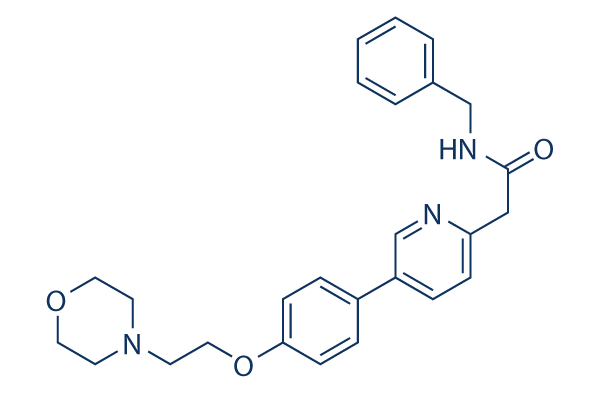
Chemical Structure
Molecular Weight: 431.53
Quality Control
| Related Targets | EGFR VEGFR JAK FGFR PDGFR HIF HER2 FLT3 FLT Bcr-Abl |
|---|---|
| Other Src Inhibitors | WH-4-023 Saracatinib (AZD0530) PP2 (AGL 1879) SU6656 PP1 Src Inhibitor 1 UM-164 RK 24466 eCF506 Tolimidone (MLR-1023) |
Cell Culture, Treatment & Working Concentration
| Cell Lines | Assay Type | Concentration | Incubation Time | Formulation | Activity Description | PMID |
|---|---|---|---|---|---|---|
| mouse NIH3T3 cells | Function assay | 3 days | Inhibition of constitutively active human c-SRC527F mutant-induced growth inhibition in mouse NIH3T3 cells after 3 days by MTT assay | |||
| Click to View More Cell Line Experimental Data | ||||||
Solubility
|
In vitro |
DMSO
: 86 mg/mL
(199.29 mM)
Water : Insoluble Ethanol : Insoluble |
Molarity Calculator
|
In vivo |
|||||
In vivo Formulation Calculator (Clear solution)
Step 1: Enter information below (Recommended: An additional animal making an allowance for loss during the experiment)
Step 2: Enter the in vivo formulation (This is only the calculator, not formulation. Please contact us first if there is no in vivo formulation at the solubility Section.)
Calculation results:
Working concentration: mg/ml;
Method for preparing DMSO master liquid: mg drug pre-dissolved in μL DMSO ( Master liquid concentration mg/mL, Please contact us first if the concentration exceeds the DMSO solubility of the batch of drug. )
Method for preparing in vivo formulation: Take μL DMSO master liquid, next addμL PEG300, mix and clarify, next addμL Tween 80, mix and clarify, next add μL ddH2O, mix and clarify.
Method for preparing in vivo formulation: Take μL DMSO master liquid, next add μL Corn oil, mix and clarify.
Note: 1. Please make sure the liquid is clear before adding the next solvent.
2. Be sure to add the solvent(s) in order. You must ensure that the solution obtained, in the previous addition, is a clear solution before proceeding to add the next solvent. Physical methods such
as vortex, ultrasound or hot water bath can be used to aid dissolving.
Chemical Information, Storage & Stability
| Molecular Weight | 431.53 | Formula | C26H29N3O3 |
Storage (From the date of receipt) | |
|---|---|---|---|---|---|
| CAS No. | 897016-82-9 | Download SDF | Storage of Stock Solutions |
|
|
| Synonyms | KX2-391,KX 01 | Smiles | C1COCCN1CCOC2=CC=C(C=C2)C3=CN=C(C=C3)CC(=O)NCC4=CC=CC=C4 | ||
Mechanism of Action
| Targets/IC50/Ki |
Src (HuH7)
(Cell-free assay) 9 nM(GI50)
Src (PLC/PRF/5)
(Cell-free assay) 13 nM(GI50)
Src (Hep 3B)
(Cell-free assay) 26 nM(GI50)
Src (Hep G2)
(Cell-free assay) 60 nM(GI50)
|
|---|---|
| In vitro |
KX2-391 is a Src inhibitor that is directed to the Src substrate pocket. KX2-391 shows steep dose-response curves against Huh7 (GI 50 = 9 nM), PLC/PRF/5 (GI 50 = 13 nM), Hep3B (GI 50 = 26 nM), and HepG2 (GI 50 = 60 nM), four hepatic cell cancer (HCC) cell lines. KX2-391 is found to inhibit certain leukemia cells that are resistant to current commercially available drugs, such as those derived from chronic leukemia cells with the T3151 mutation. KX2-391 is evaluated in engineered Src driven cell growth assays inNIH3T3/c-Src527F and SYF/c-Src527F cells and exhibits GI50 with 23 nM and 39 nM, respectively. |
| In vivo |
In pre-clinical animal models of cancer, orally administered KX2-391 is shown to inhibit primary tumor growth and to suppress metastasis. |
References |
|
Applications
| Methods | Biomarkers | Images | PMID |
|---|---|---|---|
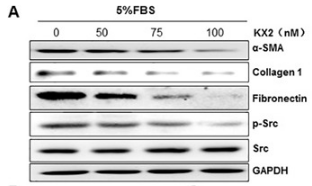
| Western blot | α-SMA / Collagen 1 / Fibronectin / p-Src / Src |
|
29137389 |
Clinical Trial Information
(data from https://clinicaltrials.gov, updated on 2024-05-22)
| NCT Number | Recruitment | Conditions | Sponsor/Collaborators | Start Date | Phases |
|---|---|---|---|---|---|
| NCT05900258 | Completed | Actinic Keratosis |
Medical University of Graz |
May 11 2023 | Phase 4 |
| NCT05741294 | Completed | Actinic Keratosis |
Almirall S.A. |
January 17 2023 | Phase 4 |
| NCT03575780 | Completed | Actinic Keratoses |
Athenex Inc.|TKL Research Inc. |
September 7 2018 | Phase 1 |
| NCT02838628 | Completed | Actinic Keratosis |
Almirall S.A.|Athenex Inc. |
April 11 2016 | Phase 2 |
Tech Support
Tel: +1-832-582-8158 Ext:3
If you have any other enquiries, please leave a message.
Frequently Asked Questions
Question 1:
How to formulate it for animal trials?
Answer:
It can be dissolved in 4% DMSO/corn oil at 5 mg/ml as a homogeneous suspension for oral administration and dissolved in 4% DMSO/30% PEG 300/ddH2O at 5 mg/ml as a clear solution.
Signaling Pathway Map

Products are for research use only. Not for human use. We do not sell to patients.
©Copyright 2013 Selleck Chemicals. All Rights Reserved.