
-
 Argentina
-
 Australia
-
 Austria
-
 Belgium
-
 Brazil
-
 Canada
-
 China
China
-
 Czech Republic
-
 Denmark
-
 Finland
-
 France
-
 Germany
-
 Greece
-
 Hong Kong
-
 Hungary
-
 Iceland
-
 India
India
-
 Ireland
-
 Israel
-
 Italy
Italy
-
 Japan
Japan
-
 Korea
Korea
-
 Luxembourg
-
 Malaysia
-
 Netherlands
-
 New Zealand
-
 Norway
-
 Poland
-
 Portugal
-
 Qatar
Qatar
-
 Romania
-
 Saudi Arabia
-
 Singapore
-
 Spain
Spain
-
 Sweden
-
 Switzerland
-
 Taiwan
-
 Turkey
-
 United Kingdom
-
 United States
research use only
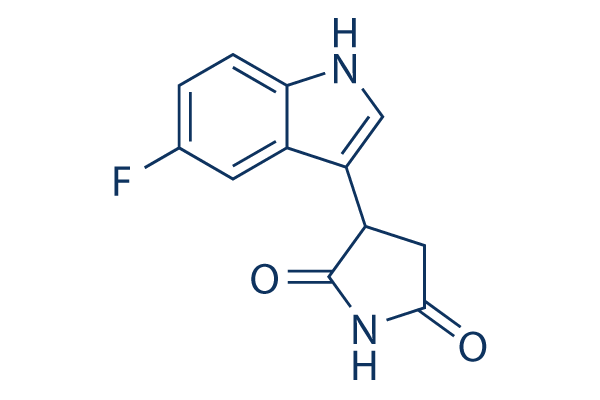
PF-06840003 IDO/TDO inhibitor
Cat.No.S8657
Quality Control
Solubility
|
In vitro |
DMSO
: 46 mg/mL
(198.09 mM)
Ethanol : 6 mg/mL Water : Insoluble |
Molarity Calculator
|
In vivo |
|||||
In vivo Formulation Calculator (Clear solution)
Step 1: Enter information below (Recommended: An additional animal making an allowance for loss during the experiment)
Step 2: Enter the in vivo formulation (This is only the calculator, not formulation. Please contact us first if there is no in vivo formulation at the solubility Section.)
Calculation results:
Working concentration: mg/ml;
Method for preparing DMSO master liquid: mg drug pre-dissolved in μL DMSO ( Master liquid concentration mg/mL, Please contact us first if the concentration exceeds the DMSO solubility of the batch of drug. )
Method for preparing in vivo formulation: Take μL DMSO master liquid, next addμL PEG300, mix and clarify, next addμL Tween 80, mix and clarify, next add μL ddH2O, mix and clarify.
Method for preparing in vivo formulation: Take μL DMSO master liquid, next add μL Corn oil, mix and clarify.
Note: 1. Please make sure the liquid is clear before adding the next solvent.
2. Be sure to add the solvent(s) in order. You must ensure that the solution obtained, in the previous addition, is a clear solution before proceeding to add the next solvent. Physical methods such
as vortex, ultrasound or hot water bath can be used to aid dissolving.
Chemical Information, Storage & Stability
| Molecular Weight | 232.21 | Formula | C12H9FN2O2 |
Storage (From the date of receipt) | |
|---|---|---|---|---|---|
| CAS No. | 198474-05-4 | Download SDF | Storage of Stock Solutions |
|
|
| Synonyms | EOS200271 | SMILES | C1C(C(=O)NC1=O)C2=CNC3=C2C=C(C=C3)F | ||
Read more about storage stability stock solution CAS number SMILES
Mechanism of Action
| Targets/IC50/Ki |
hIDO-1
(Cell-free) 0.41 μM
dIDO-1
(Cell-free) 0.59 μM
mIDO-1
(Cell-free) 1.5 μM
|
|---|---|
| In vitro |
PF-06840003 is a racemic mixture. The IC50s of this compound for hIDO-1, mouse IDO-1 and dog IDO-1 are 0.41, 1.5 and 0.59 μM, respectively. It has very weak activity against hTDO-2, with an IC50 of 140 μM. In cellular assays, this chemical shows activity both in the HeLa assay (IC50 1.8 μM) as well as in the LPS/INFγ-stimulated THP1 cells (IC50 1.7 μM). It is a very weak inhibitor of CYPs with IC50 values greater than 100 μM for most major CYP isozymes except 2C19 (IC50 value is 78 μM). Additionally, it does not exhibit metabolism-dependent (time-dependent and NADPH-dependent or time-dependent (NADPH-independent) inhibition of the major CYP enzymes investigated.
|
| In vivo |
PF-06840003 has a predicted half-life of 16−19 h. Oral bioavailability in the mouse and rat was 59 and 94%, respectively, and 19% in dog. This compound has shown significant antitumor activity in monotherapy in Pan02, B16−F10, CT26, MC38, 4T1, and Renca models (p < 0.05 vs vehicle-treated group) and very good synergy in combination with anti-PDL1 mAb in CT26 model (p < 0.05 vs monotherapy groups).The PK profile of the compound is excellent, with a low/moderate clearance in most preclinical species. It also shows good CNS penetration in rat, suggesting potential impact on brain metastases.
|
References |
Clinical Trial Information
(data from https://clinicaltrials.gov, updated on 2020-01-27)
| NCT Number | Recruitment | Conditions | Sponsor/Collaborators | Start Date | Phases |
|---|---|---|---|---|---|
| NCT02764151 | TERMINATED | Oligodendroglioma; Astrocytoma; Malignant Glioma |
Pfizer |
2016-09-09 | PHASE1 |
Read more about Clinical Trials
Tech Support
Tel: +1-832-582-8158 Ext:3
If you have any other enquiries, please leave a message.

Products are for research use only. Not for human use. We do not sell to patients.
©Copyright 2013 Selleck Chemicals. All Rights Reserved.