
-
 Argentina
-
 Australia
-
 Austria
-
 Belgium
-
 Brazil
-
 Canada
-
 China
China
-
 Czech Republic
-
 Denmark
-
 Finland
-
 France
-
 Germany
-
 Greece
-
 Hong Kong
-
 Hungary
-
 Iceland
-
 India
India
-
 Ireland
-
 Israel
-
 Italy
Italy
-
 Japan
Japan
-
 Korea
Korea
-
 Luxembourg
-
 Malaysia
-
 Netherlands
-
 New Zealand
-
 Norway
-
 Poland
-
 Portugal
-
 Qatar
Qatar
-
 Romania
-
 Saudi Arabia
-
 Singapore
-
 Spain
Spain
-
 Sweden
-
 Switzerland
-
 Taiwan
-
 Turkey
-
 United Kingdom
-
 United States
research use only
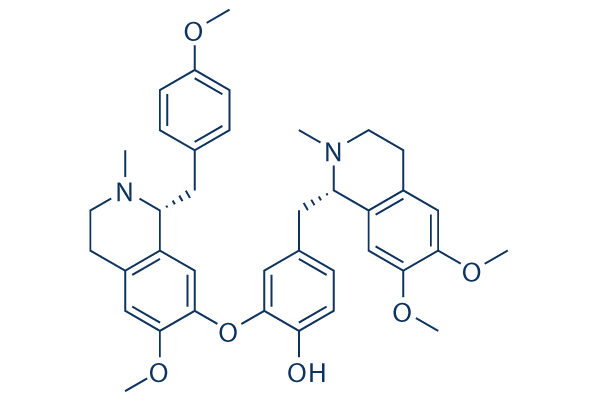
Neferine NF-κB inhibitor
Cat.No.S5144
Quality Control
| Related Targets | HDAC Antioxidant ROS IκB/IKK Nrf2 AP-1 MALT NOD |
|---|---|
| Other NF-κB Inhibitors | DCZ0415 Omaveloxolone (RTA-408) BAY 11-7082 (BAY 11-7821) JSH-23 QNZ (EVP4593) Caffeic Acid Phenethyl Ester SC75741 DHA (Dihydroartemisinin) Andrographolide CBL0137 |
Solubility
|
In vitro |
DMSO
: 100 mg/mL
(160.05 mM)
|
Molarity Calculator
|
In vivo |
|||||
In vivo Formulation Calculator (Clear solution)
Step 1: Enter information below (Recommended: An additional animal making an allowance for loss during the experiment)
Step 2: Enter the in vivo formulation (This is only the calculator, not formulation. Please contact us first if there is no in vivo formulation at the solubility Section.)
Calculation results:
Working concentration: mg/ml;
Method for preparing DMSO master liquid: mg drug pre-dissolved in μL DMSO ( Master liquid concentration mg/mL, Please contact us first if the concentration exceeds the DMSO solubility of the batch of drug. )
Method for preparing in vivo formulation: Take μL DMSO master liquid, next addμL PEG300, mix and clarify, next addμL Tween 80, mix and clarify, next add μL ddH2O, mix and clarify.
Method for preparing in vivo formulation: Take μL DMSO master liquid, next add μL Corn oil, mix and clarify.
Note: 1. Please make sure the liquid is clear before adding the next solvent.
2. Be sure to add the solvent(s) in order. You must ensure that the solution obtained, in the previous addition, is a clear solution before proceeding to add the next solvent. Physical methods such
as vortex, ultrasound or hot water bath can be used to aid dissolving.
Chemical Information, Storage & Stability
| Molecular Weight | 624.77 | Formula | C38H44N2O6 |
Storage (From the date of receipt) | |
|---|---|---|---|---|---|
| CAS No. | 2292-16-2 | Download SDF | Storage of Stock Solutions |
|
|
| Synonyms | (R)-1,2-Dimethoxyaporphine | SMILES | CN1CCC2=CC(=C(C=C2C1CC3=CC=C(C=C3)OC)OC4=C(C=CC(=C4)CC5C6=CC(=C(C=C6CCN5C)OC)OC)O)OC | ||
Read more about storage stability stock solution CAS number SMILES
Mechanism of Action
| Targets/IC50/Ki |
NF-κB
|
|---|---|
| In vitro |
Neferine induces reactive oxygen species mediated caspase-dependent apoptosis in liver and lung cancer cells, reverses the multidrug resistance in human breast cancer cells (MCF-7/ADM), human hepatocarcinoma (HepG2/ADR) and human gastric carcinoma cells (SGC7901/VCR). This compound enhances the cytotoxic potential of cisplatin in A549 cells and augments cisplatin inducecd Sub-G1 accumulation. It inhibits the migration and invasion of human lung cancer cells and lowers the antioxidant enzyme activities. This chemical sensitizes the lung cancer cells to cisplatin and induces apoptosis through G1 cell cycle arrest, upstream ROS production, depletion of cellular antioxidant pool, reduction of mitochondrial membrane potential (ΔΨm) with increased expression of Bax, Bad, Bak, down regulates the expression of Bcl2, release of cytochrome c, cleaved caspase-9, cleaved caspase-3 and PARP. |
| In vivo |
Neferine has an antifibrosis effect on CCl4-induced hepatic fibrosis in mice, possibly partly due to the decreased expression of TGF-β1 in the liver. The plasma concentration-time curves of this compound (10, 20 and 50 mg/kg, i.g.) shows double absorption peaks with the first peak at 10 min and the second peak at 1 h. The tβ1/2 are 15.6 h, 22.9 h and 35.5 h, for each of these doses, respectively. This compound distributes rapidly into different organ systems, with the highest concentrations found in the liver, followed by the lung, kidney and heart at doses of 10 or 20 mg/kg. At 50 mg/kg dose, concentrations of the kidney and lung are higher than those of others. Moreover, this compound is mainly metabolized in the liver and converted partially by CYP2D6 to liensinine, isoliensinine, desmethyl-liensinine and desmethyl-isoliensinine. |
References |
|
Tech Support
Tel: +1-832-582-8158 Ext:3
If you have any other enquiries, please leave a message.
Signaling Pathway Map

Products are for research use only. Not for human use. We do not sell to patients.
©Copyright 2013 Selleck Chemicals. All Rights Reserved.