
-
 Argentina
-
 Australia
-
 Austria
-
 Belgium
-
 Brazil
-
 Canada
-
 China
China
-
 Czech Republic
-
 Denmark
-
 Finland
-
 France
-
 Germany
-
 Greece
-
 Hong Kong
-
 Hungary
-
 Iceland
-
 India
India
-
 Ireland
-
 Israel
-
 Italy
Italy
-
 Japan
Japan
-
 Korea
Korea
-
 Luxembourg
-
 Malaysia
-
 Netherlands
-
 New Zealand
-
 Norway
-
 Poland
-
 Portugal
-
 Qatar
Qatar
-
 Romania
-
 Saudi Arabia
-
 Singapore
-
 Spain
Spain
-
 Sweden
-
 Switzerland
-
 Taiwan
-
 Turkey
-
 United Kingdom
-
 United States
research use only
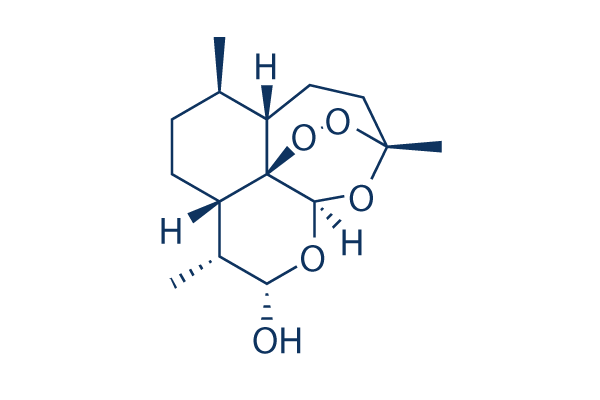
DHA (Dihydroartemisinin) NF-κB inhibitor
Cat.No.S2290
Quality Control
| Related Targets | HDAC Antioxidant ROS IκB/IKK Nrf2 AP-1 MALT NOD |
|---|---|
| Other NF-κB Inhibitors | DCZ0415 Omaveloxolone (RTA-408) BAY 11-7082 (BAY 11-7821) JSH-23 QNZ (EVP4593) Caffeic Acid Phenethyl Ester SC75741 Andrographolide CBL0137 Withaferin A (WFA) |
Solubility
|
In vitro |
DMSO
: 14 mg/mL
(49.23 mM)
Ethanol : 7 mg/mL Water : Insoluble |
Molarity Calculator
|
In vivo |
|||||
In vivo Formulation Calculator (Clear solution)
Step 1: Enter information below (Recommended: An additional animal making an allowance for loss during the experiment)
Step 2: Enter the in vivo formulation (This is only the calculator, not formulation. Please contact us first if there is no in vivo formulation at the solubility Section.)
Calculation results:
Working concentration: mg/ml;
Method for preparing DMSO master liquid: mg drug pre-dissolved in μL DMSO ( Master liquid concentration mg/mL, Please contact us first if the concentration exceeds the DMSO solubility of the batch of drug. )
Method for preparing in vivo formulation: Take μL DMSO master liquid, next addμL PEG300, mix and clarify, next addμL Tween 80, mix and clarify, next add μL ddH2O, mix and clarify.
Method for preparing in vivo formulation: Take μL DMSO master liquid, next add μL Corn oil, mix and clarify.
Note: 1. Please make sure the liquid is clear before adding the next solvent.
2. Be sure to add the solvent(s) in order. You must ensure that the solution obtained, in the previous addition, is a clear solution before proceeding to add the next solvent. Physical methods such
as vortex, ultrasound or hot water bath can be used to aid dissolving.
Chemical Information, Storage & Stability
| Molecular Weight | 284.35 | Formula | C15H24O5 |
Storage (From the date of receipt) | |
|---|---|---|---|---|---|
| CAS No. | 71939-50-9 | Download SDF | Storage of Stock Solutions |
|
|
Read more about storage stability stock solution CAS number
Mechanism of Action
| Targets/IC50/Ki |
NF-κB
|
|---|---|
| In vitro |
Dihydroartemisinin (DHA) inhibits the growth of certain cancer cell lines and xenograft tumors such as leukemia, glioma, fibrosarcoma, and breast, cervical, ovarian, lung, oral and pancreatic cancer. It inhibits cell and tumor growth by modulating various tumor-suppressive pathways, such as inhibiting cell proliferation and inducing apoptosis through regulation of proliferation- and apoptosis-related proteins.This compound inhibits the proliferation and viability of cells in a dose-dependent manner and induces apoptosis.Its mediated cytotoxicity is tumor selective. The endoperoxide bridge of DHA is reportedly essential for its cytotoxicity because it reacts with intracellular ferrous iron to generate reactive oxygen species or carbon-centered radicals, leading to cytotoxicity. |
| In vivo |
DHA (Dihydroartemisinin) significantly inhibited HCC cell growth in vitro and in vivo via inducing G2/M cell cycle arrest and apoptosis. In the rat whole embryo culture (WEC), this compound has been shown to primarily affect primitive red blood cells (RBCs) causing subsequent tissue damage and dysmorphogenesis. |
References |
|
Applications
| Methods | Biomarkers | Images | PMID |
|---|---|---|---|
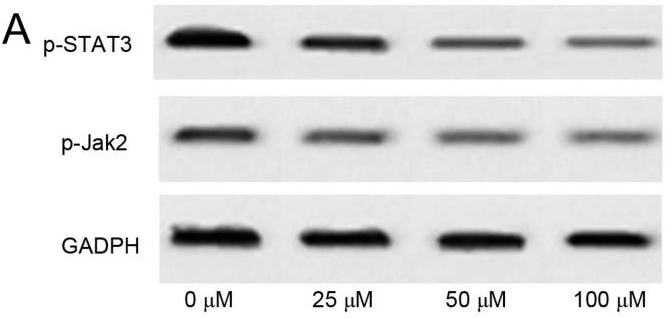
| Western blot | p-STAT3 / p-JAK2 MMP-2 / MMP-9 E-cadherin / N-cadherin / Vimentin / Twist / Slug / Snail |
|
29434895 |
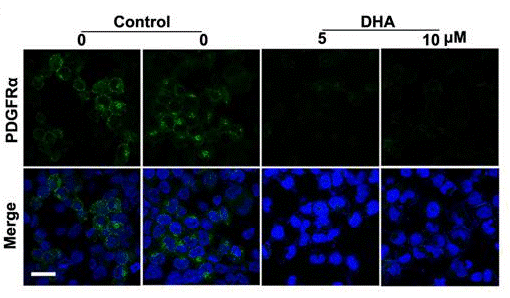
| Immunofluorescence | PDGFRα |
|
29387451 |
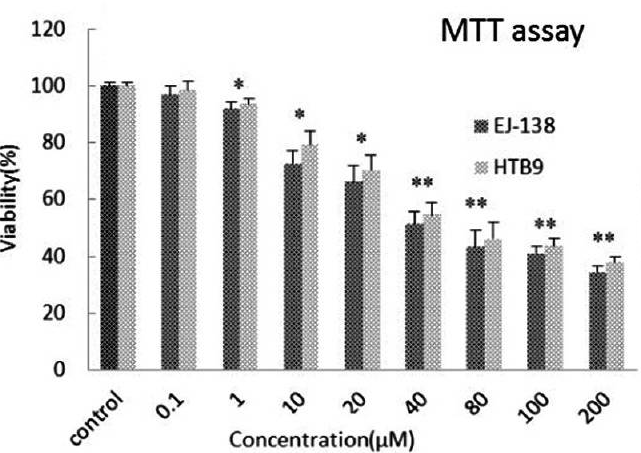
| Growth inhibition assay | Cell viability |
|
29114376 |
Clinical Trial Information
(data from https://clinicaltrials.gov, updated on 2026-01-07)
| NCT Number | Recruitment | Conditions | Sponsor/Collaborators | Start Date | Phases |
|---|---|---|---|---|---|
| NCT07322068 | NOT_YET_RECRUITING | Malaria, Falciparum |
Stanford University |
2026-09 | PHASE4 |
| NCT07575438 | NOT_YET_RECRUITING | Type 2 Diabetes; Prediabetes (Insulin Resistance, Impaired Glucose Tolerance); Prediabetes / Type 2 Diabetes; Obesity & Overweight; Obesity and Diabetes Mellitus, Type 2 |
May Faraj, PDt, PhD |
2026-07 | PHASE2 |
| NCT06933095 | RECRUITING | Eldery People; Cognitive Decline; Memory Decline; DHA CNS Delivery |
University of Cincinnati |
2024-09-15 | |
| NCT07246525 | NOT_YET_RECRUITING | Malaria |
University of California, San Francisco |
2026-08-01 | PHASE4 |
| NCT06736925 | RECRUITING | Subconcussive Head Impact; Omega-3 Fatty Acids |
Indiana University |
2025-02-28 | |
| NCT03965988 | RECRUITING | Breath Holding Attack |
Sherief Abd-Elsalam |
2018-05-01 | PHASE3 |
Read more about Clinical Trials
Tech Support
Tel: +1-832-582-8158 Ext:3
If you have any other enquiries, please leave a message.
Signaling Pathway Map

Products are for research use only. Not for human use. We do not sell to patients.
©Copyright 2013 Selleck Chemicals. All Rights Reserved.