
-
 Argentina
-
 Australia
-
 Austria
-
 Belgium
-
 Brazil
-
 Canada
-
 China
China
-
 Czech Republic
-
 Denmark
-
 Finland
-
 France
-
 Germany
-
 Greece
-
 Hong Kong
-
 Hungary
-
 Iceland
-
 India
India
-
 Ireland
-
 Israel
-
 Italy
Italy
-
 Japan
Japan
-
 Korea
Korea
-
 Luxembourg
-
 Malaysia
-
 Netherlands
-
 New Zealand
-
 Norway
-
 Poland
-
 Portugal
-
 Qatar
Qatar
-
 Romania
-
 Saudi Arabia
-
 Singapore
-
 Spain
Spain
-
 Sweden
-
 Switzerland
-
 Taiwan
-
 Turkey
-
 United Kingdom
-
 United States
research use only
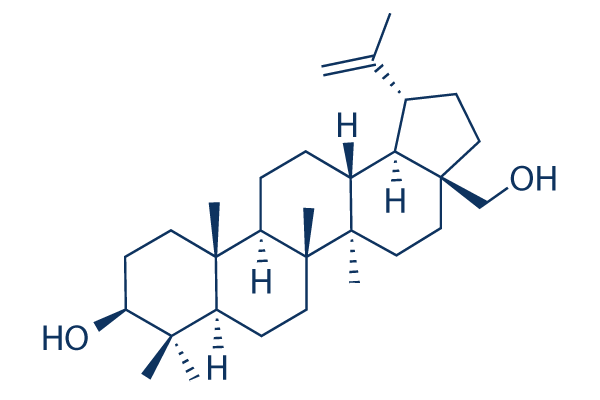
Betulin Fatty Acid Synthase inhibitor
Cat.No.S4754
Quality Control
| Related Targets | Dehydrogenase HSP Transferase P450 (e.g. CYP17) PDE phosphatase PPAR Vitamin Carbohydrate Metabolism Mitochondrial Metabolism |
|---|---|
| Other Fatty Acid Synthase Inhibitors | Denifanstat (TVB-2640) Fatostatin TVB-3664 C75 FT113 C75 trans Sodium palmitate IPI-9119 Desoxyrhaponticin Praeruptorin B |
Solubility
|
In vitro |
DMSO
: 7 mg/mL
(15.81 mM)
Water : Insoluble Ethanol : Insoluble |
Molarity Calculator
|
In vivo |
|||||
In vivo Formulation Calculator (Clear solution)
Step 1: Enter information below (Recommended: An additional animal making an allowance for loss during the experiment)
Step 2: Enter the in vivo formulation (This is only the calculator, not formulation. Please contact us first if there is no in vivo formulation at the solubility Section.)
Calculation results:
Working concentration: mg/ml;
Method for preparing DMSO master liquid: mg drug pre-dissolved in μL DMSO ( Master liquid concentration mg/mL, Please contact us first if the concentration exceeds the DMSO solubility of the batch of drug. )
Method for preparing in vivo formulation: Take μL DMSO master liquid, next addμL PEG300, mix and clarify, next addμL Tween 80, mix and clarify, next add μL ddH2O, mix and clarify.
Method for preparing in vivo formulation: Take μL DMSO master liquid, next add μL Corn oil, mix and clarify.
Note: 1. Please make sure the liquid is clear before adding the next solvent.
2. Be sure to add the solvent(s) in order. You must ensure that the solution obtained, in the previous addition, is a clear solution before proceeding to add the next solvent. Physical methods such
as vortex, ultrasound or hot water bath can be used to aid dissolving.
Chemical Information, Storage & Stability
| Molecular Weight | 442.72 | Formula | C30H50O2 |
Storage (From the date of receipt) | |
|---|---|---|---|---|---|
| CAS No. | 473-98-3 | Download SDF | Storage of Stock Solutions |
|
|
| Synonyms | betulinol, betuline, betulinic alcohol | SMILES | CC(=C)C1CCC2(C1C3CCC4C5(CCC(C(C5CCC4(C3(CC2)C)C)(C)C)O)C)CO | ||
Read more about storage stability stock solution CAS number SMILES
Mechanism of Action
| In vitro |
Betulin significantly inhibits cell viability in cervix carcinoma HeLa cells, hepatoma HepG2 cells, lung adenocarcinoma A549 cells, and breast cancer MCF-7 cells with IC50 values ranging from 10 to 15 mg/mL. While this compound exhibits only moderate anticancer activity in other human cancer cells such as hepatoma SK-HEP-1 cells, prostate carcinoma PC-3, and lung carcinoma NCI-H460, with IC50 values ranging from 20 to 60 mg/mL, it shows minor growth inhibition in human erythroleukemia K562 cells (IC50>100 mg/mL). This compound does not directly trigger mitochondrial cytochrome c release in isolated mitochondria. Bax and Bak are rapidly translocated to the mitochondria 30 min after betulin treatment. In vitro, it inhibits LPS-induced tumor necrosis factor α (TNF-α) and (interleukin) IL-6 levels and up-regulates the level of IL-10. Also this chemical suppresses the phosphorylation of nuclear factor-kB (NF-kB) p65 protein in LPS-stimulated RAW 264.7 cells.
|
|---|---|
| In vivo |
In vivo, Betulin alleviates LPS-induced acute lung injury. Treatment with this compound diminishes pro-inflammatory cytokines, myeloperoxidase activity and bacterial loads in lung tissue during gramnegative pneumonia. In HFD-fed apoE−/− mice, this compound administration significantly reduces lesions in en face aortas and aortic sinuses. Furthermore, this compound administration significantly increases ABCA1 expression and suppresses macrophage positive areas in the aortic sinuses. Moreover, this compound administration improves plasma lipid profiles and enhances fecal cholesterol excretion in the mice.
|
References |
|
Clinical Trial Information
(data from https://clinicaltrials.gov, updated on 2024-05-22)
| NCT Number | Recruitment | Conditions | Sponsor/Collaborators | Start Date | Phases |
|---|---|---|---|---|---|
| NCT01657292 | Completed | Burns |
Birken AG|Amryt Pharma |
2012-08 | Phase 3 |
Read more about Clinical Trials
Tech Support
Tel: +1-832-582-8158 Ext:3
If you have any other enquiries, please leave a message.

Products are for research use only. Not for human use. We do not sell to patients.
©Copyright 2013 Selleck Chemicals. All Rights Reserved.