Tyrosinase

Isoform-selective Products

  • All (24)
  • Tyrosinase Inhibitors (23)
  • Tyrosinase Activator (1)
  • New Tyrosinase Products
Cat.No. Product Name Information Product Use Citations Product Validations
S2263 Arbutin Arbutin (Uva, p-Arbutin, β-Arbutin) is a tyrosinase inhibitor with IC50 of 0.9 mM and 0.7 mM for Monophenolase and Diphenolase, respectively.
Transl Oncol, 2023, 35:101712
G3 (Bethesda), 2020, 4;10(5):1585-1597
Int J Mol Sci, 2017, 18(9)
S6237 2-Ketoglutaric acid (alpha-ketoglutarate) 2-Ketoglutaric acid (alpha-ketoglutarate) is a key molecule in the TCA cycle, playing a fundamental role in determining the overall rate of this important metabolic process. In the TCA cycle, it is decarboxylated to succinyl-CoA and carbon dioxide by AKG dehydrogenase, which functions as a key control point of the TCA cycle. This compound is a reversible inhibitor of tyrosinase.
Int J Biol Sci, 2021, 17(5):1250-1262
Front Cell Infect Microbiol, 2020, 10:599087
S3783 Echinacoside Echinacoside, a natural polyphenolic compound, has various biological activities, such as antioxidative, anti-inflammatory, neuroprotective, hepatoprotective, nitric oxide radical-scavenging and vasodilative actions. This compound, one of the phenylethanoids isolated from the stems of Cistanche salsa, elicits neuroprotection by activating Trk receptors and their downstream signal pathways. It also has a remarkable antiosteoporotic activity.
Antioxidants (Basel), 2023, 10.3390/antiox12111925
Naunyn Schmiedebergs Arch Pharmacol, 2020, 10.1007/s00210-020-02022-w
S1652 Monobenzone Monobenzone(Benoquin) is a compound used as a topical agent for medical depigmentation. It can specifically block tyrosinase.Monobenzone can be used to induce animal models of Vitiligo.
Front Genet, 2020, 11:1000
S4739 Oxyresveratrol Oxyresveratrol (Tetrahydroxystilbene, 2,3',4,5'-tetrahydroxystilbene), a naturally occurring compound particularly found in Morus alba L., exhibits a potent inhibitory effect on dopa oxidase activity of tyrosinase which catalyzes rate-limiting steps of melanin biosynthesis.
Int J Mol Sci, 2022, 23(23)15102
S5174 Kojic acid Kojic acid is a fungal metabolite that inhibits tyrosinase with an IC50 value of 30.6 µM for mushroom tyrosinase. It is a synthetic intermediate used for production of food additives.
Int J Mol Sci, 2017, 18(9)
S4132 Deoxyarbutin DeoxyArbutin(D-arbutin,D-Arb) is a reversible tyrosinase inhibitor, inhibiting tyrosinase activity with IC50 of 50 nM.
S4571 Hexylresorcinol Hexylresorcinol (4-Hexylresorcinol) is an organic compound with local anaesthetic, antiseptic and anthelmintic properties, and is a potent inhibitor of mushroom tyrosinase. The IC50 values of this compound for monophenolase is 1.24 μM and for diphenolase is 0.85 μM.
S6272 Glycolic acid Glycolic acid (dicarbonous acid, hydroxyacetic acid, hydroacetic acid) is the smallest alpha-hydroxy acid. Due to its excellent capability to penetrate skin, this compound is often used in skin care products, most often as a chemical peel. It is an inhibitor of tyrosinase, suppressing melanin formation and lead to a lightening of skin colour.
E2861 Kojic acid dipalmitate Kojic acid is a slow-binding inhibitor of catecholase activity of tyrosinase with a Ki of 2.75 µM.
S2375 Aloin (Barbaloin) Aloin (Barbaloin), a natural anthracycline from Aloe vera, is a tyrosinase inhibitor.
Cytotechnology, 2025, 77(4):137
Nat Prod Commun, 2023, 18(5): 1–11
Nan Fang Yi Ke Da Xue Xue Bao, 2023, 43(5):702-709
S9284 Aloesin Aloesin (Aloe resin B) is a kind of herbal extraction form the aloe vera. It is a strong inhibitor of tyrosinase activity and up-regulates cyclin E-dependent kinase activity in vitro.
S4997 4-Butylresorcinol 4-Butylresorcinol (4-n-Butylresorcinol, Rucinol) is a potent inhibitor of tyrosinase and is used in cosmetics as a depigmenting agent.
S3691 4-Chlorosalicylic acid 4-Chlorosalicylic acid (4-Chloro-2-hydroxybenzoic acid, 4-chloro salicylic acid) was used in sensitive spectrofluorometric determination of terbium in mixed rare earths and preparation of poly(4-chlorosalicylic acid-formaldehyde) via condensation with formaldehyde. This compound is a pharmaceutical intermediate. It inhibits monophenolase and diphenolase activity with IC50s of 1.89 mM and 1.10 mM. It has potent antimicrobial activity. It is active against E. coli with the MIC of 250 μg/mL and with the MBC of 500 μg/mL.
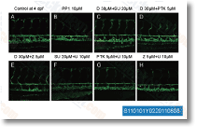
E2908 1-PHENYL-2-THIOUREA 1-PHENYL-2-THIOUREA(N-Phenylthiourea, PTU, Phenylthiocarbamide) is an inhibitor of tyrosinase (Tyr). This compound blocks pigmentation and improves optical transparency in zebrafish (Danio rerio) embryo.
S9089 Magnoflorine Magnoflorine (Escholin, Thalictrin), an important compound in Aristolochia, was usually used as an anxiolytic chemical. It shows significant antioxidant activity as a DPPH free radical scavenger and inhibits α-tyrosinase.
S3166 Calcium 2-oxoglutarate Calcium 2-oxoglutarate (Calcium oxoglurate, Calcium 2-oxopentanedioate, Calcium α-ketoglutarate, Calcium AKG, Calcium 2-ketoglutaric acid, Calcium oxoglutaric acid) is the Calcium salt form of 2-oxoglutarate. 2-oxoglutarate is naturally found in organisms and is a well-known intermediate in the production of ATP or GTP in the Krebs cycle. 2-oxoglutarate is a reversible inhibitor of tyrosinase with IC50 of 15 mM.
S9111 Isorhamnetin Isorhamnetin (3-methylquercetin, 3'-Methoxyquercetin, Isorhamnetol), a natural flavonol aglycon, is a tyrosinase inhibitor and has antioxidant activity.
Front Pharmacol, 2023, 14:1290868
Anat Rec (Hoboken), 2020, 10.1002/ar.24506
S9376 Benzylacetone Benzylacetone (4-Phenyl-2-butanone, Methyl 2-phenylethyl ketone) is an attractant compound in flowers. This compound exhibits potent and reversible antityrosinase (mushroom) activity, with IC50s of 2.8 mM and 0.6 mM for monophenolase and diphenolase, respectively.
S6221 Methyl cinnamate Methyl cinnamate, an active component of Zanthoxylum armatum, is a widely used natural flavor compound with antimicrobial and tyrosinase inhibitor activities. Methyl Cinnamate Inhibits Adipocyte Differentiation via Activation of the CaMKK2--AMPK Pathway in 3T3-L1 Preadipocytes.
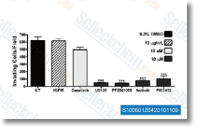
S1021 Dasatinib Dasatinib is a novel, potent and multi-targeted inhibitor that targets Abl, Src and c-Kit, with IC50 of <1 nM, 0.8 nM and 79 nM in cell-free assays, respectively. Dasatinib induces autophagy and apoptosis with anti-tumor activity.
Cancer Cell, 2025, S1535-6108(25)00070-4
Mil Med Res, 2025, 12(1):83
Nat Commun, 2025, 16(1):4069
Verified customer review of Dasatinib
S1005 Axitinib (AG-013736) Axitinib is a multi-target inhibitor of VEGFR1, VEGFR2, VEGFR3, PDGFRβ and c-Kit with IC50 of 0.1 nM, 0.2 nM, 0.1-0.3 nM, 1.6 nM and 1.7 nM in Porcine aorta endothelial cells, respectively.
Cancer Cell, 2025, S1535-6108(25)00070-4
Chem Biol Interact, 2025, 418:111628
Development, 2025, 152(13)dev204684
Verified customer review of Axitinib (AG-013736)
S4921 MNS (3,4-Methylenedioxy-β-nitrostyrene) MNS (3,4-Methylenedioxy-β-nitrostyrene) is a tyrosine kinase inhibitor that inhibits Syk, Src, and p97 with IC50 values of 2.5 μM, 29.3 μM, and 1.7 μM, respectively.
Journal of Biomedical Engineering, 2021, 38(5):903-910
Phytomedicine, 2019, 61:152859
J Biomol Struct Dyn, 2019, 10.1080/07391102.2019.1640133
Verified customer review of MNS (3,4-Methylenedioxy-β-nitrostyrene)
E1509 Bezuclastinib Bezuclastinib(CGT9486; PLX 9486) is a potent inhibitor of c-kit and c-kit D816V with an IC50 value of <1 μM. This compound is also an inhibitor of tyrosine kinase.
S2263 Arbutin Arbutin (Uva, p-Arbutin, β-Arbutin) is a tyrosinase inhibitor with IC50 of 0.9 mM and 0.7 mM for Monophenolase and Diphenolase, respectively.
Transl Oncol, 2023, 35:101712
G3 (Bethesda), 2020, 4;10(5):1585-1597
Int J Mol Sci, 2017, 18(9)
S6237 2-Ketoglutaric acid (alpha-ketoglutarate) 2-Ketoglutaric acid (alpha-ketoglutarate) is a key molecule in the TCA cycle, playing a fundamental role in determining the overall rate of this important metabolic process. In the TCA cycle, it is decarboxylated to succinyl-CoA and carbon dioxide by AKG dehydrogenase, which functions as a key control point of the TCA cycle. This compound is a reversible inhibitor of tyrosinase.
Int J Biol Sci, 2021, 17(5):1250-1262
Front Cell Infect Microbiol, 2020, 10:599087
S1652 Monobenzone Monobenzone(Benoquin) is a compound used as a topical agent for medical depigmentation. It can specifically block tyrosinase.Monobenzone can be used to induce animal models of Vitiligo.
Front Genet, 2020, 11:1000
S4739 Oxyresveratrol Oxyresveratrol (Tetrahydroxystilbene, 2,3',4,5'-tetrahydroxystilbene), a naturally occurring compound particularly found in Morus alba L., exhibits a potent inhibitory effect on dopa oxidase activity of tyrosinase which catalyzes rate-limiting steps of melanin biosynthesis.
Int J Mol Sci, 2022, 23(23)15102
S5174 Kojic acid Kojic acid is a fungal metabolite that inhibits tyrosinase with an IC50 value of 30.6 µM for mushroom tyrosinase. It is a synthetic intermediate used for production of food additives.
Int J Mol Sci, 2017, 18(9)
S4132 Deoxyarbutin DeoxyArbutin(D-arbutin,D-Arb) is a reversible tyrosinase inhibitor, inhibiting tyrosinase activity with IC50 of 50 nM.
S4571 Hexylresorcinol Hexylresorcinol (4-Hexylresorcinol) is an organic compound with local anaesthetic, antiseptic and anthelmintic properties, and is a potent inhibitor of mushroom tyrosinase. The IC50 values of this compound for monophenolase is 1.24 μM and for diphenolase is 0.85 μM.
S6272 Glycolic acid Glycolic acid (dicarbonous acid, hydroxyacetic acid, hydroacetic acid) is the smallest alpha-hydroxy acid. Due to its excellent capability to penetrate skin, this compound is often used in skin care products, most often as a chemical peel. It is an inhibitor of tyrosinase, suppressing melanin formation and lead to a lightening of skin colour.
E2861 Kojic acid dipalmitate Kojic acid is a slow-binding inhibitor of catecholase activity of tyrosinase with a Ki of 2.75 µM.
S2375 Aloin (Barbaloin) Aloin (Barbaloin), a natural anthracycline from Aloe vera, is a tyrosinase inhibitor.
Cytotechnology, 2025, 77(4):137
Nat Prod Commun, 2023, 18(5): 1–11
Nan Fang Yi Ke Da Xue Xue Bao, 2023, 43(5):702-709
S9284 Aloesin Aloesin (Aloe resin B) is a kind of herbal extraction form the aloe vera. It is a strong inhibitor of tyrosinase activity and up-regulates cyclin E-dependent kinase activity in vitro.
S4997 4-Butylresorcinol 4-Butylresorcinol (4-n-Butylresorcinol, Rucinol) is a potent inhibitor of tyrosinase and is used in cosmetics as a depigmenting agent.
S3691 4-Chlorosalicylic acid 4-Chlorosalicylic acid (4-Chloro-2-hydroxybenzoic acid, 4-chloro salicylic acid) was used in sensitive spectrofluorometric determination of terbium in mixed rare earths and preparation of poly(4-chlorosalicylic acid-formaldehyde) via condensation with formaldehyde. This compound is a pharmaceutical intermediate. It inhibits monophenolase and diphenolase activity with IC50s of 1.89 mM and 1.10 mM. It has potent antimicrobial activity. It is active against E. coli with the MIC of 250 μg/mL and with the MBC of 500 μg/mL.
E2908 1-PHENYL-2-THIOUREA 1-PHENYL-2-THIOUREA(N-Phenylthiourea, PTU, Phenylthiocarbamide) is an inhibitor of tyrosinase (Tyr). This compound blocks pigmentation and improves optical transparency in zebrafish (Danio rerio) embryo.
S9089 Magnoflorine Magnoflorine (Escholin, Thalictrin), an important compound in Aristolochia, was usually used as an anxiolytic chemical. It shows significant antioxidant activity as a DPPH free radical scavenger and inhibits α-tyrosinase.
S3166 Calcium 2-oxoglutarate Calcium 2-oxoglutarate (Calcium oxoglurate, Calcium 2-oxopentanedioate, Calcium α-ketoglutarate, Calcium AKG, Calcium 2-ketoglutaric acid, Calcium oxoglutaric acid) is the Calcium salt form of 2-oxoglutarate. 2-oxoglutarate is naturally found in organisms and is a well-known intermediate in the production of ATP or GTP in the Krebs cycle. 2-oxoglutarate is a reversible inhibitor of tyrosinase with IC50 of 15 mM.
S9111 Isorhamnetin Isorhamnetin (3-methylquercetin, 3'-Methoxyquercetin, Isorhamnetol), a natural flavonol aglycon, is a tyrosinase inhibitor and has antioxidant activity.
Front Pharmacol, 2023, 14:1290868
Anat Rec (Hoboken), 2020, 10.1002/ar.24506
S9376 Benzylacetone Benzylacetone (4-Phenyl-2-butanone, Methyl 2-phenylethyl ketone) is an attractant compound in flowers. This compound exhibits potent and reversible antityrosinase (mushroom) activity, with IC50s of 2.8 mM and 0.6 mM for monophenolase and diphenolase, respectively.
S6221 Methyl cinnamate Methyl cinnamate, an active component of Zanthoxylum armatum, is a widely used natural flavor compound with antimicrobial and tyrosinase inhibitor activities. Methyl Cinnamate Inhibits Adipocyte Differentiation via Activation of the CaMKK2--AMPK Pathway in 3T3-L1 Preadipocytes.
S1021 Dasatinib Dasatinib is a novel, potent and multi-targeted inhibitor that targets Abl, Src and c-Kit, with IC50 of <1 nM, 0.8 nM and 79 nM in cell-free assays, respectively. Dasatinib induces autophagy and apoptosis with anti-tumor activity.
Cancer Cell, 2025, S1535-6108(25)00070-4
Mil Med Res, 2025, 12(1):83
Nat Commun, 2025, 16(1):4069
Verified customer review of Dasatinib
S1005 Axitinib (AG-013736) Axitinib is a multi-target inhibitor of VEGFR1, VEGFR2, VEGFR3, PDGFRβ and c-Kit with IC50 of 0.1 nM, 0.2 nM, 0.1-0.3 nM, 1.6 nM and 1.7 nM in Porcine aorta endothelial cells, respectively.
Cancer Cell, 2025, S1535-6108(25)00070-4
Chem Biol Interact, 2025, 418:111628
Development, 2025, 152(13)dev204684
Verified customer review of Axitinib (AG-013736)
S4921 MNS (3,4-Methylenedioxy-β-nitrostyrene) MNS (3,4-Methylenedioxy-β-nitrostyrene) is a tyrosine kinase inhibitor that inhibits Syk, Src, and p97 with IC50 values of 2.5 μM, 29.3 μM, and 1.7 μM, respectively.
Journal of Biomedical Engineering, 2021, 38(5):903-910
Phytomedicine, 2019, 61:152859
J Biomol Struct Dyn, 2019, 10.1080/07391102.2019.1640133
Verified customer review of MNS (3,4-Methylenedioxy-β-nitrostyrene)
E1509 Bezuclastinib Bezuclastinib(CGT9486; PLX 9486) is a potent inhibitor of c-kit and c-kit D816V with an IC50 value of <1 μM. This compound is also an inhibitor of tyrosine kinase.
S3783 Echinacoside Echinacoside, a natural polyphenolic compound, has various biological activities, such as antioxidative, anti-inflammatory, neuroprotective, hepatoprotective, nitric oxide radical-scavenging and vasodilative actions. This compound, one of the phenylethanoids isolated from the stems of Cistanche salsa, elicits neuroprotection by activating Trk receptors and their downstream signal pathways. It also has a remarkable antiosteoporotic activity.
Antioxidants (Basel), 2023, 10.3390/antiox12111925
Naunyn Schmiedebergs Arch Pharmacol, 2020, 10.1007/s00210-020-02022-w