
-
 Australia
-
 Austria
-
 Belgium
-
 Brazil
-
 Canada
-
 China
China
-
 Czech Republic
-
 Denmark
-
 Finland
-
 France
-
 Germany
-
 Greece
-
 Hong Kong
-
 Hungary
-
 Iceland
-
 India
India
-
 Ireland
-
 Israel
-
 Italy
Italy
-
 Japan
Japan
-
 Korea
Korea
-
 Luxembourg
-
 Malaysia
-
 Netherlands
-
 New Zealand
-
 Norway
-
 Poland
-
 Qatar
Qatar
-
 Romania
-
 Saudi Arabia
-
 Singapore
-
 Spain
Spain
-
 Sweden
-
 Switzerland
-
 Taiwan
-
 Turkey
-
 United Kingdom
-
 United States
research use only
Bisindolylmaleimide IX (Ro 31-8220) Mesylate PKC inhibitor
Cat.No.S7207
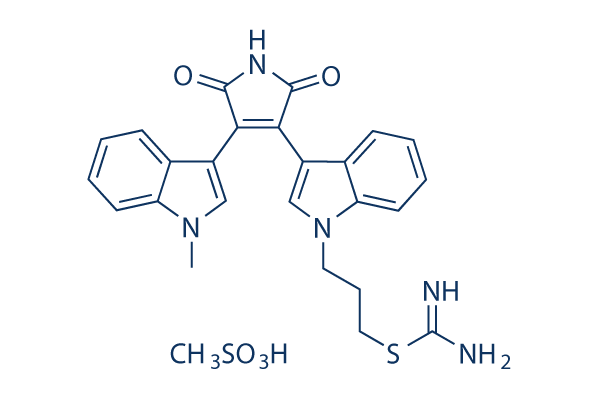
Chemical Structure
Molecular Weight: 553.65
Quality Control
Cell Culture, Treatment & Working Concentration
| Cell Lines | Assay Type | Concentration | Incubation Time | Formulation | Activity Description | PMID |
|---|---|---|---|---|---|---|
| Sf9 | Function assay | Inhibition of His-tagged human MSK1 expressed in Sf9 cells, IC50=0.008μM | 10998351 | |||
| Sf21 | Function assay | Inhibition of His-tagged human GSK3b expressed in Sf21 cells, IC50=0.038μM | 10998351 | |||
| HCT116 | Antiproliferative assay | 48 hrs | Antiproliferative activity against human HCT116 cells over expressing RSK2 after 48 hrs by MTT assay, IC50=0.84μM | 21488662 | ||
| PC3 | Cytotoxicity assay | 48 hrs | Cytotoxicity against human PC3 cells assessed as growth inhibition after 48 hrs by MTT assay, IC50=1.74μM | 23434140 | ||
| MDA-MB-231 | Antiproliferative assay | 48 hrs | Antiproliferative activity against human MDA-MB-231 cells over expressing RSK2 after 48 hrs by MTT assay, IC50=1.77μM | 21488662 | ||
| MCF7 | Antiproliferative assay | 48 hrs | Antiproliferative activity against human MCF7 cells over expressing RSK2 after 48 hrs by MTT assay, IC50=1.96μM | 21488662 | ||
| MCF7 | Cytotoxicity assay | 48 hrs | Cytotoxicity against human MCF7 cells assessed as growth inhibition after 48 hrs by MTT assay, IC50=1.96μM | 23434140 | ||
| DE3 | Function assay | Inhibition of human full length SIRT1 expressed in DE3 cells by fluorimetric assay, IC50=25μM | 19734050 | |||
| A549 | Function assay | Inhibition of SIRT2 in A549 cells assessed as ability to induce hyperacetylation of tubulin by Western blot analysis | 17149860 | |||
| A549 | Function assay | 10 uM | Inhibition of SIRT2 in A549 cells assessed as ability to induce hyperacetylation of tubulin at 10 uM by Western blot analysis | 17149860 | ||
| MCF7 | Function assay | 10 uM | 16 hrs | Inhibition of SIRT2 in human MCF7 cells assessed as tubulin hyperacetylation at 10 uM after 16 hrs by Western blot | 20030343 | |
| Click to View More Cell Line Experimental Data | ||||||
Solubility
|
In vitro |
DMSO
: 100 mg/mL
(180.61 mM)
Water : Insoluble Ethanol : Insoluble |
Molarity Calculator
|
In vivo |
|||||
In vivo Formulation Calculator (Clear solution)
Step 1: Enter information below (Recommended: An additional animal making an allowance for loss during the experiment)
Step 2: Enter the in vivo formulation (This is only the calculator, not formulation. Please contact us first if there is no in vivo formulation at the solubility Section.)
Calculation results:
Working concentration: mg/ml;
Method for preparing DMSO master liquid: mg drug pre-dissolved in μL DMSO ( Master liquid concentration mg/mL, Please contact us first if the concentration exceeds the DMSO solubility of the batch of drug. )
Method for preparing in vivo formulation: Take μL DMSO master liquid, next addμL PEG300, mix and clarify, next addμL Tween 80, mix and clarify, next add μL ddH2O, mix and clarify.
Method for preparing in vivo formulation: Take μL DMSO master liquid, next add μL Corn oil, mix and clarify.
Note: 1. Please make sure the liquid is clear before adding the next solvent.
2. Be sure to add the solvent(s) in order. You must ensure that the solution obtained, in the previous addition, is a clear solution before proceeding to add the next solvent. Physical methods such
as vortex, ultrasound or hot water bath can be used to aid dissolving.
Chemical Information, Storage & Stability
| Molecular Weight | 553.65 | Formula | C25H23N5O2S.CH4O3S |
Storage (From the date of receipt) | |
|---|---|---|---|---|---|
| CAS No. | 138489-18-6 | Download SDF | Storage of Stock Solutions |
|
|
Mechanism of Action
| Targets/IC50/Ki |
PKCα
(Cell-free assay) 5 nM
PKCβ2
(Cell-free assay) 14 nM
PKCβ1
(Cell-free assay) 24 nM
PKCε
(Cell-free assay) 24 nM
PKCγ
(Cell-free assay) 27 nM
|
|---|---|
| In vitro |
Ro 31-8220 inhibits rat brain PKC activity with IC50 of 23 nM, and does not show any high degree of selectivity between PKC-α, PKC-β, PKC-γ, and PKC-ε. Ro 31-8220 also inhibits MSK1, MAPKAPK1, RSK, GSK3β and S6K1 with a potency similar to that for PKC. In addition, Ro 31-8220 inhibits voltage-dependent Na+ channels. Ro 31-8220 alters cellular protein kinase C localization and potently inhibits growth of A549 and MCF-7 cells with IC50 of 0.78 μM and 0.897 μM, respectively. RO 31-8220 enhances epinephrine-induced platelet aggregation in catecholamine hypo-responsive platelets by enhancing Akt phosphorylation. Ro 31-8220 significantly decreases apoE secretion from primary human macrophages by inhibiting vesicular transport of apoE to the plasma membrane without significantly affecting apoE mRNA or apoE protein levels.
|
| Kinase Assay |
Assay of PKC Activity
|
|
Assay mixtures contain 0.2 mg/mL peptide-gamma, 10 μM MgCl2, 0.6 mM CaCl2, 10 μM [γ-32P]ATP, 1.25 mg/mL phosphatidylserine and 1.25 ng/mL phorbol 12-myristate 13-acetate in 20 mM Hepes (pH 7.5), 2 mM EDTA, 1 mM dithiothreitol and 0.02% (w/v) Triton X-100. Peptide-γ is a synthetic peptide, GPRPLFCRKGSLRQKW, resembling the PKC-γ pseudosubstrate site, except that a serine residue replaces the pseudosubstrate alanine, converting the peptide from an inhibitor into a substrat. The assays are started by the addition of 2.5 m-units of enzyme, incubated at 30 °C for 10 min and terminated by spotting on to P81 paper, followed by extensive washing in 75 mM orthophosphoric acid. The papers are then washed in ethanol, dried, and incorporated radioactivity is determined by liquidscintillation spectroscopy.
|
|
| In vivo |
In MLP−/− Mice, Ro 31-8220 (6 mg/kg/d, s.c.) results in a significant increase in cardiac contractility.
|
References |
|
Tech Support
Tel: +1-832-582-8158 Ext:3
If you have any other enquiries, please leave a message.
Signaling Pathway Map

Products are for research use only. Not for human use. We do not sell to patients.
©Copyright 2013 Selleck Chemicals. All Rights Reserved.