
-
 Argentina
-
 Australia
-
 Austria
-
 Belgium
-
 Brazil
-
 Canada
-
 China
China
-
 Czech Republic
-
 Denmark
-
 Finland
-
 France
-
 Germany
-
 Greece
-
 Hong Kong
-
 Hungary
-
 Iceland
-
 India
India
-
 Ireland
-
 Israel
-
 Italy
Italy
-
 Japan
Japan
-
 Korea
Korea
-
 Luxembourg
-
 Malaysia
-
 Netherlands
-
 New Zealand
-
 Norway
-
 Poland
-
 Portugal
-
 Qatar
Qatar
-
 Romania
-
 Saudi Arabia
-
 Singapore
-
 Spain
Spain
-
 Sweden
-
 Switzerland
-
 Taiwan
-
 Turkey
-
 United Kingdom
-
 United States
research use only
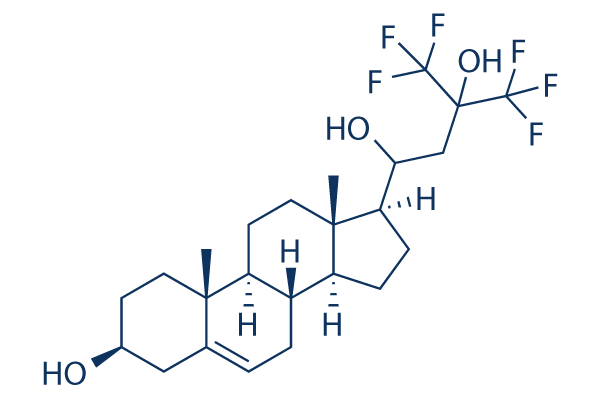
NSC12 FGFR inhibitor
Cat.No.S7940
Quality Control
| Related Targets | EGFR VEGFR JAK PDGFR Src HIF FLT3 HER2 FLT Bcr-Abl |
|---|---|
| Other FGFR Inhibitors | PD173074 AZD4547 (Fexagratinib) BLU9931 Futibatinib (TAS-120) LY2874455 H3B-6527 PD-166866 Fisogatinib (BLU-554) Zoligratinib (Debio-1347) SSR128129E |
Solubility
|
In vitro |
Ethanol : 63 mg/mL
DMSO
: 10.3 mg/mL
(21.25 mM)
Water : Insoluble |
Molarity Calculator
|
In vivo |
|||||
In vivo Formulation Calculator (Clear solution)
Step 1: Enter information below (Recommended: An additional animal making an allowance for loss during the experiment)
Step 2: Enter the in vivo formulation (This is only the calculator, not formulation. Please contact us first if there is no in vivo formulation at the solubility Section.)
Calculation results:
Working concentration: mg/ml;
Method for preparing DMSO master liquid: mg drug pre-dissolved in μL DMSO ( Master liquid concentration mg/mL, Please contact us first if the concentration exceeds the DMSO solubility of the batch of drug. )
Method for preparing in vivo formulation: Take μL DMSO master liquid, next addμL PEG300, mix and clarify, next addμL Tween 80, mix and clarify, next add μL ddH2O, mix and clarify.
Method for preparing in vivo formulation: Take μL DMSO master liquid, next add μL Corn oil, mix and clarify.
Note: 1. Please make sure the liquid is clear before adding the next solvent.
2. Be sure to add the solvent(s) in order. You must ensure that the solution obtained, in the previous addition, is a clear solution before proceeding to add the next solvent. Physical methods such
as vortex, ultrasound or hot water bath can be used to aid dissolving.
Chemical Information, Storage & Stability
| Molecular Weight | 484.52 | Formula | C24H34F6O3 |
Storage (From the date of receipt) | |
|---|---|---|---|---|---|
| CAS No. | 102586-30-1 | Download SDF | Storage of Stock Solutions |
|
|
| Synonyms | NSC 172285 | SMILES | CC12CCC3C(C1CCC2C(CC(C(F)(F)F)(C(F)(F)F)O)O)CC=C4C3(CCC(C4)O)C | ||
Read more about storage stability stock solution CAS number SMILES
Mechanism of Action
| Targets/IC50/Ki |
FGF3
(Cell-free assay) 15.9 μM(Kd)
FGF8b
(Cell-free assay) 18.9 μM(Kd)
FGF22
(Cell-free assay) 26.8 μM(Kd)
FGF20
(Cell-free assay) 29.4 μM(Kd)
FGF2/FGFR
(Cell-free assay) 30 μM
FGF2
(Cell-free assay) 51 μM(Kd)
FGF16
(Cell-free assay) 53.7 μM(Kd)
FGF6
(Cell-free assay) 53.8 μM(Kd)
FGF18
(Cell-free assay) 63.4 μM(Kd)
FGF4
(Cell-free assay) 119 μM(Kd)
|
|---|---|
| In vitro |
NSC12 inhibits FGF-dependent tumor growth, angiogenesis, and metastases. This compound does not affect FGF2/heparin interaction, whereas it inhibits the binding of FGF2 to the immobilized receptor (ID50 ∼30 μM). It interferes with FGF2/FGFR1 interaction without affecting the ability of the growth factor to interact with heparin or HSPGs. This chemical also binds immobilized FGF3, FGF4, FGF6, FGF8, FGF16, FGF18, FGF20, and FGF22 with Kd values ranging between ∼16 and ∼120 μM. It may act as a multi-FGF trap by interacting with all members of the canonical FGF subfamilies. This compound hampers FGF23-mediated FGFR1 activation in Klotho-expressing Chinese hamster ovary (CHO) cells. Treatment with it causes the reduction of the S phase of the cell cycle in all tumor cell lines but LLC cells, in which an accumulation in the S phase is observed. It inhibits FGFR1, FGFR2, FGFR3, and FGFR4 phosphorylation in CHO cell transfectants. This inhibitor reduces the proliferation of various FGF-dependent murine and human cancer cell lines with no inhibitory effect on HCC827 cancer cells that harbor a tumor-driving mutation of the EGFR TK domain and on FGF-independent cancer cell lines.
|
| In vivo |
Parenteral and oral delivery of NSC12 inhibits FGFR activation, tumor growth, angiogenesis, and metastasis in FGF-dependent murine and human tumor models. This compound causes a significant decrease of tumor weight, tumor cell FGFR1 phosphorylation and proliferation, and tumor CD31+ neovascularization at all the doses tested in the animal models.
|
References |
Tech Support
Tel: +1-832-582-8158 Ext:3
If you have any other enquiries, please leave a message.
Signaling Pathway Map

Products are for research use only. Not for human use. We do not sell to patients.
©Copyright 2013 Selleck Chemicals. All Rights Reserved.