
-
 Australia
-
 Austria
-
 Belgium
-
 Brazil
-
 Canada
-
 China
China
-
 Czech Republic
-
 Denmark
-
 Finland
-
 France
-
 Germany
-
 Greece
-
 Hong Kong
-
 Hungary
-
 Iceland
-
 India
India
-
 Ireland
-
 Israel
-
 Italy
Italy
-
 Japan
Japan
-
 Korea
Korea
-
 Luxembourg
-
 Malaysia
-
 Netherlands
-
 New Zealand
-
 Norway
-
 Poland
-
 Qatar
Qatar
-
 Romania
-
 Saudi Arabia
-
 Singapore
-
 Spain
Spain
-
 Sweden
-
 Switzerland
-
 Taiwan
-
 Turkey
-
 United Kingdom
-
 United States
research use only
Carvacrol AChR inhibitor
Cat.No.S3788
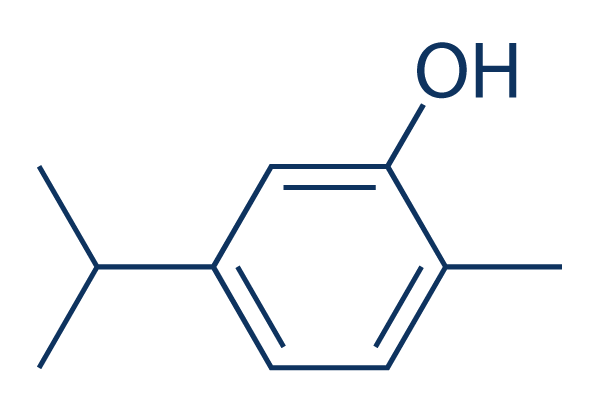
Chemical Structure
Molecular Weight: 150.22
Quality Control
Solubility
|
In vitro |
DMSO
: 30 mg/mL
(199.7 mM)
Ethanol : 30 mg/mL Water : Insoluble |
Molarity Calculator
|
In vivo |
|||||
In vivo Formulation Calculator (Clear solution)
Step 1: Enter information below (Recommended: An additional animal making an allowance for loss during the experiment)
Step 2: Enter the in vivo formulation (This is only the calculator, not formulation. Please contact us first if there is no in vivo formulation at the solubility Section.)
Calculation results:
Working concentration: mg/ml;
Method for preparing DMSO master liquid: mg drug pre-dissolved in μL DMSO ( Master liquid concentration mg/mL, Please contact us first if the concentration exceeds the DMSO solubility of the batch of drug. )
Method for preparing in vivo formulation: Take μL DMSO master liquid, next addμL PEG300, mix and clarify, next addμL Tween 80, mix and clarify, next add μL ddH2O, mix and clarify.
Method for preparing in vivo formulation: Take μL DMSO master liquid, next add μL Corn oil, mix and clarify.
Note: 1. Please make sure the liquid is clear before adding the next solvent.
2. Be sure to add the solvent(s) in order. You must ensure that the solution obtained, in the previous addition, is a clear solution before proceeding to add the next solvent. Physical methods such
as vortex, ultrasound or hot water bath can be used to aid dissolving.
Chemical Information, Storage & Stability
| Molecular Weight | 150.22 | Formula | C10H14O |
Storage (From the date of receipt) | 2 years -20°C liquid |
|---|---|---|---|---|---|
| CAS No. | 499-75-2 | Download SDF | Storage of Stock Solutions |
|
|
Mechanism of Action
| In vitro |
Carvacrol (CVC) possesses weak antioxidant and cytotoxic activity in cultured primary rat neurons. In addition, this compound has weak antioxidant properties and little anticancer potentials in rat N2a neuroblastoma cell line. It is a novel inhibitor of transient receptor potential (TRP) channels in drosophila and mammalian. In human hepatoma HepG2 cells, this chemical induces cell apoptosis by selectively decreasing phosphorylation of extracellular signal-regulated kinase 1/2 (ERK1/2) and P38; In human macrophage-like U937 cells, in response to lipopolysaccharide treatment, it activates peroxisome proliferator-activated receptors (PPAR alpha and gamma) and suppresses cyclooxygenase-2 (COX-2) mRNA and protein expression.
|
|---|---|
| In vivo |
Carvacrol has the ability to protect liver against ischemia/reperfusion injury in rats. In the central nervous system, this compound is regarded as a potential drug for Alzheimer's disease due to its inhibitory effect on acetylcholinesterase (AChE) activity by using phenolic hydroxyl group of carvacrol to bind to AChE and leading to a loss of function of AChE. In addition, it is found to have an antidepressant-like effect in mice by affecting the dopaminergic system. Dietary carvacrol supplementation prevents high fat diet-induced obesity by modulating gene expressions that lead to adipogenesis and inflammation. This chemical crosses the blood-brain barrier easily and rapidly.
|
References |
|
Tech Support
Tel: +1-832-582-8158 Ext:3
If you have any other enquiries, please leave a message.
Signaling Pathway Map

Products are for research use only. Not for human use. We do not sell to patients.
©Copyright 2013 Selleck Chemicals. All Rights Reserved.