
- Bioactive Compounds
- By Signaling Pathways
- PI3K/Akt/mTOR
- Epigenetics
- Methylation
- Immunology & Inflammation
- Protein Tyrosine Kinase
- Angiogenesis
- Apoptosis
- Autophagy
- ER stress & UPR
- JAK/STAT
- MAPK
- Cytoskeletal Signaling
- Cell Cycle
- TGF-beta/Smad
- Compound Libraries
- Antibodies
- Bioreagents
- qPCR
- 2x SYBR Green qPCR Master Mix
- 2x SYBR Green qPCR Master Mix(Low ROX)
- 2x SYBR Green qPCR Master Mix(High ROX)
- Protein Assay
- Protein A/G Magnetic Beads for IP
- Anti-Flag magnetic beads
- Anti-Flag Affinity Gel
- Anti-Myc magnetic beads
- Anti-HA magnetic beads
- Poly FLAG Peptide lyophilized powder
- Protease Inhibitor Cocktail
- Protease Inhibitor Cocktail (EDTA-Free, 100X in DMSO)
- Phosphatase Inhibitor Cocktail (2 Tubes, 100X)
- Cell Biology
- Cell Counting Kit-8 (CCK-8)
- Animal Experiment
- Mouse Direct PCR Kit (For Genotyping)
- New Products
- Contact Us
-
 Australia
-
 Austria
-
 Belgium
-
 Brazil
-
 Canada
-
 China
China
-
 Czech Republic
-
 Denmark
-
 Finland
-
 France
-
 Germany
-
 Greece
-
 Hong Kong
-
 Hungary
-
 Iceland
-
 India
India
-
 Ireland
-
 Israel
-
 Italy
Italy
-
 Japan
Japan
-
 Korea
Korea
-
 Luxembourg
-
 Malaysia
-
 Netherlands
-
 New Zealand
-
 Norway
-
 Poland
-
 Qatar
Qatar
-
 Romania
-
 Saudi Arabia
-
 Singapore
-
 Spain
Spain
-
 Sweden
-
 Switzerland
-
 Taiwan
-
 Turkey
-
 United Kingdom
-
 United States
-
 Other Countries

MC1568
MC1568 is a selective HDAC inhibitor for maize HD1-A with IC50 of 100 nM in a cell-free assay. It is 34-fold more selective for HD1-A than HD1-B.
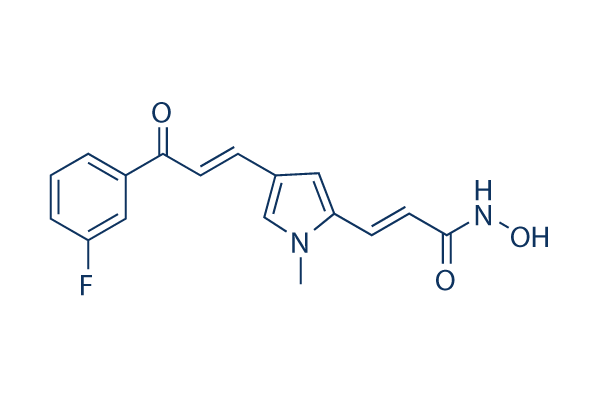
MC1568 Chemical Structure
CAS: 852475-26-4
Selleck's MC1568 has been cited by 48 publications
Purity & Quality Control
Batch:
Purity:
99.51%
99.51
MC1568 Related Products
| Related Targets | HDAC1 HDAC2 HDAC3 HDAC4 HDAC5 HDAC6 HDAC7 HDAC8 HDAC9 HDAC10 HDAC11 HD1 HD2 | Click to Expand |
|---|---|---|
| Related Compound Libraries | Kinase Inhibitor Library Angiogenesis Related compound Library TGF-beta/Smad compound library Cytoskeletal Signaling Pathway Compound Library Anti-Cardiovascular Disease Compound Library | Click to Expand |
Signaling Pathway
Choose Selective HDAC Inhibitors
Biological Activity
| Description | MC1568 is a selective HDAC inhibitor for maize HD1-A with IC50 of 100 nM in a cell-free assay. It is 34-fold more selective for HD1-A than HD1-B. | ||||
|---|---|---|---|---|---|
| Targets |
|
| In vitro | ||||
| In vitro | MC1568 is a selective class II (IIa) histone deacetylas (HDAC II) inhibitor with IC50 of 220 nM and 176-fold class II selectivity (against class I). In human breast cancer ZR-75.1 cell lysates, MC1568 (5 μM) shows no inhibitory activity against HDAC1 but is able to inhibit HDAC4. [1] In MCF-7 cells, MC1568 (20 μM) increases the accumulation of acetylated H3 and H4 histones, as well as the levels of acetyl-tubulin, which indicates a inhibitory effect of MC1568 on HDAC6. [2] In C2C12 cells, MC1568 (5 μM) arrests myogenesis by decreasing myocyte enhancer factor 2D (MEF2D) expression, stabilizing the HDAC4-HDAC3-MEF2D complex, and by inhibiting differentiation-induced MEF2D acetylation. [3] MC1568 (5 or 10 μM) interferes with the RAR- and PPARγ-mediated differentiation-inducing signaling pathways. In F9 cells, MC1568 specifically blocks endodermal differentiation despite not affecting retinoic acid-induced maturation of promyelocytic NB4 cells. In 3T3-L1 cells, MC1568 attenuates PPARγ-induced adipogenesis. [4] | |||
|---|---|---|---|---|
| Kinase Assay | Maize HD2, HD1-B, and HD1-A Enzyme Inhibition. | |||
| The enzyme liberats tritiated acetic acid from the substrate, which is quantified by scintillation counting. IC50 values are results of triple determinations. A 50 μL sample of maize enzyme (at 30 °C) is incubated (30 min) with 10 μL of total [3H]acetate-prelabeled chicken reticulocyte histones (2 mg/mL). Reaction is stopped by addition of 50 μL of 1 M HCl/0.4 M acetate and 800 μL of ethyl acetate. After centrifugation (1×10⁴ g, 5 min), an aliquot of 600 μL of the upper phase is counted for radioactivity in 3 mL of liquid scintillation cocktail. MC1568 is tested at a starting concentration of 40 μM, and active substances are diluted further. NaB, VPA, TSA, SAHA, 85 TPX, HC-toxin, and tubacin are used as the reference compounds, and blank solvents are used as negative controls. | ||||
| Cell Research | Cell lines | 3T3-L1 cells | ||
| Concentrations | ~10 μM, dissolved in DMSO | |||
| Incubation Time | 8 days | |||
| Method | The 3T3-L1 cells are propagated and differentiated using a cocktail of isobutylmethylxanthine, dexamethasone, and insulin. From the second day post-confluence and throughout the differentiation period of 8 days, the 3T3-L1 cells are induced by: (1) no induction: at post-confluence and throughout the differentiation period of 8 days, the cells are incubated with DMSO or MC1568. (2) troglitazone: at post-confluence and throughout the differentiation period of 8 days, the cells are induced with 5 μM troglitazone, MC1568, or both. (3) rosiglitazone: at post-confluence and throughout the differentiation period of 8 days, the cells are incubated with 1 μM rosiglitazone and either DMSO or MC1568. (4) rosiglitazone and dexamethasone: at post-confluence, the cells received 1 μM of rosiglitazone and 390 ng/mL dexamethasone. Throughout the differentiation period of 8 days, the cells are induced with 1 μM of rosiglitazone and either DMSO or MC1568. All medium is renewed every second day. | |||
| In Vivo | ||
| In vivo | In mice, MC1568 (50 mg/kg) shows an apparent tissue-selective HDAC inhibition. In skeletal muscle and heart, MC1568 inhibits the activity of HDAC4 and HDAC5 without affecting HDAC3 activity, thereby leaving MEF2-HDAC complexes in a repressed state. [3] In reporting PPRE-Luc mice, MC1568 (50 mg/kg) impairs PPARγ signaling mostly in the heart and adipose tissues. [4] In a recent study of pancreatic explants, MC1568 enhances expression of Pax4, a key factor required for proper β-and δ-cell differentiation and amplifies endocrine β- and δ-cells. [5] | |
|---|---|---|
| Animal Research | Animal Models | PPRE-Luc transgenic mouse (C57BL/6) |
| Dosages | 50 mg/kg | |
| Administration | By gavage once a day | |
Chemical Information & Solubility
| Molecular Weight | 314.31 | Formula | C17H15FN2O3 |
| CAS No. | 852475-26-4 | SDF | Download MC1568 SDF |
| Smiles | CN1C=C(C=C1C=CC(=O)NO)C=CC(=O)C2=CC(=CC=C2)F | ||
| Storage (From the date of receipt) | |||
|
In vitro |
DMSO : 22 mg/mL ( (69.99 mM); Moisture-absorbing DMSO reduces solubility. Please use fresh DMSO.) Water : Insoluble Ethanol : Insoluble |
Molecular Weight Calculator |
|
In vivo Add solvents to the product individually and in order. |
In vivo Formulation Calculator |
||||
Preparing Stock Solutions
Molarity Calculator
In vivo Formulation Calculator (Clear solution)
Step 1: Enter information below (Recommended: An additional animal making an allowance for loss during the experiment)
mg/kg
g
μL
Step 2: Enter the in vivo formulation (This is only the calculator, not formulation. Please contact us first if there is no in vivo formulation at the solubility Section.)
% DMSO
%
% Tween 80
% ddH2O
%DMSO
%
Calculation results:
Working concentration: mg/ml;
Method for preparing DMSO master liquid: mg drug pre-dissolved in μL DMSO ( Master liquid concentration mg/mL, Please contact us first if the concentration exceeds the DMSO solubility of the batch of drug. )
Method for preparing in vivo formulation: Take μL DMSO master liquid, next addμL PEG300, mix and clarify, next addμL Tween 80, mix and clarify, next add μL ddH2O, mix and clarify.
Method for preparing in vivo formulation: Take μL DMSO master liquid, next add μL Corn oil, mix and clarify.
Note: 1. Please make sure the liquid is clear before adding the next solvent.
2. Be sure to add the solvent(s) in order. You must ensure that the solution obtained, in the previous addition, is a clear solution before proceeding to add the next solvent. Physical methods such
as vortex, ultrasound or hot water bath can be used to aid dissolving.
Tech Support
Answers to questions you may have can be found in the inhibitor handling instructions. Topics include how to prepare stock solutions, how to store inhibitors, and issues that need special attention for cell-based assays and animal experiments.
Tel: +1-832-582-8158 Ext:3
If you have any other enquiries, please leave a message.
* Indicates a Required Field
Tags: buy MC1568 | MC1568 supplier | purchase MC1568 | MC1568 cost | MC1568 manufacturer | order MC1568 | MC1568 distributor



Products are for research use only. Not for human use. We do not sell to patients.
©Copyright 2013 Selleck Chemicals. All Rights Reserved.