
-
 Argentina
-
 Australia
-
 Austria
-
 Belgium
-
 Brazil
-
 Canada
-
 China
China
-
 Czech Republic
-
 Denmark
-
 Finland
-
 France
-
 Germany
-
 Greece
-
 Hong Kong
-
 Hungary
-
 Iceland
-
 India
India
-
 Ireland
-
 Israel
-
 Italy
Italy
-
 Japan
Japan
-
 Korea
Korea
-
 Luxembourg
-
 Malaysia
-
 Netherlands
-
 New Zealand
-
 Norway
-
 Poland
-
 Portugal
-
 Qatar
Qatar
-
 Romania
-
 Saudi Arabia
-
 Singapore
-
 Spain
Spain
-
 Sweden
-
 Switzerland
-
 Taiwan
-
 Turkey
-
 United Kingdom
-
 United States
research use only
GSK690693 pan-Akt Inhibitor
Cat.No.S1113
Quality Control
| Related Targets | PI3K mTOR GSK-3 ATM/ATR DNA-PK AMPK PDPK1 PTEN PI4K PP2A |
|---|---|
| Other Akt Inhibitors | SC79 AZD5363 (Capivasertib) MK-2206 Dihydrochloride Ipatasertib (GDC-0068) Perifosine Triciribine (API-2) Afuresertib (GSK2110183) CCT128930 A-674563 HCl AKTi-1/2 (AKT Inhibitor VIII) |
Cell Culture, Treatment & Working Concentration
| Cell Lines | Assay Type | Concentration | Incubation Time | Formulation | Activity Description | PMID |
|---|---|---|---|---|---|---|
| LNCaP | Proliferation assay | Antiproliferative activity against human LNCaP cells, IC50=20 nM | 18800763 | |||
| BT474 | Proliferation assay | Antiproliferative activity against human BT474 cells, IC50=50 nM | 18800763 | |||
| Sf9 | Function assay | Inhibition of human recombinant ROCK1 expressed in Sf9 cells, IC50=0.89 μM | 18800763 | |||
| NCI-H460 | Growth inhibition assay | 72 h | Growth inhibition of human NCI-H460 cells after 72 hrs by coulter counter method, IC50=5.4 μM | 24900862 | ||
| PC3 | Proliferation assay | 72 h | Antiproliferative activity against human PC3 cells after 72 hrs by MTT assay, IC50=15.5 μM | 24308997 | ||
| HFF | Cytotoxic assay | Cytotoxicity against HFF cells, IC50=16.3 μM | 18800763 | |||
| LNCAP | Antiproliferative assay | Antiproliferative activity against human LNCAP cells, IC50 = 0.021 μM. | 19179070 | |||
| BT474 | Antiproliferative assay | Antiproliferative activity against human BT474 cells, IC50 = 0.069 μM. | 19179070 | |||
| BT474 | Function assay | Inhibition of GSK3-beta phosphorylation in human BT474 cells, IC50 = 0.138 μM. | 19179070 | |||
| JVM2 | Antiproliferative assay | 72 hrs | Antiproliferative activity against human JVM2 cells after 72 hrs by CellTiter Glo assay, IC50 = 1.6 μM. | 28704757 | ||
| JeKo1 | Antiproliferative assay | 72 hrs | Antiproliferative activity against human JeKo1 cells after 72 hrs by CellTiter Glo assay, IC50 = 3 μM. | 28704757 | ||
| Z138 | Antiproliferative assay | 72 hrs | Antiproliferative activity against human Z138 cells after 72 hrs by CellTiter Glo assay, IC50 = 3.1 μM. | 28704757 | ||
| SP49 | Antiproliferative assay | 72 hrs | Antiproliferative activity against human SP49 cells after 72 hrs by CellTiter Glo assay, IC50 = 4.8 μM. | 28704757 | ||
| Maver1 | Antiproliferative assay | 72 hrs | Antiproliferative activity against human Maver1 cells after 72 hrs by CellTiter Glo assay, IC50 = 5.1 μM. | 28704757 | ||
| C6 | Function assay | 24 hrs | Inhibition of Akt in rat C6 cells after 24 hrs by ELISA, IC50 = 6.97 μM. | 29966916 | ||
| C6 | Cytotoxicity assay | 24 hrs | Cytotoxicity against rat C6 cells assessed as decrease in cell viability after 24 hrs by MTT assay, IC50 = 14.5 μM. | 29966916 | ||
| A549 | Function assay | 24 hrs | Inhibition of Akt in human A549 cells after 24 hrs by ELISA, IC50 = 17.33 μM. | 29966916 | ||
| Mino | Antiproliferative assay | 72 hrs | Antiproliferative activity against human Mino cells after 72 hrs by CellTiter Glo assay, IC50 = 20.8 μM. | 28704757 | ||
| A673 | qHTS assay | qHTS of pediatric cancer cell lines to identify multiple opportunities for drug repurposing: Primary screen for A673 cells | 29435139 | |||
| RD | qHTS assay | qHTS of pediatric cancer cell lines to identify multiple opportunities for drug repurposing: Primary screen for RD cells | 29435139 | |||
| NB1643 | qHTS assay | qHTS of pediatric cancer cell lines to identify multiple opportunities for drug repurposing: Primary screen for NB1643 cells | 29435139 | |||
| SJ-GBM2 | qHTS assay | qHTS of pediatric cancer cell lines to identify multiple opportunities for drug repurposing: Primary screen for SJ-GBM2 cells | 29435139 | |||
| SK-N-MC | qHTS assay | qHTS of pediatric cancer cell lines to identify multiple opportunities for drug repurposing: Primary screen for SK-N-MC cells | 29435139 | |||
| NB-EBc1 | qHTS assay | qHTS of pediatric cancer cell lines to identify multiple opportunities for drug repurposing: Primary screen for NB-EBc1 cells | 29435139 | |||
| LAN-5 | qHTS assay | qHTS of pediatric cancer cell lines to identify multiple opportunities for drug repurposing: Primary screen for LAN-5 cells | 29435139 | |||
| MCL | Antiproliferative assay | 24 hrs | Antiproliferative activity against primary human MCL cells up to 60 uM after 24 hrs by CellTiter Glo assay | 28704757 | ||
| Click to View More Cell Line Experimental Data | ||||||
Solubility
|
In vitro |
DMSO
: 21 mg/mL
(49.35 mM)
Water : Insoluble Ethanol : Insoluble |
Molarity Calculator
|
In vivo |
|||||
In vivo Formulation Calculator (Clear solution)
Step 1: Enter information below (Recommended: An additional animal making an allowance for loss during the experiment)
Step 2: Enter the in vivo formulation (This is only the calculator, not formulation. Please contact us first if there is no in vivo formulation at the solubility Section.)
Calculation results:
Working concentration: mg/ml;
Method for preparing DMSO master liquid: mg drug pre-dissolved in μL DMSO ( Master liquid concentration mg/mL, Please contact us first if the concentration exceeds the DMSO solubility of the batch of drug. )
Method for preparing in vivo formulation: Take μL DMSO master liquid, next addμL PEG300, mix and clarify, next addμL Tween 80, mix and clarify, next add μL ddH2O, mix and clarify.
Method for preparing in vivo formulation: Take μL DMSO master liquid, next add μL Corn oil, mix and clarify.
Note: 1. Please make sure the liquid is clear before adding the next solvent.
2. Be sure to add the solvent(s) in order. You must ensure that the solution obtained, in the previous addition, is a clear solution before proceeding to add the next solvent. Physical methods such
as vortex, ultrasound or hot water bath can be used to aid dissolving.
Chemical Information, Storage & Stability
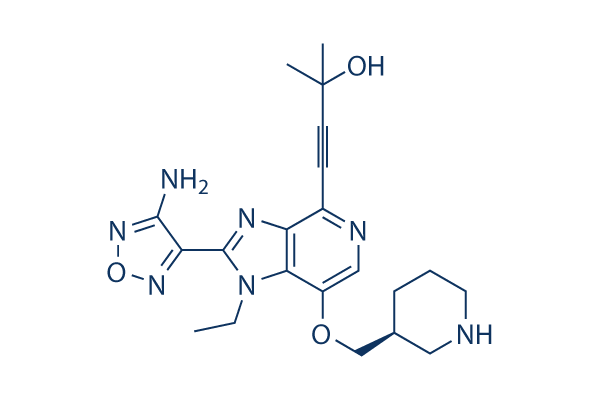
| Molecular Weight | 425.48 | Formula | C21H27N7O3 |
Storage (From the date of receipt) | |
|---|---|---|---|---|---|
| CAS No. | 937174-76-0 | Download SDF | Storage of Stock Solutions |
|
|
| Synonyms | N/A | SMILES | CCN1C2=C(C(=NC=C2OCC3CCCNC3)C#CC(C)(C)O)N=C1C4=NON=C4N | ||
Read more about storage stability stock solution CAS number SMILES
Mechanism of Action
| Targets/IC50/Ki |
ULK1
STING
AMPK
Akt1
(Cell-free assay) 2 nM
PKCη
(Cell-free assay) 2 nM
PKCθ
(Cell-free assay) 2 nM
PrkX
(Cell-free assay) 5 nM
Akt3
(Cell-free assay) 9 nM
Akt2
(Cell-free assay) 13 nM
PKCδ
(Cell-free assay) 14 nM
PKCβ
(Cell-free assay) 19 nM
PKCε
(Cell-free assay) 21 nM
PKA
(Cell-free assay) 24 nM
PKG1β
(Cell-free assay) 33 nM
|
|---|---|
| In vitro |
GSK690693 is very selective for the Akt isoforms versus the majority of kinases in other families. However, this compound is less selective for members of the AGC kinase family including PKA, PrkX, and PKC isozymes with IC50 of 24 nM, 5 nM, and 2-21 nM, respectively. It also potently inhibits AMPK and DAPK3 from the CAMK family with IC50 of 50 nM and 81 nM, respectively, and PAK4, 5, and 6 from the STE family with IC50 of 10 nM, 52 nM, and 6 nM, respectively. This chemical inhibits the phosphorylation of GSK3β in tumor cells with IC50 ranging from 43 nM to 150 nM. Its treatment leads to a dose-dependent increase in the nuclear accumulation of the transcription factor FOXO3A. This compound potently inhibits the proliferation of T47D, ZR-75-1, BT474, HCC1954, MDA-MB-453, and LNCaP cells with IC50 of 72 nM, 79 nM, 86 nM, 119 nM, 975 nM, and 147 nM, respectively. Its treatment induces apoptosis at concentrations >100 nM in both LNCaP and BT474 cells. Consistent with the role of AKT in cell survival, it induces apoptosis in sensitive ALL cell lines. |
| Kinase Assay |
In vitro kinase assays
|
|
His-tagged full-length Akt1, 2, or 3 are expressed and purified from baculovirus. Activation is carried out with purified PDK1 to phosphorylate Thr308 and purified MK2 to phosphorylate Ser473. To more accurately measure time-dependent inhibition of Akt, activated Akt enzymes are incubated with GSK690693 at various concentrations at room temperature for 30 minutes before the reaction is initiated with the addition of substrate. Final reaction contains 5 nM to 15 nM Akt1, 2, and 3 enzymes; 2 μM ATP; 0.15 μCi/μL[γ-33P]ATP; 1 μM Peptide (Biotin-aminohexanoicacid-ARKR-ERAYSFGHHA-amide); 10 mM MgCl2; 25 mM MOPS (pH 7.5); 1 mM DTT; 1 mM CHAPS; and 50 mM KCl. The reactions are incubated at room temperature for 45 minutes, followed by termination with Leadseeker beads in PBS containing EDTA (final concentration, 2 mg/mL beads and 75 mM EDTA). The plates are then sealed, the beads are allowed to settle for at least 5 hours, and product formation is quantitated using a Viewlux Imager.
|
|
| In vivo |
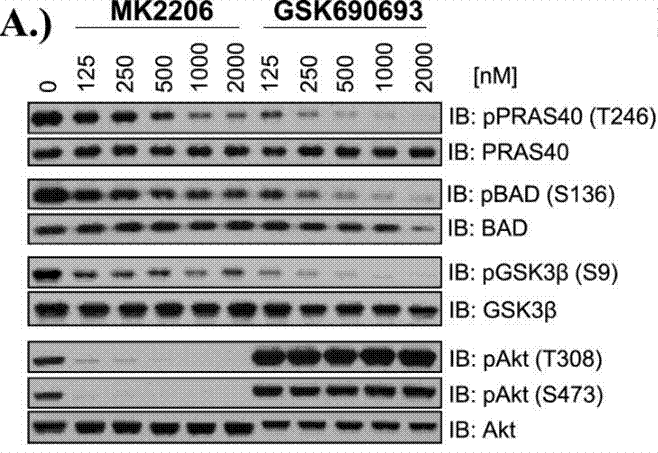
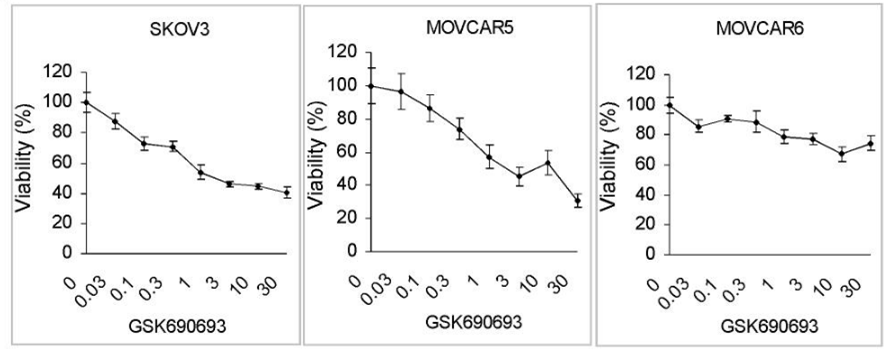
A single administration of GSK690693 inhibits GSK3β phosphorylation in human breast carcinoma (BT474) xenografts in a dose- and time-dependent manner. Similarly, this compound induces a reduction in phosphorylation of the Akt substrates, PRAS40, and FKHR/FKHRL1. It also results in an acute increase in blood glucose, returning to baseline 8 to 10 hours after drug administration. Administration of this chemical induces reductions in phosphorylated Akt substrates in vivo, and potently inhibits the growth of human SKOV-3 ovarian, LNCaP prostate, and BT474 and HCC-1954 breast carcinoma xenografts, with maximal inhibition of 58% to 75% at the dose of 30 mg/kg/day. This compound exhibits efficacy irrespective of the mechanism of Akt activation involved. It is most effective in delaying tumor progression in Lck-MyrAkt2 mice expressing a membrane-bound, constitutively active form of Akt. |
References |
|
Applications
| Methods | Biomarkers | Images | PMID |
|---|---|---|---|
| Western blot | pPRAS40 / PRAS40 / pBAD / BAD p-Akt / Akt / p-GSK3 / p-mTOR / mTOR / p-p70S6K / p-FoxO3a / p-FoxO1 |
|
25551293 |
| Growth inhibition assay | Cell viability |
|
20075391 |
Clinical Trial Information
(data from https://clinicaltrials.gov, updated on 2015-04-17)
| NCT Number | Recruitment | Conditions | Sponsor/Collaborators | Start Date | Phases |
|---|---|---|---|---|---|
| NCT00666081 | WITHDRAWN | Cancer |
GlaxoSmithKline |
2008-04 | PHASE1 |
| NCT00493818 | TERMINATED | Cancer |
GlaxoSmithKline |
2007-04 | PHASE1 |
| NCT00666081 | Withdrawn | Cancer |
GlaxoSmithKline |
2008-04 | Phase 1 |
| NCT00493818 | Terminated | Cancer |
GlaxoSmithKline |
2007-04 | Phase 1 |
Read more about Clinical Trials
Tech Support
Tel: +1-832-582-8158 Ext:3
If you have any other enquiries, please leave a message.
Frequently Asked Questions
Question 1:
Why did pAKT increase after treatment with it?
Answer:
It actually inhibits AKT, but does not necessarily decrease p-Akt level. Treatment with this compound caused AKT hyper phosphorylation which has already been reported in some papers. (For example, http://www.bloodjournal.org/content/113/8/1723.short?sso-checked=true). To test the inhibition of AKT activity, you might have to look at the level of AKT substrates.
Signaling Pathway Map

Products are for research use only. Not for human use. We do not sell to patients.
©Copyright 2013 Selleck Chemicals. All Rights Reserved.