
-
 Argentina
-
 Australia
-
 Austria
-
 Belgium
-
 Brazil
-
 Canada
-
 China
China
-
 Czech Republic
-
 Denmark
-
 Finland
-
 France
-
 Germany
-
 Greece
-
 Hong Kong
-
 Hungary
-
 Iceland
-
 India
India
-
 Ireland
-
 Israel
-
 Italy
Italy
-
 Japan
Japan
-
 Korea
Korea
-
 Luxembourg
-
 Malaysia
-
 Netherlands
-
 New Zealand
-
 Norway
-
 Poland
-
 Portugal
-
 Qatar
Qatar
-
 Romania
-
 Saudi Arabia
-
 Singapore
-
 Spain
Spain
-
 Sweden
-
 Switzerland
-
 Taiwan
-
 Turkey
-
 United Kingdom
-
 United States
research use only
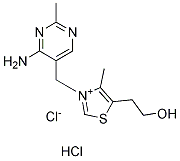
Thiamine HCl (Vitamin B1) Vitamin chemical
Cat.No.S3211
Quality Control
Solubility
|
In vitro |
Water : 67 mg/mL
DMSO
: Insoluble
Ethanol : Insoluble |
Molarity Calculator
|
In vivo |
|||||
In vivo Formulation Calculator (Clear solution)
Step 1: Enter information below (Recommended: An additional animal making an allowance for loss during the experiment)
Step 2: Enter the in vivo formulation (This is only the calculator, not formulation. Please contact us first if there is no in vivo formulation at the solubility Section.)
Calculation results:
Working concentration: mg/ml;
Method for preparing DMSO master liquid: mg drug pre-dissolved in μL DMSO ( Master liquid concentration mg/mL, Please contact us first if the concentration exceeds the DMSO solubility of the batch of drug. )
Method for preparing in vivo formulation: Take μL DMSO master liquid, next addμL PEG300, mix and clarify, next addμL Tween 80, mix and clarify, next add μL ddH2O, mix and clarify.
Method for preparing in vivo formulation: Take μL DMSO master liquid, next add μL Corn oil, mix and clarify.
Note: 1. Please make sure the liquid is clear before adding the next solvent.
2. Be sure to add the solvent(s) in order. You must ensure that the solution obtained, in the previous addition, is a clear solution before proceeding to add the next solvent. Physical methods such
as vortex, ultrasound or hot water bath can be used to aid dissolving.
Chemical Information, Storage & Stability
| Molecular Weight | 337.27 | Formula | C12 H17N4OS.HCl |
Storage (From the date of receipt) | |
|---|---|---|---|---|---|
| CAS No. | 67-03-8 | Download SDF | Storage of Stock Solutions |
|
|
| Synonyms | N/A | SMILES | CC1=C(SC=[N+]1CC2=CN=C(N=C2N)C)CCO.Cl.[Cl-] | ||
Read more about storage stability stock solution CAS number SMILES
Mechanism of Action
| In vitro |
Thiamine HCl (Vitamin B1) (50 mM), in addition to its nutritional value, induces systemic acquired resistance (SAR) in rice, tobacco, cucumber, and Arabidopsis. It also confers resistance to fungal, bacterial, and viral infections in treated rice, Arabidopsis (Arabidopsis thaliana), and vegetable crop plants. This compound induces the transient expression of pathogenesis-related (PR) genes in rice and other plants, and potentiates stronger and more rapid PR gene expression along with up-regulation of protein kinase C activity. At a concentration of 10 μM, it prevents acetaldehyde-induced inhibition of myocyte shortening in adult rat ventricular myocytes, effectively blunts the acetaldehyde-induced depression in ±dL/dt, and prevents acetaldehyde-induced shortening of time-to-peak shortening. Furthermore, it inhibits acetaldehyde-induced elevation in both protein carbonyl formation and caspase-3 activation in adult rat ventricular myocytes. Its uptake is energy- and temperature-dependent, pH-sensitive, Na+-independent, and saturable at both the nanomolar (apparent Km, 30 nM) and the micromolar (apparent Km, 1.72 mM) concentration ranges in ARPE-19 cells. Uptake of this compound is adaptively regulated by extracellular substrate level via transcriptionally mediated mechanisms that involve both hTHTR-1 and hTHTR-2 in ARPE-19 cells, and is also regulated by an intracellular Ca2+-calmodulin-mediated pathway. Thiamine-responsive megaloblastic anemia (TRMA) fibroblasts are rescued from death with 10 nM-30 nM of it (in the range of normal plasma thiamine concentrations). Normal fibroblasts exhibit saturable, high-affinity thiamine uptake (Km 400 nM-550 nM; Vmax 11 pmol/min/1×106 cells), while TRMA fibroblasts lack detectable high-affinity uptake. At 30 nM, the rate of its uptake by TRMA fibroblasts is 10-fold less than that of wild-type, which explains the increased apoptosis of TRMA fibroblasts.
|
|---|---|
| In vivo |
Thiamine HCl (Vitamin B1) deficiency results in amyloid precursor protein immunoreactivity accumulated in swollen neurites within, or around lesions in rats, or in abnormal clusters in mice.
|
References |
|
Applications
| Methods | Biomarkers | Images | PMID |
|---|---|---|---|
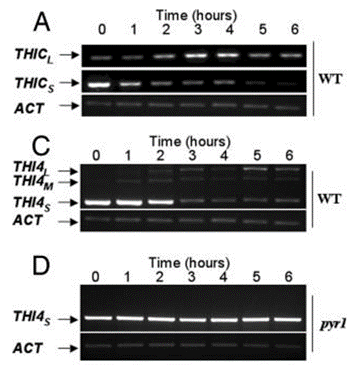
| Western blot | THICL / THICS / THI4L / THI4M / THI4S / ACT Bax / Bid / p53 / p84 Rpb1 / Fcp1 / f-Rpb3 / Tfg3 / Rpb7 / Rpb4 |
|
18093957 |
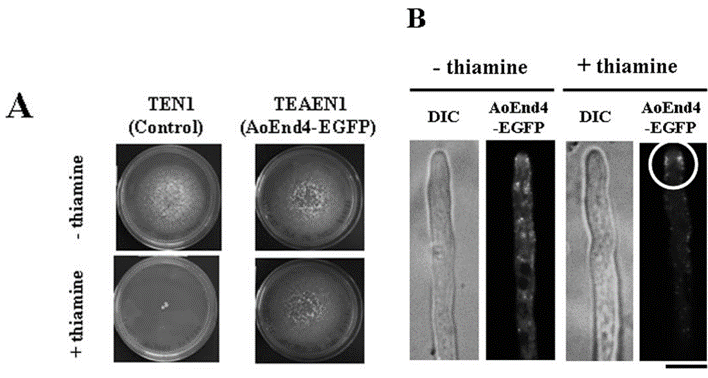
| Growth inhibition assay | TEN1 and TEAEN1 strains hippocampal Dcx+ cells |
|
19028995 |
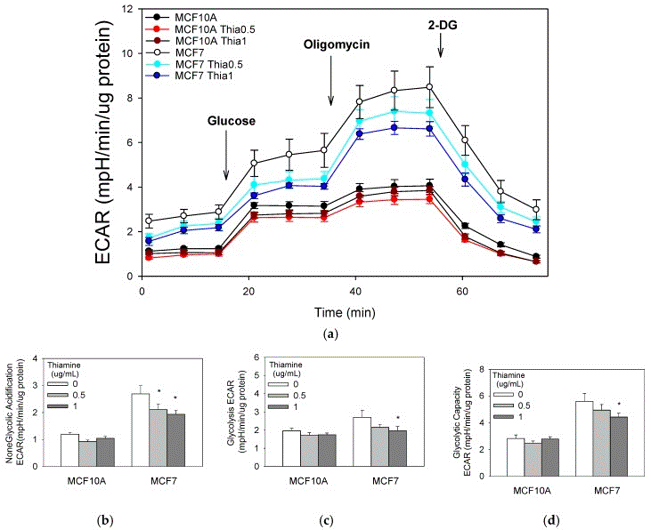
| Glycolysis stress test | Glycolysis stress |
|
29914147 |
| Cell death | Cell survival |
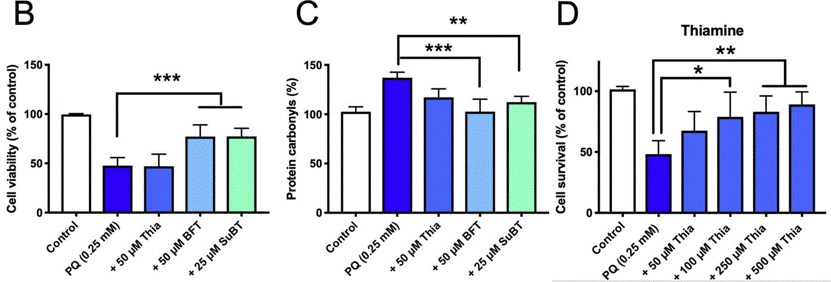
|
31193162 |
| Western blot / RNA Blot | PR-1 / rRNA PR-1 / rRNA |
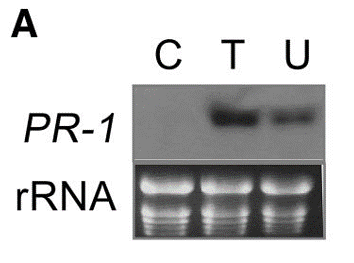
|
15980201 |
| Immunofluorescence | Thi76KR / Thi7M399R / ThiN350K |
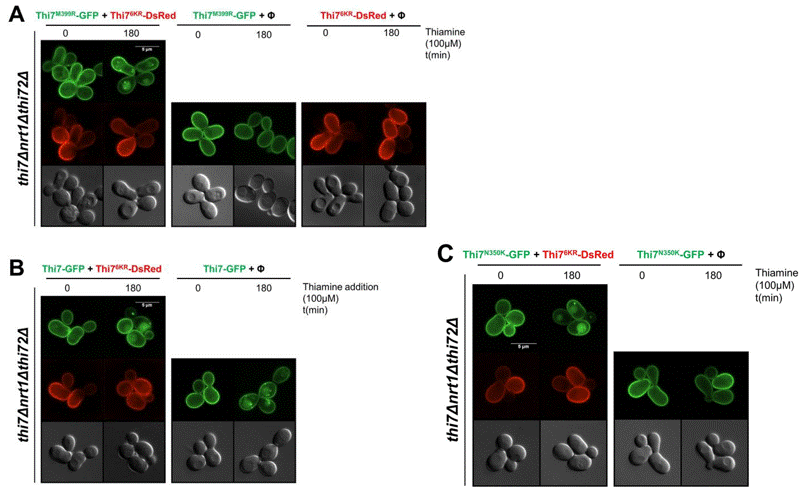
|
31658248 |
Clinical Trial Information
(data from https://clinicaltrials.gov, updated on 2026-08-28)
| NCT Number | Recruitment | Conditions | Sponsor/Collaborators | Start Date | Phases |
|---|---|---|---|---|---|
| NCT07793071 | NOT_YET_RECRUITING | Major Depressive Disorder (MDD); Thiamine; Vitamin B1; Thiamine Diphosphate (TDP); Pediatrics |
Massachusetts General Hospital |
2026-10-01 | PHASE2 |
| NCT07795996 | RECRUITING | Neurocognition, Child |
Mount Saint Vincent University |
2026-06-01 | |
| NCT06649825 | ENROLLING_BY_INVITATION | Familial Adenomatous Polyposis (FAP) |
Shanghai Zhongshan Hospital |
2024-01-08 | |
| NCT06959251 | RECRUITING | Primary Ciliary Dyskinesia |
Instituto Nacional de Enfermedades Respiratorias |
2025-10-02 | |
| NCT05817851 | RECRUITING | Cardiac Arrest |
Centre Hospitalier de Bethune |
2023-12-27 | PHASE2 |
| NCT07708233 | RECRUITING | Diabetic Peripheral Neuropathy (DPN) |
Thammasat University |
2026-07-14 | PHASE4 |
Read more about Clinical Trials
Tech Support
Tel: +1-832-582-8158 Ext:3
If you have any other enquiries, please leave a message.

Products are for research use only. Not for human use. We do not sell to patients.
©Copyright 2013 Selleck Chemicals. All Rights Reserved.