
-
 Argentina
-
 Australia
-
 Austria
-
 Belgium
-
 Brazil
-
 Canada
-
 China
China
-
 Czech Republic
-
 Denmark
-
 Finland
-
 France
-
 Germany
-
 Greece
-
 Hong Kong
-
 Hungary
-
 Iceland
-
 India
India
-
 Ireland
-
 Israel
-
 Italy
Italy
-
 Japan
Japan
-
 Korea
Korea
-
 Luxembourg
-
 Malaysia
-
 Netherlands
-
 New Zealand
-
 Norway
-
 Poland
-
 Portugal
-
 Qatar
Qatar
-
 Romania
-
 Saudi Arabia
-
 Singapore
-
 Spain
Spain
-
 Sweden
-
 Switzerland
-
 Taiwan
-
 Turkey
-
 United Kingdom
-
 United States
research use only
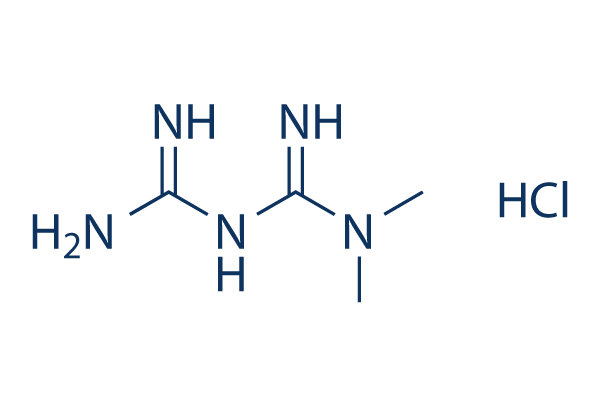
Metformin Hydrochloride Antihyperglycemic agent
Cat.No.S1950
Quality Control
Products Often Used Together with Metformin Hydrochloride
| Related Targets | Dehydrogenase HSP Transferase P450 (e.g. CYP17) PDE phosphatase PPAR Vitamin Mitochondrial Metabolism Casein Kinase |
|---|---|
| Other Carbohydrate Metabolism Inhibitors | 2-DG (2-Deoxy-D-glucose) Bromopyruvic acid (3-BP) Dorzagliatin 1-Deoxynojirimycin LY2608204 Voglibose AZD1656 FBPase-1 inhibitor-1 4',7-Dimethoxy-5-Hydroxyflavone BI-9787 |
Cell Culture, Treatment & Working Concentration
| Cell Lines | Assay Type | Concentration | Incubation Time | Formulation | Activity Description | PMID |
|---|---|---|---|---|---|---|
| human HepG2 cells | Function assay | 1 mM | 24 h | Activation of AMPK in human HepG2 cells assessed as reduction of gluconeogenesis at 1 mM after 24 hrs by enzymatic colorimetric assay | 26471090 | |
| mouse 3T3L1 cells | Function assay | 1 mM | Induction of AMPK phosphorylation in mouse 3T3L1 cells at 1 mM by Western blot analysis | 25216379 | ||
| human HepG2 cells | Function assay | 1 mM | 24 h | Reduction of glucose consumption in insulin-resistant human HepG2 cells at 1 mM after 24 hrs by glucose oxidase method in presence of 22.2 mM of glucose | 23025244 | |
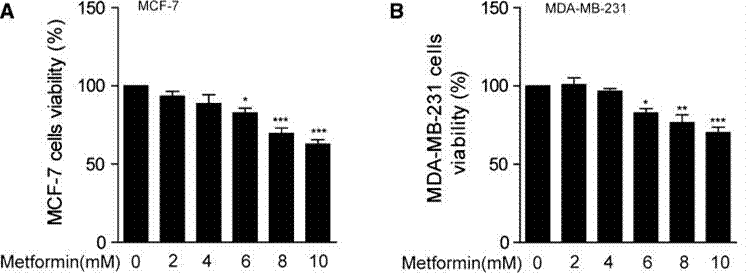
| human MDA-MB-231 cells | Function assay | 1 to 20 mM | 24 h | Antiproliferative activity against human MDA-MB-231 cells at 1 to 20 mM after 24 hrs by MTT assay. | 22459208 | |
| human HepG2 cells | Function assay | 24 h | Increase in glucose consumption in insulin-resistant human HepG2 cells after 24 hrs, EC50=0.27 μM. | 21856048 | ||
| Hs575T | Function assay | 20 mM | 24 hrs | Inhibition of mTOR phosphorylation in triple-negative human Hs575T cells at 20 mM after 24 hrs by immunoblot analysis | 23490148 | |
| Hs578T | Antiinvasive assay | 20 mM | 17 hrs | Antiinvasive activity against triple-negative human Hs578T cells at 20 mM after 17 hrs by light microscopic analysis | 23490148 | |
| Hs575T | Function assay | 20 mM | 24 hrs | Activation of AMPK in triple-negative human Hs575T cells at 20 mM after 24 hrs by immunoblot analysis | 23490148 | |
| L6 | Function assay | 2 mM | 4 hrs | Increase in glucose uptake in rat L6 cells at 2 mM treated for 4 hrs post 30 mins AMPK inhibitor compound C treatment | 29128163 | |
| HepG2 | Function assay | 1 mM | 24 hrs | Induction of glucose consumption in human HepG2 cells at 1 mM incubated for 24 hrs | 28651984 | |
| Click to View More Cell Line Experimental Data | ||||||
Solubility
|
In vitro |
Water : 33 mg/mL Ethanol : Insoluble |
Molarity Calculator
|
In vivo |
|||||
In vivo Formulation Calculator (Clear solution)
Step 1: Enter information below (Recommended: An additional animal making an allowance for loss during the experiment)
Step 2: Enter the in vivo formulation (This is only the calculator, not formulation. Please contact us first if there is no in vivo formulation at the solubility Section.)
Calculation results:
Working concentration: mg/ml;
Method for preparing DMSO master liquid: mg drug pre-dissolved in μL DMSO ( Master liquid concentration mg/mL, Please contact us first if the concentration exceeds the DMSO solubility of the batch of drug. )
Method for preparing in vivo formulation: Take μL DMSO master liquid, next addμL PEG300, mix and clarify, next addμL Tween 80, mix and clarify, next add μL ddH2O, mix and clarify.
Method for preparing in vivo formulation: Take μL DMSO master liquid, next add μL Corn oil, mix and clarify.
Note: 1. Please make sure the liquid is clear before adding the next solvent.
2. Be sure to add the solvent(s) in order. You must ensure that the solution obtained, in the previous addition, is a clear solution before proceeding to add the next solvent. Physical methods such
as vortex, ultrasound or hot water bath can be used to aid dissolving.
Chemical Information, Storage & Stability
| Molecular Weight | 165.62 | Formula | C4H11N5.HCl |
Storage (From the date of receipt) | |
|---|---|---|---|---|---|
| CAS No. | 1115-70-4 | Download SDF | Storage of Stock Solutions |
|
|
| Synonyms | 1,1-Dimethylbiguanide HCl | SMILES | CN(C)C(=N)N=C(N)N.Cl | ||
Read more about storage stability stock solution CAS number SMILES
Mechanism of Action
| Targets/IC50/Ki |
AMPK
(Hepatocytes) |
|---|---|
| In vitro |
Metformin (500 μM) activates AMPK in hepatocytes, as a result, acetyl-CoA carboxylase (ACC) activity is reduced, fatty acid oxidation is induced, and expression of lipogenic enzymes is suppressed. Metformin (2 mM) activates muscle AMPK and promotes glucose uptake. Metformin (500 μM) or AICAR strongly suppresses SREBP-1 mRNA expression in rat hepatocytes. Metformin ameliorates hyperglycemia without stimulating insulin secretion, promoting weight gain, or causing hypoglycemia. Metformin has beneficial effects on circulating lipids linked to increased cardiovascular risk. Metformin decreases hepatic glucose production and increases skeletal myocyte glucose uptake. Metformin requires LKB1 in the liver to lower blood glucose levels. Metformin (2 mM) leads to a significant increase in the activity of both α1- and α2-containing complexes in muscle cells. Metformin (2 mM) also increases threonine 172 phosphorylation in muscle cells. |
| In vivo |
Metformin (100 mg/ml, po) treatment produces significant decreases in hepatic expression of mRNAs for SREBP-1, FAS, and S14 in SD rats that are consistent with effects documented in cells. Metformin also decreases hepatic lipids in obese mice. Metformin (250 mg/kg, i.p.) increases AMPK phosphorylation in livers of wild-type mice. Metformin (250 mg/kg, i.p.) treatment reduces blood glucose by more than 50% in the wild-type mice on a high-fat diet. Metformin (250 mg/kg, i.p.) treatment also loweres blood glucose in the ob/ob mice by 40%. |
References |
|
Applications
| Methods | Biomarkers | Images | PMID |
|---|---|---|---|
| Western blot | pSTAT3 (Ser727) / STAT3 / Jak2 / Cdk5 / pNFκB / Bcl-2 / Bcl-XL / c-Myc pACC / ACC / pS6 / S6 TTP / p-STAT3 / STAT3 / c-Myc p-AMPK / AMPK / p-mTOR / mTOR / p-S6K / S6K |

|
28114390 |
| Immunofluorescence | beta-catenin / AMPK CD86 / CD206 PAR LKB1 |

|
30854043 |
| Growth inhibition assay | Cell viability |
|
26956973 |
Clinical Trial Information
(data from https://clinicaltrials.gov, updated on 2024-05-22)
| NCT Number | Recruitment | Conditions | Sponsor/Collaborators | Start Date | Phases |
|---|---|---|---|---|---|
| NCT05910554 | Not yet recruiting | Sarcoidosis Pulmonary |
University of Maryland Baltimore |
2024-05-01 | Phase 2 |
| NCT06120881 | Recruiting | Type 2 Diabetes |
University of California San Francisco|National Institute of Diabetes and Digestive and Kidney Diseases (NIDDK) |
2024-04-01 | Early Phase 1 |
| NCT06147050 | Not yet recruiting | Long COVID |
Purpose Life Sciences |
2024-04 | Phase 3 |
| NCT06296836 | Not yet recruiting | Diabetes Mellitus Type 2 |
University of Illinois at Chicago|Emily Hanners|Dulal Bhaumik|Avisek Datta|Peggy Choye|Hailey Soni|Annesti Elmasri|Julie Jun|Colin Goodman |
2024-04-01 | Phase 4 |
Read more about Clinical Trials
Tech Support
Tel: +1-832-582-8158 Ext:3
If you have any other enquiries, please leave a message.

Products are for research use only. Not for human use. We do not sell to patients.
©Copyright 2013 Selleck Chemicals. All Rights Reserved.