
-
 Argentina
-
 Australia
-
 Austria
-
 Belgium
-
 Brazil
-
 Canada
-
 China
China
-
 Czech Republic
-
 Denmark
-
 Finland
-
 France
-
 Germany
-
 Greece
-
 Hong Kong
-
 Hungary
-
 Iceland
-
 India
India
-
 Ireland
-
 Israel
-
 Italy
Italy
-
 Japan
Japan
-
 Korea
Korea
-
 Luxembourg
-
 Malaysia
-
 Netherlands
-
 New Zealand
-
 Norway
-
 Poland
-
 Portugal
-
 Qatar
Qatar
-
 Romania
-
 Saudi Arabia
-
 Singapore
-
 Spain
Spain
-
 Sweden
-
 Switzerland
-
 Taiwan
-
 Turkey
-
 United Kingdom
-
 United States
research use only
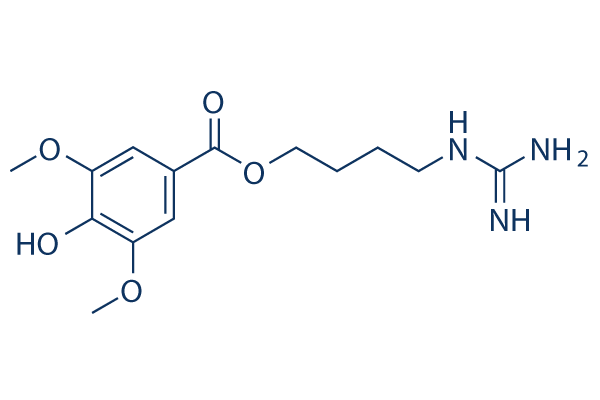
Leonurine Autophagy chemical
Cat.No.S3890
Quality Control
| Related Targets | CXCR Nrf2 Mitophagy LRRK2 ULK FKBP Heme Oxygenase cGAS LC3 Cell wall |
|---|---|
| Other Autophagy Inhibitors | Resveratrol (trans-Resveratrol) Spautin-1 PIK-III Lys05 Trihydrochloride DC661 Autophinib Spermidine SMER28 QX77 EN6 |
Solubility
|
In vitro |
DMSO
: Insoluble
|
Molarity Calculator
|
In vivo |
|||||
In vivo Formulation Calculator (Clear solution)
Step 1: Enter information below (Recommended: An additional animal making an allowance for loss during the experiment)
Step 2: Enter the in vivo formulation (This is only the calculator, not formulation. Please contact us first if there is no in vivo formulation at the solubility Section.)
Calculation results:
Working concentration: mg/ml;
Method for preparing DMSO master liquid: mg drug pre-dissolved in μL DMSO ( Master liquid concentration mg/mL, Please contact us first if the concentration exceeds the DMSO solubility of the batch of drug. )
Method for preparing in vivo formulation: Take μL DMSO master liquid, next addμL PEG300, mix and clarify, next addμL Tween 80, mix and clarify, next add μL ddH2O, mix and clarify.
Method for preparing in vivo formulation: Take μL DMSO master liquid, next add μL Corn oil, mix and clarify.
Note: 1. Please make sure the liquid is clear before adding the next solvent.
2. Be sure to add the solvent(s) in order. You must ensure that the solution obtained, in the previous addition, is a clear solution before proceeding to add the next solvent. Physical methods such
as vortex, ultrasound or hot water bath can be used to aid dissolving.
Chemical Information, Storage & Stability
| Molecular Weight | 311.33 | Formula | C14H21N3O5 |
Storage (From the date of receipt) | |
|---|---|---|---|---|---|
| CAS No. | 24697-74-3 | Download SDF | Storage of Stock Solutions |
|
|
| Synonyms | N/A | SMILES | COC1=CC(=CC(=C1O)OC)C(=O)OCCCCN=C(N)N | ||
Read more about storage stability stock solution CAS number SMILES
Mechanism of Action
| In vitro |
Leonurine inhibits U937 cells adhesion to TNF-α-activated HUVEC in a concentration dependent manner. Treatment with this compound blocks TNF-α-induced mRNA and protein expression of adhesion molecules (intercellular adhesion molecule-1 and vascular cell adhesion molecule-1), cyclooxygenase-2, and monocyte chemoattractant protein-1 in endothelial cells. In addition, this compound attenuates TNF-α-induced intracellular ROS production in HUVEC. Furthermore, it suppresses the TNF-α-activated p38 phosphorylation and IκBα degradation. Subsequently reduced NF-κB p65 phosphorylation, nuclear translocation, and DNA-binding activity are also observed. This chemical attenuates DOX-induced apoptosis in H9c2 cell by increasing anti-oxidant, anti-apoptotic ability and protecting mitochondrial function.
|
|---|---|
| In vivo |
Leonurine attenuates hyperalgesia in mice with induced adenomyosis via down-regulating expressions of p-P65, COX-2, and OTR, and could be beneficial for treating adenomyosis. This compound exerts antidepressant-like effects, which may be mediated, at least in part, by improving monoamine neurotransmitters and inhibiting neuroinflammation. It possesses neuroprotective effects in animal models of ischemic stroke, parkinson's disease, and alzheimer's disease. This chemical treatment significantly rescues behavioral deficit of animals, promotes neuronal survival, and inhibits inflammation.
|
References |
|
Tech Support
Tel: +1-832-582-8158 Ext:3
If you have any other enquiries, please leave a message.
Signaling Pathway Map

Products are for research use only. Not for human use. We do not sell to patients.
©Copyright 2013 Selleck Chemicals. All Rights Reserved.