
-
 Argentina
-
 Australia
-
 Austria
-
 Belgium
-
 Brazil
-
 Canada
-
 China
China
-
 Czech Republic
-
 Denmark
-
 Finland
-
 France
-
 Germany
-
 Greece
-
 Hong Kong
-
 Hungary
-
 Iceland
-
 India
India
-
 Ireland
-
 Israel
-
 Italy
Italy
-
 Japan
Japan
-
 Korea
Korea
-
 Luxembourg
-
 Malaysia
-
 Netherlands
-
 New Zealand
-
 Norway
-
 Poland
-
 Portugal
-
 Qatar
Qatar
-
 Romania
-
 Saudi Arabia
-
 Singapore
-
 Spain
Spain
-
 Sweden
-
 Switzerland
-
 Taiwan
-
 Turkey
-
 United Kingdom
-
 United States
research use only
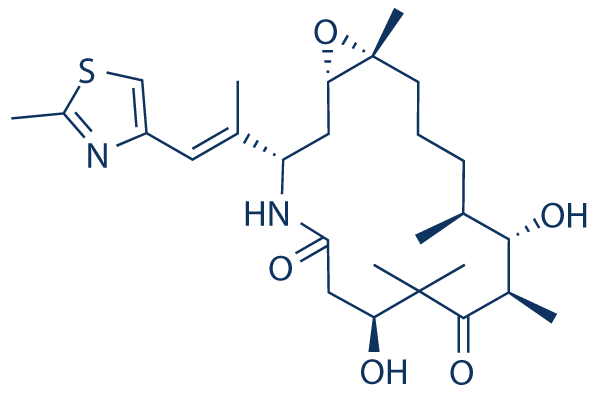
Ixabepilone Microtubule Associated inhibitor
Cat.No.S7930
Quality Control
| Related Targets | Akt Wnt/beta-catenin PKC HSP ROCK Integrin Bcr-Abl Actin FAK Kinesin |
|---|---|
| Other Microtubule Associated Inhibitors | Nocodazole Patupilone (Epothilone B) CW069 Combretastatin A4 Lexibulin (CYT997) Epothilone A ABT-751 (E7010) Cucurbitacin B TRx0237 (LMTX) mesylate DM1 (Mertansine) |
Solubility
|
In vitro |
DMSO
: 100 mg/mL
(197.35 mM)
Ethanol : 47 mg/mL Water : Insoluble |
Molarity Calculator
|
In vivo |
|||||
In vivo Formulation Calculator (Clear solution)
Step 1: Enter information below (Recommended: An additional animal making an allowance for loss during the experiment)
Step 2: Enter the in vivo formulation (This is only the calculator, not formulation. Please contact us first if there is no in vivo formulation at the solubility Section.)
Calculation results:
Working concentration: mg/ml;
Method for preparing DMSO master liquid: mg drug pre-dissolved in μL DMSO ( Master liquid concentration mg/mL, Please contact us first if the concentration exceeds the DMSO solubility of the batch of drug. )
Method for preparing in vivo formulation: Take μL DMSO master liquid, next addμL PEG300, mix and clarify, next addμL Tween 80, mix and clarify, next add μL ddH2O, mix and clarify.
Method for preparing in vivo formulation: Take μL DMSO master liquid, next add μL Corn oil, mix and clarify.
Note: 1. Please make sure the liquid is clear before adding the next solvent.
2. Be sure to add the solvent(s) in order. You must ensure that the solution obtained, in the previous addition, is a clear solution before proceeding to add the next solvent. Physical methods such
as vortex, ultrasound or hot water bath can be used to aid dissolving.
Chemical Information, Storage & Stability
| Molecular Weight | 506.70 | Formula | C27H42N2O5S |
Storage (From the date of receipt) | |
|---|---|---|---|---|---|
| CAS No. | 219989-84-1 | Download SDF | Storage of Stock Solutions |
|
|
| Synonyms | Azaepothilone B, BMS-247550, Aza-epothilone B | SMILES | CC1CCCC2(C(O2)CC(NC(=O)CC(C(C(=O)C(C1O)C)(C)C)O)C(=CC3=CSC(=N3)C)C)C | ||
Read more about storage stability stock solution CAS number SMILES
Mechanism of Action
| Targets/IC50/Ki |
microtubule(tubulin stabilising)
|
|---|---|
| In vitro |
BMS-247550 is a highly potent cytotoxic agent capable of killing cancer cells at low nanomolar concentrations and retains its antineoplastic activity against human cancers that are naturally insensitive to paclitaxel or that have developed resistance to paclitaxel. |
| In vivo |
In vivo, BMS-247550 has clearly demonstrated antitumor activity that is superior to paclitaxel in both paclitaxel-resistant and -sensitive tumors. BMS-247550 is more efficacious than paclitaxel in all five paclitaxel-resistant tumors evaluated in this study (four human and one murine): i.e., the clinically derived paclitaxel resistant Pat-7 ovarian carcinoma, the A2780Tax ovarian carcinoma that is resistant to paclitaxel because of tubulin mutations, the HCT116/VM46 MDR colon carcinoma, the clinically derived paclitaxel-resistant Pat-21 breast carcinoma, and the murine fibrosarcoma M5076. Against three paclitaxel-sensitive human tumor xenografts, BMS-247550 produces antitumor activity equivalent to paclitaxel: i.e., A2780 human ovarian carcinoma, HCT116, and LS174T human colon carcinoma. |
References |
Clinical Trial Information
(data from https://clinicaltrials.gov, updated on 2026-05-22)
| NCT Number | Recruitment | Conditions | Sponsor/Collaborators | Start Date | Phases |
|---|---|---|---|---|---|
| NCT00877500 | ACTIVE_NOT_RECRUITING | Bilateral Breast Carcinoma; HER2/Neu Negative; Invasive Breast Carcinoma |
M.D. Anderson Cancer Center |
2009-03-30 | PHASE2 |
| NCT04796324 | TERMINATED | Metastatic Breast Cancer |
Allarity Therapeutics |
2021-03-01 | PHASE2 |
| NCT03093155 | COMPLETED | Epithelial Ovarian Cancer; Fallopian Tube Cancer; Primary Peritoneal Cancer |
Yale University |
2017-04-03 | PHASE2 |
| NCT02915744 | COMPLETED | Metastasis; Breast Cancer |
Nektar Therapeutics |
2016-11 | PHASE3 |
| NCT01097642 | COMPLETED | Breast Cancer |
The Methodist Hospital Research Institute |
2008-10-10 | PHASE2 |
| NCT01446016 | COMPLETED | Breast Neoplasms; Breast Cancer |
The Methodist Hospital Research Institute |
2011-09 | PHASE2 |
Read more about Clinical Trials
Tech Support
Tel: +1-832-582-8158 Ext:3
If you have any other enquiries, please leave a message.
Signaling Pathway Map

Products are for research use only. Not for human use. We do not sell to patients.
©Copyright 2013 Selleck Chemicals. All Rights Reserved.