
-
 Argentina
-
 Australia
-
 Austria
-
 Belgium
-
 Brazil
-
 Canada
-
 China
China
-
 Czech Republic
-
 Denmark
-
 Finland
-
 France
-
 Germany
-
 Greece
-
 Hong Kong
-
 Hungary
-
 Iceland
-
 India
India
-
 Ireland
-
 Israel
-
 Italy
Italy
-
 Japan
Japan
-
 Korea
Korea
-
 Luxembourg
-
 Malaysia
-
 Netherlands
-
 New Zealand
-
 Norway
-
 Poland
-
 Portugal
-
 Qatar
Qatar
-
 Romania
-
 Saudi Arabia
-
 Singapore
-
 Spain
Spain
-
 Sweden
-
 Switzerland
-
 Taiwan
-
 Turkey
-
 United Kingdom
-
 United States
research use only
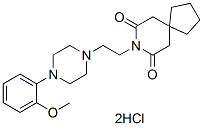
BMY 7378 Dihydrochloride 5-HT Receptor antagonist
Cat.No.S2691
Quality Control
Solubility
|
In vitro |
DMSO
: 92 mg/mL
(200.68 mM)
Water : 92 mg/mL Ethanol : 20 mg/mL |
Molarity Calculator
|
In vivo |
|||||
In vivo Formulation Calculator (Clear solution)
Step 1: Enter information below (Recommended: An additional animal making an allowance for loss during the experiment)
Step 2: Enter the in vivo formulation (This is only the calculator, not formulation. Please contact us first if there is no in vivo formulation at the solubility Section.)
Calculation results:
Working concentration: mg/ml;
Method for preparing DMSO master liquid: mg drug pre-dissolved in μL DMSO ( Master liquid concentration mg/mL, Please contact us first if the concentration exceeds the DMSO solubility of the batch of drug. )
Method for preparing in vivo formulation: Take μL DMSO master liquid, next addμL PEG300, mix and clarify, next addμL Tween 80, mix and clarify, next add μL ddH2O, mix and clarify.
Method for preparing in vivo formulation: Take μL DMSO master liquid, next add μL Corn oil, mix and clarify.
Note: 1. Please make sure the liquid is clear before adding the next solvent.
2. Be sure to add the solvent(s) in order. You must ensure that the solution obtained, in the previous addition, is a clear solution before proceeding to add the next solvent. Physical methods such
as vortex, ultrasound or hot water bath can be used to aid dissolving.
Chemical Information, Storage & Stability
| Molecular Weight | 458.42 | Formula | C22H31N3O3.2HCl |
Storage (From the date of receipt) | |
|---|---|---|---|---|---|
| CAS No. | 21102-95-4 | Download SDF | Storage of Stock Solutions |
|
|
| Synonyms | N/A | SMILES | COC1=CC=CC=C1N2CCN(CC2)CCN3C(=O)CC4(CCCC4)CC3=O.Cl.Cl | ||
Read more about storage stability stock solution CAS number SMILES
Mechanism of Action
| Targets/IC50/Ki |
5-HT1A
8.3(pIC50)
α1D-adrenoceptor
8.2(pKi)
Dopamine D2 receptor
7.4(pIC50)
α2C-adrenoceptor
6.54(pKi)
5-HT1C
6.4(pIC50)
5-HT1D
5.9(pIC50)
H1 receptor
5.7(pIC50)
5-HT2
5.5(pIC50)
H2 receptor
5.3(pIC50)
α2-adrenoceptor
5.1(pIC50)
β1-adrenoceptor
5.1(pIC50)
Dopamine D1 receptor
5(pIC50)
|
|---|---|
| In vitro |
BMY 7378 shows 10-fold selectivity for α2C-adrenoceptors over other α2-adrenoceptors with pKi of 6.54. BMY 7378 is selective for the α1D-adrenoceptor subtype (PKi: hamster α1b-adrenoceptor 6.2, human α1b-adrenoceptor 7.2; bovine α1c-adrenoceptor 6.1, human α1c-adrenoceptor 6.6; rat α1d-adrenoceptor 8.2, human α1d-adrenoceptor 9.4 BMY 7378 at concentration of 1 nM to 30 nM elicits inhibitory effects in a concentration-dependent manner in the rat dorsal raphe nucleus.
|
| In vivo |
BMY 7378 (pA2 of 8.67) is approximately 100 times more potent than yohimbine (pA2 of 6.62) against contractions to noradrenaline in rat aorta. BMY 7378 (pA2 of 6.48) is approximately 10 times less potent than yohimbine (pA2 of 7.56) at antagonizing the contractile response to noradrenaline in human saphenous vein (α2C-adrenoceptor). BMY 7378 dose dependently (0.25-5 mg/kg s.c.) reduces the undetectable levels forepaw treading and head weaving induced by 8-OH-DPAT (0.75 mg/kg s.c.) in rats. BMY 7378 causes a marked and dose-dependent (0.01-1.0 mg/kg s.c.) decrease of 5-HT release in ventral hippocampus of the anaesthetized rat as detected by brain microdialysis in rats.
|
References |
|
Tech Support
Tel: +1-832-582-8158 Ext:3
If you have any other enquiries, please leave a message.
Signaling Pathway Map

Products are for research use only. Not for human use. We do not sell to patients.
©Copyright 2013 Selleck Chemicals. All Rights Reserved.