
-
 Argentina
-
 Australia
-
 Austria
-
 Belgium
-
 Brazil
-
 Canada
-
 China
China
-
 Czech Republic
-
 Denmark
-
 Finland
-
 France
-
 Germany
-
 Greece
-
 Hong Kong
-
 Hungary
-
 Iceland
-
 India
India
-
 Ireland
-
 Israel
-
 Italy
Italy
-
 Japan
Japan
-
 Korea
Korea
-
 Luxembourg
-
 Malaysia
-
 Netherlands
-
 New Zealand
-
 Norway
-
 Poland
-
 Portugal
-
 Qatar
Qatar
-
 Romania
-
 Saudi Arabia
-
 Singapore
-
 Spain
Spain
-
 Sweden
-
 Switzerland
-
 Taiwan
-
 Turkey
-
 United Kingdom
-
 United States
research use only
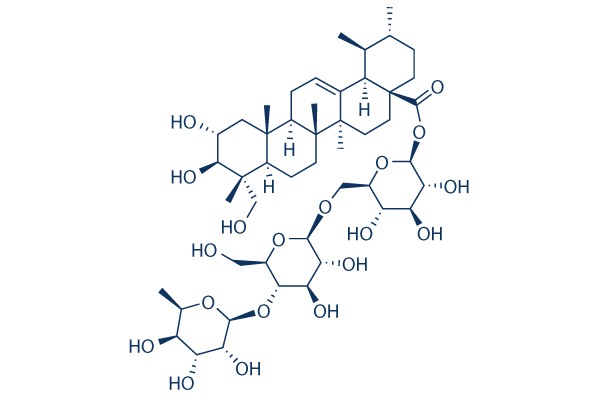
Asiaticoside ROS inhibitor
Cat.No.S3616
Quality Control
Solubility
|
In vitro |
DMSO
: 100 mg/mL
(104.26 mM)
Water : Insoluble Ethanol : Insoluble |
Molarity Calculator
|
In vivo |
|||||
In vivo Formulation Calculator (Clear solution)
Step 1: Enter information below (Recommended: An additional animal making an allowance for loss during the experiment)
Step 2: Enter the in vivo formulation (This is only the calculator, not formulation. Please contact us first if there is no in vivo formulation at the solubility Section.)
Calculation results:
Working concentration: mg/ml;
Method for preparing DMSO master liquid: mg drug pre-dissolved in μL DMSO ( Master liquid concentration mg/mL, Please contact us first if the concentration exceeds the DMSO solubility of the batch of drug. )
Method for preparing in vivo formulation: Take μL DMSO master liquid, next addμL PEG300, mix and clarify, next addμL Tween 80, mix and clarify, next add μL ddH2O, mix and clarify.
Method for preparing in vivo formulation: Take μL DMSO master liquid, next add μL Corn oil, mix and clarify.
Note: 1. Please make sure the liquid is clear before adding the next solvent.
2. Be sure to add the solvent(s) in order. You must ensure that the solution obtained, in the previous addition, is a clear solution before proceeding to add the next solvent. Physical methods such
as vortex, ultrasound or hot water bath can be used to aid dissolving.
Chemical Information, Storage & Stability
| Molecular Weight | 959.12 | Formula | C48H78O19 |
Storage (From the date of receipt) | |
|---|---|---|---|---|---|
| CAS No. | 16830-15-2 | Download SDF | Storage of Stock Solutions |
|
|
| Synonyms | Ba 2742, BRN0078195, CCRIS8995, NSC166062, Emdecassol,Madecassol | SMILES | CC1CCC2(CCC3(C(=CCC4C3(CCC5C4(CC(C(C5(C)CO)O)O)C)C)C2C1C)C)C(=O)OC6C(C(C(C(O6)COC7C(C(C(C(O7)CO)OC8C(C(C(C(O8)C)O)O)O)O)O)O)O)O | ||
Read more about storage stability stock solution CAS number SMILES
Mechanism of Action
| In vitro |
In the central nervous system, Asiaticoside has been shown to attenuate in vitro neuronal damage caused by exposure to β-amyloid. In cultured mouse cortical neurons exposed to glutamate-induced excitotoxicity invoked by N-methyl-D-aspartate, pretreatment with this compound decreases neuronal cell loss in a concentration-dependent manner and restored changes in expression of apoptotic-related proteins Bcl-2 and Bax. This compound pretreatment also attenuates the upregulation of NR2B expression, a subunit of N-methyl-D-aspartate receptors, but does not affect expression of NR2A subunits. It also significantly inhibits Ca 2+ influx induced by N-methyl-D-aspartate. Presence of this chemical along with the DNA during irradiation prevents the relaxation of the supercoiled form to the open circular form.
|
|---|---|
| In vivo |
In vivo studies demonstrate that Asiaticoside could attenuate neurobehavioral, neurochemical and histological changes in transient focal middle cerebral artery occlusion animals. In addition, this compound shows anxiolytic effects in acute and chronic stress animals. It has been shown to have wound healing effects, anti-inflammatory effects, and promotes liver protective activity. Administration of this chemical prior to whole-body radiation exposure of the mice prevents this increase in radiation-induced increase in comet parameters, which could be the result of protection to DNA under in vivo conditions of radiation exposure.
|
References |
|
Clinical Trial Information
(data from https://clinicaltrials.gov, updated on 2026-09-03)
| NCT Number | Recruitment | Conditions | Sponsor/Collaborators | Start Date | Phases |
|---|---|---|---|---|---|
| NCT07802340 | RECRUITING | Revascularization of Immature Young Permenant Teeth |
Mansoura University |
2026-09-15 | |
| NCT07241533 | RECRUITING | Overweight , Obesity |
Shanghai Zhongshan Hospital |
2025-12-01 | |
| NCT03814850 | Withdrawn | Unruptured Cerebral Aneurysm |
Sebastian Koch|University of Miami |
2024-12-01 | Not Applicable |
| NCT05287347 | Not yet recruiting | Pancreatic Adenocarcinoma |
Beth Israel Deaconess Medical Center|National Institutes of Health (NIH)|Dana-Farber Cancer Institute |
2024-10 | -- |
| NCT06360094 | Not yet recruiting | Idiopathic Pulmonary Fibrosis|Progressive Pulmonary Fibrosis |
Boehringer Ingelheim |
2024-07-27 | Phase 2 |
| NCT06566508 | UNKNOWN | Intracanal Medication |
Mansoura University |
2023-11-20 | PHASE2; PHASE3 |
Read more about Clinical Trials
Tech Support
Tel: +1-832-582-8158 Ext:3
If you have any other enquiries, please leave a message.

Products are for research use only. Not for human use. We do not sell to patients.
©Copyright 2013 Selleck Chemicals. All Rights Reserved.