
-
 Argentina
-
 Australia
-
 Austria
-
 Belgium
-
 Brazil
-
 Canada
-
 China
China
-
 Czech Republic
-
 Denmark
-
 Finland
-
 France
-
 Germany
-
 Greece
-
 Hong Kong
-
 Hungary
-
 Iceland
-
 India
India
-
 Ireland
-
 Israel
-
 Italy
Italy
-
 Japan
Japan
-
 Korea
Korea
-
 Luxembourg
-
 Malaysia
-
 Netherlands
-
 New Zealand
-
 Norway
-
 Poland
-
 Portugal
-
 Qatar
Qatar
-
 Romania
-
 Saudi Arabia
-
 Singapore
-
 Spain
Spain
-
 Sweden
-
 Switzerland
-
 Taiwan
-
 Turkey
-
 United Kingdom
-
 United States
research use only
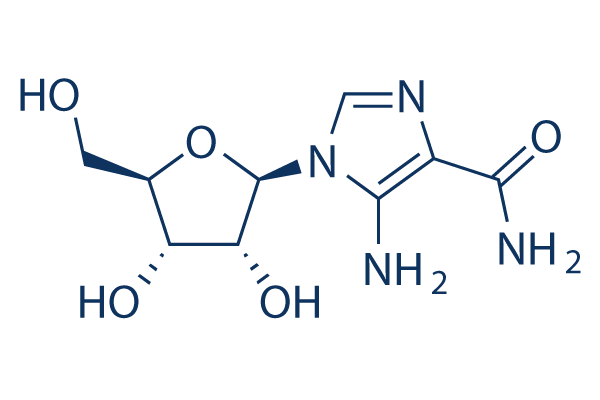
AICAR (Acadesine) AMPK activator
Cat.No.S1802
Quality Control
Products Often Used Together with AICAR (Acadesine)
| Related Targets | PI3K Akt mTOR GSK-3 ATM/ATR DNA-PK PDPK1 PTEN PI4K PP2A |
|---|---|
| Other AMPK Inhibitors | Dorsomorphin Dihydrochloride Dorsomorphin (Compound C) A-769662 GSK621 WZ4003 Ex229 (Compound 991) Phenformin HCl BAY-3827 HTH-01-015 MK-8722 |
Cell Culture, Treatment & Working Concentration
| Cell Lines | Assay Type | Concentration | Incubation Time | Formulation | Activity Description | PMID |
|---|---|---|---|---|---|---|
| 3T3L1 | Function assay | 0.2 mM | 9 days | Increase in AMPKalpha Thr172 phosphorylation in mouse 3T3L1 cells at 0.2 mM after 9 days by Western blot method | 26088335 | |
| 3T3L1 | Function assay | 500 μM | 5 h | Activation of AMPK in mouse 3T3L1 cells assessed as AMPK phosphorylation at 500 uM after 5 hrs by Western blotting analysis | 25262940 | |
| C2C12 | Function assay | 1 mM | 1 hr | Activation of AMPK in mouse C2C12 cells assessed as increase in ACC phosphorylation at Ser79 residues at 1 mM after 1 hr by Western blot analysis | 27887844 | |
| 3T3L1 | Function assay | 2 mM | 4 hrs | Induction of AMPKalpha phosphorylation at Thr172 residue in mouse 3T3L1 cells at 2 mM after 4 hrs by Western blot analysis | 29425817 | |
| C2C12 | Function assay | 0.2 mM | 30 mins | Inhibition of PTP1B in differentiated mouse C2C12 cells assessed as upregulation of ACC phosphorylation at Ser-79 residue at 0.2 mM after 30 mins by Western blot assay | 28951079 | |
| RCC4 | Function assay | 1 mM | 48 hrs | Induction of autophagy in human RCC4 cells assessed as increase in LC3 conversion at 1 mM after 48 hrs by Western blot method | 28325600 | |
| 3T3L1 | Function assay | 0.2 mM | Inhibition of adipogenesis in mouse 3T3L1 cells assessed as reduction in triglyceride content at 0.2 mM by colorimetric assay | 26088335 | ||
| 3T3L1 | Function assay | 0.2 mM | 3 days | Reduction in SCD1 protein expression in mouse 3T3L1 cells at 0.2 mM after 3 days by Western blot method | 26088335 | |
| 3T3L1 | Function assay | 0.2 mM | 3 days | Reduction in SREBP-1c protein expression in mouse 3T3L1 cells at 0.2 mM after 3 days by Western blot method | 26088335 | |
| 3T3L1 | Function assay | 0.2 mM | 9 days | Activation of AMPK in mouse 3T3L1 cells assessed as increase in ACC Ser79 phosphorylation at 0.2 mM after 9 days by Western blot method | 26088335 | |
| 3T3L1 | Function assay | 0.2 mM | 3 days | Reduction in C/EBPalpha protein expression in mouse 3T3L1 cells at 0.2 mM after 3 days by Western blot method | 26088335 | |
| 3T3L1 | Function assay | 0.2 mM | 3 days | Reduction in PPARgamma protein expression in mouse 3T3L1 cells at 0.2 mM after 3 days by Western blot method | 26088335 | |
| 3T3L1 | Function assay | 0.2 mM | 3 days | Reduction in FAS protein expression in mouse 3T3L1 cells at 0.2 mM after 3 days by Western blot method | 26088335 | |
| Click to View More Cell Line Experimental Data | ||||||
Solubility
|
In vitro |
DMSO
: 51 mg/mL
(197.49 mM)
Water : 20 mg/mL Ethanol : Insoluble |
Molarity Calculator
|
In vivo |
|||||
In vivo Formulation Calculator (Clear solution)
Step 1: Enter information below (Recommended: An additional animal making an allowance for loss during the experiment)
Step 2: Enter the in vivo formulation (This is only the calculator, not formulation. Please contact us first if there is no in vivo formulation at the solubility Section.)
Calculation results:
Working concentration: mg/ml;
Method for preparing DMSO master liquid: mg drug pre-dissolved in μL DMSO ( Master liquid concentration mg/mL, Please contact us first if the concentration exceeds the DMSO solubility of the batch of drug. )
Method for preparing in vivo formulation: Take μL DMSO master liquid, next addμL PEG300, mix and clarify, next addμL Tween 80, mix and clarify, next add μL ddH2O, mix and clarify.
Method for preparing in vivo formulation: Take μL DMSO master liquid, next add μL Corn oil, mix and clarify.
Note: 1. Please make sure the liquid is clear before adding the next solvent.
2. Be sure to add the solvent(s) in order. You must ensure that the solution obtained, in the previous addition, is a clear solution before proceeding to add the next solvent. Physical methods such
as vortex, ultrasound or hot water bath can be used to aid dissolving.
Chemical Information, Storage & Stability
| Molecular Weight | 258.23 | Formula | C9H14N4O5 |
Storage (From the date of receipt) | |
|---|---|---|---|---|---|
| CAS No. | 2627-69-2 | Download SDF | Storage of Stock Solutions |
|
|
| Synonyms | NSC105823, AICA Riboside | SMILES | C1=NC(=C(N1C2C(C(C(O2)CO)O)O)N)C(=O)N | ||
Read more about storage stability stock solution CAS number SMILES
Mechanism of Action
| Features |
A potential first-in-class ARA.
|
|---|---|
| Targets/IC50/Ki |
AMPK
(Cell-free assay) AMPKK
(Cell-free assay) |
| In vitro |
Acadesine (500 μM) increases the ZMP content in extracts of isolated hepatocytes after up to 30-40 min treatment, then remains fairly constant at approximately 4 nmol/g. This compound causes a transient 12-fold activation of AMPK at 15 min in rat hepatocytes and 2-3 fold activation of AMPK in adipocytes, without affecting levels of ATP, ADP or AMP. It also causes a dramatic inhibition of both fatty acid and sterol synthesis in rat hepatocytes, as well as a dramatic inactivation of HMG-CoA reductase. AICAR induces apoptosis of B-CLL cells in a dose-dependent manner with EC50 of 380 μM. At 0.5 mM, it decreases cell viability of B-CLL cells from 20 representative patients from 68% to 26%, and induces caspase activation and cytochrome c release from mitochondria. Uptake and phosphorylation of the compound are required to induce apoptosis and activate AMPK in B-CLL cells. While concentrations of 2-4 mM only slightly affect the viability of T cells from B-CLL patients, 0.5 mM remarkedly reduces viability of B cells but not T cells. It triggers loss of cell metabolism in K562, LAMA-84 and JURL-MK1 and is also effective in killing resistant K562 cells and Ba/F3 cells carrying the T315I-BCR-ABL mutation. The effect of AICAR is abrogated by GF109203X and Ro-32-0432, both inhibitor of classical and new PKCs and accordingly, it triggers relocation and activation of several PKC isoforms in K562 cells. The compound dose-dependently inhibits K562 colony formation at day 10, the growth inhibitory effect is already detected at 0.25 mM and is maximal at 2.5 mM. AICAR causes a concentration-related reduction in CD18 expression on LPS-stimulated neutrophils in vitro. It significantly (1 mM) inhibits N-formyl-methionyl-leucyl-phenylalanine-induced granulocyte CD11b up-regulation by a mean of 61% in blood. |
| In vivo |
Acadesine (50 mg/kg) significantly reduces tumor formation in a mouse xenograft model of K562 cells. At 10 mg/kg, this compound results in higher fluid required to stabilize hemodynamics in pigs and inhibits LPS-induced protein permeability of pulmonary capillaries, peak inspiratory pressures on constant tidal volume and dead space ventilation. |
References |
|
Applications
| Methods | Biomarkers | Images | PMID |
|---|---|---|---|
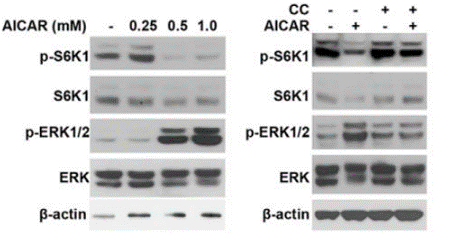
| Western blot | p-S6K1 / S6K1 / p-ERK / ERK p-IRS-1 / IRS-1 / p-AKT / AKT p-AMPK / p-ACC / p-eNOS / eNOS / vWF / VE-cadherin / ICAM-1 Cyclin D1 / p21 / p53 |
|
26528831 |
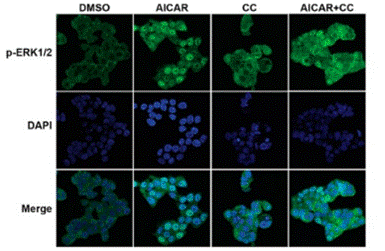
| Immunofluorescence | p-ERK YAZ / TAZ |
|
26528831 |
Clinical Trial Information
(data from https://clinicaltrials.gov, updated on 2016-11-08)
| NCT Number | Recruitment | Conditions | Sponsor/Collaborators | Start Date | Phases |
|---|---|---|---|---|---|
| NCT01813838 | TERMINATED | SMD |
Groupe Francophone des Myelodysplasies |
2013-06 | PHASE1; PHASE2 |
| NCT00559624 | COMPLETED | Leukemia, B-Cell, Chronic |
Advancell - Advanced In Vitro Cell Technologies, S.A. |
2007-12 | PHASE1; PHASE2 |
| NCT00872001 | TERMINATED | Coronary Artery Bypass; Myocardial Infarction; Ventricular Dysfunction, Left; Stroke; Cardiopulmonary Bypass |
Merck Sharp & Dohme LLC |
2009-04 | PHASE3 |
| NCT00004314 | COMPLETED | Lesch-Nyhan Syndrome |
National Center for Research Resources (NCRR) |
1996-02 | PHASE2 |
| NCT00168519 | COMPLETED | Diabetes Mellitus, Type 2 |
Baker Heart Research Institute |
2002-10 |
Read more about Clinical Trials
Tech Support
Tel: +1-832-582-8158 Ext:3
If you have any other enquiries, please leave a message.
Signaling Pathway Map

Products are for research use only. Not for human use. We do not sell to patients.
©Copyright 2013 Selleck Chemicals. All Rights Reserved.