
-
 Argentina
-
 Australia
-
 Austria
-
 Belgium
-
 Brazil
-
 Canada
-
 China
China
-
 Czech Republic
-
 Denmark
-
 Finland
-
 France
-
 Germany
-
 Greece
-
 Hong Kong
-
 Hungary
-
 Iceland
-
 India
India
-
 Ireland
-
 Israel
-
 Italy
Italy
-
 Japan
Japan
-
 Korea
Korea
-
 Luxembourg
-
 Malaysia
-
 Netherlands
-
 New Zealand
-
 Norway
-
 Poland
-
 Portugal
-
 Qatar
Qatar
-
 Romania
-
 Saudi Arabia
-
 Singapore
-
 Spain
Spain
-
 Sweden
-
 Switzerland
-
 Taiwan
-
 Turkey
-
 United Kingdom
-
 United States
research use only
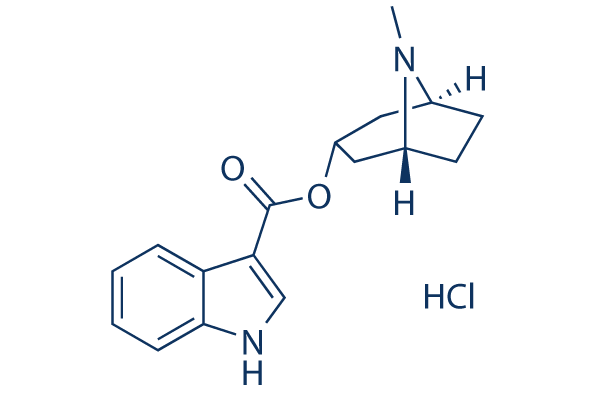
Tropisetron HCl 5-HT Receptor antagonist
Cat.No.S1898
Quality Control
Solubility
|
In vitro |
DMSO
: 64 mg/mL
(199.49 mM)
Water : 46 mg/mL Ethanol : Insoluble |
Molarity Calculator
|
In vivo |
|||||
In vivo Formulation Calculator (Clear solution)
Step 1: Enter information below (Recommended: An additional animal making an allowance for loss during the experiment)
Step 2: Enter the in vivo formulation (This is only the calculator, not formulation. Please contact us first if there is no in vivo formulation at the solubility Section.)
Calculation results:
Working concentration: mg/ml;
Method for preparing DMSO master liquid: mg drug pre-dissolved in μL DMSO ( Master liquid concentration mg/mL, Please contact us first if the concentration exceeds the DMSO solubility of the batch of drug. )
Method for preparing in vivo formulation: Take μL DMSO master liquid, next addμL PEG300, mix and clarify, next addμL Tween 80, mix and clarify, next add μL ddH2O, mix and clarify.
Method for preparing in vivo formulation: Take μL DMSO master liquid, next add μL Corn oil, mix and clarify.
Note: 1. Please make sure the liquid is clear before adding the next solvent.
2. Be sure to add the solvent(s) in order. You must ensure that the solution obtained, in the previous addition, is a clear solution before proceeding to add the next solvent. Physical methods such
as vortex, ultrasound or hot water bath can be used to aid dissolving.
Chemical Information, Storage & Stability
| Molecular Weight | 320.81 | Formula | C17H20N2O2.HCl |
Storage (From the date of receipt) | |
|---|---|---|---|---|---|
| CAS No. | 105826-92-4 | Download SDF | Storage of Stock Solutions |
|
|
| Synonyms | ICS 205-930 | SMILES | CN1C2CCC1CC(C2)OC(=O)C3=CNC4=CC=CC=C43.Cl | ||
Read more about storage stability stock solution CAS number SMILES
Mechanism of Action
| Targets/IC50/Ki |
5-HT3
|
|---|---|
| In vitro |
Tropisetron is a high affinity ligand for both th α7 nAChR and 5HT3R. Tropisetron has very low affinity for the other nicotinic subtypes tested. Tropisetron is a potent and selective serotonin 3 (5-hydroxytryptamine3; 5-HT3) receptor antagonist with antiemetic properties, probably mediated via antagonism of receptors both at peripheral sites and in the central nervous system. Tropisetron is a potent inhibitor of early and late events in TCR-mediated T cell activation. Tropisetron specifically inhibits both IL-2 gene transcription and IL-2 synthesis in stimulated T cells. Ttropisetron inhibits both the binding to DNA and the transcriptional activity of NFAT and AP-1. Tropisetron is a potent inhibitor of PMA plus ionomycin-induced NF-(kappa)B activation but in contrast TNF(alpha)-mediated NF-(kappa)B activation is not affected by this antagonist. Tropisetron acts on α7 nAChRs on isolated pig retinal ganglion cells (RGCs) to provide neuroprotection against glutamate-induced excitotoxicity. Tropisetron acts to decrease p38MAP kinase levels to inhibit apoptosis. Tropisetron is able to protect retinal ganglion cells (RGCs) from a glutamate assault in a dose-dependent manner when applied to cultures 1 hour prior to glutamate application.
|
| In vivo |
Tropisetron (1 mg/kg i.p.) significantly improves the deficient inhibitory processing of the P20-N40 auditory evoked potential in DBA/2 mice.
|
References |
|
Clinical Trial Information
(data from https://clinicaltrials.gov, updated on 2024-05-22)
| NCT Number | Recruitment | Conditions | Sponsor/Collaborators | Start Date | Phases |
|---|---|---|---|---|---|
| NCT04195204 | Unknown status | Postoperative Cognitive Dysfunction|Postoperative Delirium |
Beijing Chao Yang Hospital |
2020-11-01 | Phase 4 |
Read more about Clinical Trials
Tech Support
Tel: +1-832-582-8158 Ext:3
If you have any other enquiries, please leave a message.
Signaling Pathway Map

Products are for research use only. Not for human use. We do not sell to patients.
©Copyright 2013 Selleck Chemicals. All Rights Reserved.