
-
 Argentina
-
 Australia
-
 Austria
-
 Belgium
-
 Brazil
-
 Canada
-
 China
China
-
 Czech Republic
-
 Denmark
-
 Finland
-
 France
-
 Germany
-
 Greece
-
 Hong Kong
-
 Hungary
-
 Iceland
-
 India
India
-
 Ireland
-
 Israel
-
 Italy
Italy
-
 Japan
Japan
-
 Korea
Korea
-
 Luxembourg
-
 Malaysia
-
 Netherlands
-
 New Zealand
-
 Norway
-
 Poland
-
 Portugal
-
 Qatar
Qatar
-
 Romania
-
 Saudi Arabia
-
 Singapore
-
 Spain
Spain
-
 Sweden
-
 Switzerland
-
 Taiwan
-
 Turkey
-
 United Kingdom
-
 United States
research use only
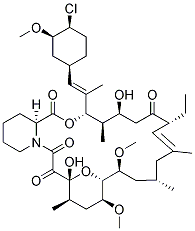
Pimecrolimus Immunology & Inflammation related inhibitor
Cat.No.S5004
Quality Control
| Related Targets | PD-1/PD-L1 CXCR STING AhR CD markers Interleukins Anti-infection Antioxidant COX Histamine Receptor |
|---|---|
| Other Immunology & Inflammation related Inhibitors | Cl-amidine Bestatin (Ubenimex) Bindarit (AF 2838) Tempol Tranilast GI254023X (GI4023) Sinomenine Geniposidic acid CORM-3 Germacrone |
Solubility
|
In vitro |
DMSO
: 100 mg/mL
(123.38 mM)
Ethanol : 100 mg/mL Water : Insoluble |
Molarity Calculator
|
In vivo |
|||||
In vivo Formulation Calculator (Clear solution)
Step 1: Enter information below (Recommended: An additional animal making an allowance for loss during the experiment)
Step 2: Enter the in vivo formulation (This is only the calculator, not formulation. Please contact us first if there is no in vivo formulation at the solubility Section.)
Calculation results:
Working concentration: mg/ml;
Method for preparing DMSO master liquid: mg drug pre-dissolved in μL DMSO ( Master liquid concentration mg/mL, Please contact us first if the concentration exceeds the DMSO solubility of the batch of drug. )
Method for preparing in vivo formulation: Take μL DMSO master liquid, next addμL PEG300, mix and clarify, next addμL Tween 80, mix and clarify, next add μL ddH2O, mix and clarify.
Method for preparing in vivo formulation: Take μL DMSO master liquid, next add μL Corn oil, mix and clarify.
Note: 1. Please make sure the liquid is clear before adding the next solvent.
2. Be sure to add the solvent(s) in order. You must ensure that the solution obtained, in the previous addition, is a clear solution before proceeding to add the next solvent. Physical methods such
as vortex, ultrasound or hot water bath can be used to aid dissolving.
Chemical Information, Storage & Stability
| Molecular Weight | 810.45 | Formula | C43H68ClNO11 |
Storage (From the date of receipt) | |
|---|---|---|---|---|---|
| CAS No. | 137071-32-0 | Download SDF | Storage of Stock Solutions |
|
|
| Synonyms | Elidel,SDZ-ASM 981 | SMILES | CCC1C=C(CC(CC(C2C(CC(C(O2)(C(=O)C(=O)N3CCCCC3C(=O)OC(C(C(CC1=O)O)C)C(=CC4CCC(C(C4)OC)Cl)C)O)C)OC)OC)C)C | ||
Read more about storage stability stock solution CAS number SMILES
Mechanism of Action
| In vitro |
Pimecrolimus blocks T-lymphocyte activation pathway by inhibiting calcineurin function. This compound prevents the release of cytokines and pro-inflammatory mediators from mast cells. It binds to macrophilin-12, the pimecrolimusmacrophilin complex then binds to the cytosolic enzyme calcineurin phosphatase. The pimecrolimus-macrophilin complex prevents the dephosphorylation of the cytoplasmic component of the nuclear factor of activated T cells by inhibiting the action of calcineurin. This chemical inhibits not only the transcription and synthesis of cytokines from mast cells, but also the release of preformed mediators serotonin and β-hexosaminidase by the inhibition of Fc∈-RI-mediated degranulation and secretion. This treatment causes a strong down-regulation of the expression of mRNA for genes associated with the macrolactam target pathway and inflammation. |
|---|---|
| In vivo |
Pimecrolimus is found to be as effective as cyclosporine A following oral ingestion and slightly superior after subcutaneous administration in mice. This compound contrasts cyclosporine A and tacrolimus by inhibiting ongoing secondary inflammatory response, but not impairing the primary immune response in allergic contact dermatitis in mice. It is as effective as the high-potency corticosteroid clobetasol-17-propionate in a pig model of allergic contact dermatitis (ACD). This chemical also effectively reduces skin inflammation and pruritus in hypomagnesemic hairless rats, a model that mimics acute signs of atopic dermatitis. It shows only a low potential to impair systemic immune responses when compared with tacrolimus as shown in rats in (1) the localized graft-versus-host reaction, (2) the antibody formation to sheep red blood cells, and (3) kidney transplantation. |
References |
|
Clinical Trial Information
(data from https://clinicaltrials.gov, updated on 2024-05-22)
| NCT Number | Recruitment | Conditions | Sponsor/Collaborators | Start Date | Phases |
|---|---|---|---|---|---|
| NCT05439941 | Terminated | Atopic Dermatitis |
Evelo Biosciences Inc. |
2022-06-06 | Phase 2 |
| NCT01692626 | Terminated | Rash |
West Virginia University |
2012-02 | Phase 2 |
| NCT00507832 | Completed | Prurigo Nodularis |
University Hospital Muenster|Novartis Pharmaceuticals |
2007-04 | Phase 2 |
| NCT00208026 | Completed | Netherton Syndrome |
Children''s Hospital of Philadelphia|Novartis Pharmaceuticals |
2005-09 | Phase 1|Phase 2 |
Read more about Clinical Trials
Tech Support
Tel: +1-832-582-8158 Ext:3
If you have any other enquiries, please leave a message.

Products are for research use only. Not for human use. We do not sell to patients.
©Copyright 2013 Selleck Chemicals. All Rights Reserved.