
-
 Argentina
-
 Australia
-
 Austria
-
 Belgium
-
 Brazil
-
 Canada
-
 China
China
-
 Czech Republic
-
 Denmark
-
 Finland
-
 France
-
 Germany
-
 Greece
-
 Hong Kong
-
 Hungary
-
 Iceland
-
 India
India
-
 Ireland
-
 Israel
-
 Italy
Italy
-
 Japan
Japan
-
 Korea
Korea
-
 Luxembourg
-
 Malaysia
-
 Netherlands
-
 New Zealand
-
 Norway
-
 Poland
-
 Portugal
-
 Qatar
Qatar
-
 Romania
-
 Saudi Arabia
-
 Singapore
-
 Spain
Spain
-
 Sweden
-
 Switzerland
-
 Taiwan
-
 Turkey
-
 United Kingdom
-
 United States
research use only
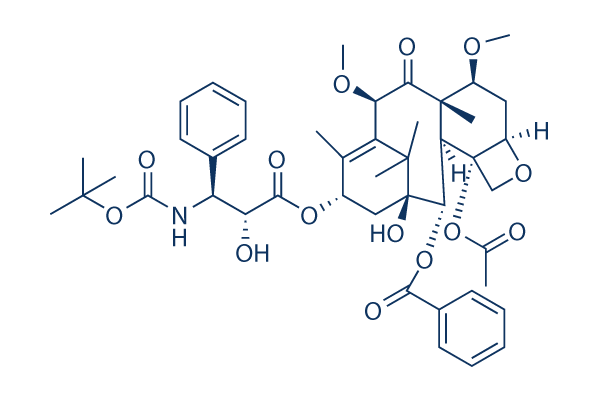
Cabazitaxel Microtubule Associated inhibitor
Cat.No.S3022
Quality Control
| Related Targets | Akt Wnt/beta-catenin PKC HSP ROCK Integrin Bcr-Abl Actin FAK Kinesin |
|---|---|
| Other Microtubule Associated Inhibitors | Nocodazole Patupilone (Epothilone B) CW069 Combretastatin A4 Lexibulin (CYT997) Epothilone A ABT-751 (E7010) Cucurbitacin B TRx0237 (LMTX) mesylate DM1 (Mertansine) |
Cell Culture, Treatment & Working Concentration
| Cell Lines | Assay Type | Concentration | Incubation Time | Formulation | Activity Description | PMID |
|---|---|---|---|---|---|---|
| SGC7901 | Growth inhibition assay | Growth inhibition of human SGC7901 cells by MTT assay, GI50=0.0003553μM | 24405702 | |||
| U937 | Growth inhibition assay | Growth inhibition of human U937 cells by MTT assay, GI50=0.0005391μM | 24405702 | |||
| MCF7 | Growth inhibition assay | Growth inhibition of human MCF7 cells by MTT assay, GI50=0.001187μM | 24405702 | |||
| PANC1 | Growth inhibition assay | Growth inhibition of human PANC1 cells by MTT assay, GI50=0.001283μM | 24405702 | |||
| HT1080 | Growth inhibition assay | Growth inhibition of human HT1080 cells by MTT assay, GI50=0.001406μM | 24405702 | |||
| DU145 | Growth inhibition assay | Growth inhibition of human DU145 cells by MTT assay, GI50=0.001429μM | 24405702 | |||
| A549 | Growth inhibition assay | Growth inhibition of human A549 cells by MTT assay, GI50=0.001483μM | 24405702 | |||
| A431 | Growth inhibition assay | Growth inhibition of human A431 cells by MTT assay, GI50=0.001483μM | 24405702 | |||
| HeLa | Growth inhibition assay | Growth inhibition of human HeLa cells by MTT assay, GI50=0.001799μM | 24405702 | |||
| K562 | Growth inhibition assay | Growth inhibition of human K562 cells by MTT assay, GI50=0.004186μM | 24405702 | |||
| HL60 | Growth inhibition assay | Growth inhibition of human HL60 cells by MTT assay, GI50=0.004736μM | 24405702 | |||
| BGC823 | Growth inhibition assay | Growth inhibition of human BGC823 cells by MTT assay, GI50=0.4672μM | 24405702 | |||
| A549 | Cytotoxicity assay | Cytotoxicity against human A549 cells, IC50=0.00148μM | 28850227 | |||
| MES-SA/Dx5 | Growth inhibition assay | 72 hrs | Growth inhibition of human MES-SA/Dx5 cells after 72 hrs by SRB assay, IC50=0.015μM | 29251920 | ||
| TC32 | qHTS assay | qHTS of pediatric cancer cell lines to identify multiple opportunities for drug repurposing: Primary screen for TC32 cells | 29435139 | |||
| A673 | qHTS assay | qHTS of pediatric cancer cell lines to identify multiple opportunities for drug repurposing: Primary screen for A673 cells | 29435139 | |||
| SK-N-MC | qHTS assay | qHTS of pediatric cancer cell lines to identify multiple opportunities for drug repurposing: Primary screen for SK-N-MC cells | 29435139 | |||
| Saos-2 | qHTS assay | qHTS of pediatric cancer cell lines to identify multiple opportunities for drug repurposing: Primary screen for Saos-2 cells | 29435139 | |||
| LAN-5 | qHTS assay | qHTS of pediatric cancer cell lines to identify multiple opportunities for drug repurposing: Primary screen for LAN-5 cells | 29435139 | |||
| OHS-50 | qHTS assay | qHTS of pediatric cancer cell lines to identify multiple opportunities for drug repurposing: Primary screen for OHS-50 cells | 29435139 | |||
| Rh41 | qHTS assay | qHTS of pediatric cancer cell lines to identify multiple opportunities for drug repurposing: Primary screen for Rh41 cells | 29435139 | |||
| A673 | qHTS assay | qHTS of pediatric cancer cell lines to identify multiple opportunities for drug repurposing: Confirmatory screen for A673 cells) | 29435139 | |||
| SK-N-MC | qHTS assay | qHTS of pediatric cancer cell lines to identify multiple opportunities for drug repurposing: Confirmatory screen for SK-N-MC cells | 29435139 | |||
| TC32 | qHTS assay | qHTS of pediatric cancer cell lines to identify multiple opportunities for drug repurposing: Confirmatory screen for TC32 cells | 29435139 | |||
| MG 63 (6-TG R) | qHTS assay | qHTS of pediatric cancer cell lines to identify multiple opportunities for drug repurposing: Confirmatory screen for MG 63 (6-TG R) cells | 29435139 | |||
| U-2 OS | qHTS assay | qHTS of pediatric cancer cell lines to identify multiple opportunities for drug repurposing: Confirmatory screen for U-2 OS cells | 29435139 | |||
| Rh41 | qHTS assay | qHTS of pediatric cancer cell lines to identify multiple opportunities for drug repurposing: Confirmatory screen for Rh41 cells | 29435139 | |||
| Saos-2 | qHTS assay | qHTS of pediatric cancer cell lines to identify multiple opportunities for drug repurposing: Confirmatory screen for Saos-2 cells | 29435139 | |||
| OHS-50 | qHTS assay | qHTS of pediatric cancer cell lines to identify multiple opportunities for drug repurposing: Confirmatory screen for OHS-50 cells | 29435139 | |||
| NCI-H524 | Cytotoxicity assay | 2 hrs | Cytotoxicity in human NCI-H524 cells pre-incubated for 2 hrs followed by compound wash out and subsequently incubated for 70 hrs by Cell Titer Glo assay, IC50=0.00026μM | 30735385 | ||
| Click to View More Cell Line Experimental Data | ||||||
Solubility
|
In vitro |
DMSO
: 167 mg/mL
(199.77 mM)
Water : Insoluble Ethanol : Insoluble |
Molarity Calculator
|
In vivo |
|||||
In vivo Formulation Calculator (Clear solution)
Step 1: Enter information below (Recommended: An additional animal making an allowance for loss during the experiment)
Step 2: Enter the in vivo formulation (This is only the calculator, not formulation. Please contact us first if there is no in vivo formulation at the solubility Section.)
Calculation results:
Working concentration: mg/ml;
Method for preparing DMSO master liquid: mg drug pre-dissolved in μL DMSO ( Master liquid concentration mg/mL, Please contact us first if the concentration exceeds the DMSO solubility of the batch of drug. )
Method for preparing in vivo formulation: Take μL DMSO master liquid, next addμL PEG300, mix and clarify, next addμL Tween 80, mix and clarify, next add μL ddH2O, mix and clarify.
Method for preparing in vivo formulation: Take μL DMSO master liquid, next add μL Corn oil, mix and clarify.
Note: 1. Please make sure the liquid is clear before adding the next solvent.
2. Be sure to add the solvent(s) in order. You must ensure that the solution obtained, in the previous addition, is a clear solution before proceeding to add the next solvent. Physical methods such
as vortex, ultrasound or hot water bath can be used to aid dissolving.
Chemical Information, Storage & Stability
| Molecular Weight | 835.93 | Formula | C45H57NO14 |
Storage (From the date of receipt) | |
|---|---|---|---|---|---|
| CAS No. | 183133-96-2 | Download SDF | Storage of Stock Solutions |
|
|
| Synonyms | XRP6258, RPR-116258A, TXD 258, Taxoid XRP6258 | SMILES | CC1=C2C(C(=O)C3(C(CC4C(C3C(C(C2(C)C)(CC1OC(=O)C(C(C5=CC=CC=C5)NC(=O)OC(C)(C)C)O)O)OC(=O)C6=CC=CC=C6)(CO4)OC(=O)C)OC)C)OC | ||
Read more about storage stability stock solution CAS number SMILES
Mechanism of Action
| Features |
A semi-synthetic derivative of a natural taxoid.
|
|---|---|
| Targets/IC50/Ki |
Microtubule
(Cell-free assay) |
| In vitro |
Cabazitaxel increases CYP3A enzyme activities in rat hepatocytes. The mean ex-vivo human plasma protein binding of this compound is 91.6%. It is rapidly and extensively metabolised in numerous metabolites. This compound demonstrates activity in several murine and human resistant cell lines. With a 4-day exposure to this chemical, cytotoxicity is noted with relatively low cabazitaxel concentrations. It shows high antitumor activity in 3 human colorectal cell lines (HCT-116, HCT-8, and HT-29). |
| In vivo |
In accompanying models, Cabazitaxel is noted to have significant antitumor activity. In murine tumor xenografts (colon C38 and pancreas P03), this compound elicites complete tumor regressions. Using SF-295 and U251 human glioblastoma cell lines, both orthotopic and subcutaneous murine xenografts are generated. This chemical treatment leads to complete regression in the majority of subcutaneously implanted tumors. Furthermore, in orthotopic models, it leads to complete tumor regression in 4 out of 10 U251 tumors. |
References |
|
Clinical Trial Information
(data from https://clinicaltrials.gov, updated on 2026-09-02)
| NCT Number | Recruitment | Conditions | Sponsor/Collaborators | Start Date | Phases |
|---|---|---|---|---|---|
| NCT06632977 | RECRUITING | Castration-Resistant Prostate Carcinoma; Stage IVB Prostate Cancer AJCC v8 |
Alliance for Clinical Trials in Oncology |
2025-02-06 | PHASE2 |
| NCT07213674 | RECRUITING | Metastatic Castration-resistant Prostate Cancer |
Amgen |
2025-11-28 | PHASE3 |
| NCT06470243 | RECRUITING | Castration-Resistant Prostate Carcinoma; Stage IVB Prostate Cancer AJCC v8 |
SWOG Cancer Research Network |
2024-11-27 | PHASE3 |
| NCT07611110 | RECRUITING | Metastatic Castration-resistant Prostate Cancer |
AstraZeneca |
2026-05-04 | PHASE3 |
| NCT06353386 | RECRUITING | Prostatic Neoplasms, Castration-Resistant |
Merck Sharp & Dohme LLC |
2024-05-20 | PHASE1; PHASE2 |
| NCT06691984 | ACTIVE_NOT_RECRUITING | Metastatic Castration-resistant Prostate Cancer |
Amgen |
2024-12-09 | PHASE3 |
Read more about Clinical Trials
Tech Support
Tel: +1-832-582-8158 Ext:3
If you have any other enquiries, please leave a message.
Frequently Asked Questions
Question 1:
What is the elimination half-life of this compound?
Answer:
According to the paper report, its elimination half-life is 95h.
Signaling Pathway Map

Products are for research use only. Not for human use. We do not sell to patients.
©Copyright 2013 Selleck Chemicals. All Rights Reserved.