
-
 Argentina
-
 Australia
-
 Austria
-
 Belgium
-
 Brazil
-
 Canada
-
 China
China
-
 Czech Republic
-
 Denmark
-
 Finland
-
 France
-
 Germany
-
 Greece
-
 Hong Kong
-
 Hungary
-
 Iceland
-
 India
India
-
 Ireland
-
 Israel
-
 Italy
Italy
-
 Japan
Japan
-
 Korea
Korea
-
 Luxembourg
-
 Malaysia
-
 Netherlands
-
 New Zealand
-
 Norway
-
 Poland
-
 Portugal
-
 Qatar
Qatar
-
 Romania
-
 Saudi Arabia
-
 Singapore
-
 Spain
Spain
-
 Sweden
-
 Switzerland
-
 Taiwan
-
 Turkey
-
 United Kingdom
-
 United States
research use only
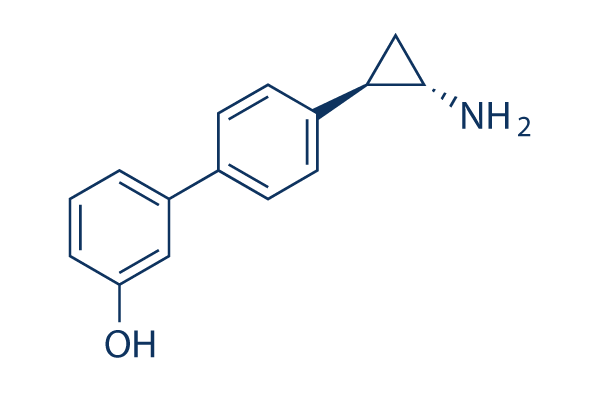
OG-L002 Histone Demethylase inhibitor
Cat.No.S7237
Quality Control
| Related Targets | HDAC JAK BET Histone Methyltransferase PKC PARP HIF PRMT EZH2 AMPK |
|---|---|
| Other Histone Demethylase Inhibitors | GSK-J4 Hydrochloride SP2509 GSK-LSD1 2HCl JIB-04 Iadademstat (ORY-1001) Dihydrochloride CPI-455 HCl IOX1 GSK J1 ML324 CP2 |
Solubility
|
In vitro |
DMSO
: 45 mg/mL
(199.74 mM)
Ethanol : 19 mg/mL Water : Insoluble |
Molarity Calculator
|
In vivo |
|||||
In vivo Formulation Calculator (Clear solution)
Step 1: Enter information below (Recommended: An additional animal making an allowance for loss during the experiment)
Step 2: Enter the in vivo formulation (This is only the calculator, not formulation. Please contact us first if there is no in vivo formulation at the solubility Section.)
Calculation results:
Working concentration: mg/ml;
Method for preparing DMSO master liquid: mg drug pre-dissolved in μL DMSO ( Master liquid concentration mg/mL, Please contact us first if the concentration exceeds the DMSO solubility of the batch of drug. )
Method for preparing in vivo formulation: Take μL DMSO master liquid, next addμL PEG300, mix and clarify, next addμL Tween 80, mix and clarify, next add μL ddH2O, mix and clarify.
Method for preparing in vivo formulation: Take μL DMSO master liquid, next add μL Corn oil, mix and clarify.
Note: 1. Please make sure the liquid is clear before adding the next solvent.
2. Be sure to add the solvent(s) in order. You must ensure that the solution obtained, in the previous addition, is a clear solution before proceeding to add the next solvent. Physical methods such
as vortex, ultrasound or hot water bath can be used to aid dissolving.
Chemical Information, Storage & Stability
| Molecular Weight | 225.29 | Formula | C15H15NO |
Storage (From the date of receipt) | |
|---|---|---|---|---|---|
| CAS No. | 1357302-64-7 | Download SDF | Storage of Stock Solutions |
|
|
| Synonyms | N/A | SMILES | C1C(C1N)C2=CC=C(C=C2)C3=CC(=CC=C3)O | ||
Read more about storage stability stock solution CAS number SMILES
Mechanism of Action
| Features |
This selective LSD1 inhibitor was discovered in 2013. Potential for use in viral diseases such as HSV and VZV.
|
|---|---|
| Targets/IC50/Ki |
LSD1
(Cell-free assay) 20 nM
|
| In vitro |
TCN 201 partially inhibits the NMDA-induced intracellular Ca2+ response in a concentration-dependent manner with a pIC50 of 6.4. TCN 201 partially inhibits [3H]CGP 39653 specific binding showing a maximal radioligand displacement of 44%, respectively, and a pIC50 of 6.5. TCN 201 at a concentration of 10 μM does not protect against Tat-induced cell death, in contrast to ifenprodil and memantine. However, this same concentration of TCN 201 prevents Tat-induced synapse loss. TCN 201 inhibits synapse recovery after Tat-induced loss. TCN 201 demonstrates potent but GluN1 co-agonist concentration-dependent inhibition of GluN1/GluN2A NMDAR-mediated responses. TCN 201 causes substantially less inhibition of the TEVC current trace. TCN 201 is around 30-times more potent than TCN 213. In cortical neurones TCN 201 shows only modest antagonism of NMDAR-mediated currents recorded from young (DIV 9-10) neurones where GluN2B expression predominates. In older cultures (DIV 15-18) or in cultures where GluN2A subunits have been over-expressed TCN 201 gives a strong block that is negatively correlated with the degree of block produced by the GluN2B-selective antagonist, ifenprodil. TCN-201 binds to a novel allosteric site located at the dimer interface between the GluN1 and GluN2 agonist binding domains.
|
| Kinase Assay |
LSD1 demethylation assay
|
|
The demethylase activity is measured by the release of H2O2 produced during the catalytic process, using the Amplex red peroxide/peroxidase-coupled assay kit. Each reaction is done in triplicate. The maximum LSD1 demethylase activity is obtained in the absence of inhibitor and corrected for background fluorescence. The Ki (IC50) of this compound is calculated as half-maximal activity.
|
|
| In vivo |
OG-L002 (6 to 40 mg/kg) represses HSV primary infection in a dose-dependent manner in a mouse model. Moreover, this compound also represses HSV reactivation from latency in a mouse ganglion explant model. |
References |
Tech Support
Tel: +1-832-582-8158 Ext:3
If you have any other enquiries, please leave a message.
Signaling Pathway Map

Products are for research use only. Not for human use. We do not sell to patients.
©Copyright 2013 Selleck Chemicals. All Rights Reserved.