
-
 Argentina
-
 Australia
-
 Austria
-
 Belgium
-
 Brazil
-
 Canada
-
 China
China
-
 Czech Republic
-
 Denmark
-
 Finland
-
 France
-
 Germany
-
 Greece
-
 Hong Kong
-
 Hungary
-
 Iceland
-
 India
India
-
 Ireland
-
 Israel
-
 Italy
Italy
-
 Japan
Japan
-
 Korea
Korea
-
 Luxembourg
-
 Malaysia
-
 Netherlands
-
 New Zealand
-
 Norway
-
 Poland
-
 Qatar
Qatar
-
 Romania
-
 Saudi Arabia
-
 Singapore
-
 Spain
Spain
-
 Sweden
-
 Switzerland
-
 Taiwan
-
 Turkey
-
 United Kingdom
-
 United States
research use only
NCB-0846 MAP4K inhibitor
Cat.No.S8392
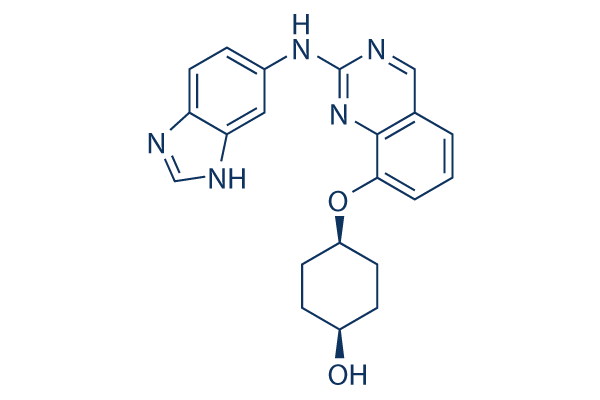
Chemical Structure
Molecular Weight: 375.42
Quality Control
| Related Targets | YAP TEAD LATS MST |
|---|---|
| Other MAP4K Inhibitors | PF-6260933 DMX-5084 BGB 15025 KY-05009 NDI-101150 KHK-6 AZ3246 Rentosertib (INS018-055, ISM001-055) PF-07265028 CompK |
Solubility
|
In vitro |
DMSO
: 75 mg/mL
(199.77 mM)
Ethanol : 2 mg/mL Water : Insoluble |
Molarity Calculator
|
In vivo |
|||||
In vivo Formulation Calculator (Clear solution)
Step 1: Enter information below (Recommended: An additional animal making an allowance for loss during the experiment)
Step 2: Enter the in vivo formulation (This is only the calculator, not formulation. Please contact us first if there is no in vivo formulation at the solubility Section.)
Calculation results:
Working concentration: mg/ml;
Method for preparing DMSO master liquid: mg drug pre-dissolved in μL DMSO ( Master liquid concentration mg/mL, Please contact us first if the concentration exceeds the DMSO solubility of the batch of drug. )
Method for preparing in vivo formulation: Take μL DMSO master liquid, next addμL PEG300, mix and clarify, next addμL Tween 80, mix and clarify, next add μL ddH2O, mix and clarify.
Method for preparing in vivo formulation: Take μL DMSO master liquid, next add μL Corn oil, mix and clarify.
Note: 1. Please make sure the liquid is clear before adding the next solvent.
2. Be sure to add the solvent(s) in order. You must ensure that the solution obtained, in the previous addition, is a clear solution before proceeding to add the next solvent. Physical methods such
as vortex, ultrasound or hot water bath can be used to aid dissolving.
Chemical Information, Storage & Stability
| Molecular Weight | 375.42 | Formula | C21H21N5O2 |
Storage (From the date of receipt) | |
|---|---|---|---|---|---|
| CAS No. | 1792999-26-8 | Download SDF | Storage of Stock Solutions |
|
|
| Synonyms | N/A | Smiles | C1CC(CCC1O)OC2=CC=CC3=CN=C(N=C32)NC4=CC5=C(C=C4)N=CN5 | ||
Mechanism of Action
| Targets/IC50/Ki |
TNIK
(Cell-free assay) 21 nM
|
|---|---|
| In vitro |
NCB-0846 blocks Wnt signalling and shows marked anti-tumour and anti-CSC activities. This compound binds to TNIK in an inactive conformation, and this binding mode seems to be essential for Wnt inhibition. It shows inhibitory activity against TNIK with an half-maximal inhibitory concentration (IC50) value of 21 nM. It also inhibits FLT3, JAK3, PDGFRα, TRKA, CDK2/CycA2, and HGK (>80% at 0.1 μM). This chemical induces faster migration of TCF4 phosphorylated by TNIK within a concentration range of 0.1-0.3 μM and completely inhibits the phosphorylation of TCF4 at a concentration of 3 μM. Furthermore, it blocks the auto-phosphorylation of TNIK. It inhibits the TCF/LEF transcriptional activity of Wnt3a-treated HEK293 and HCT116 (carrying CTNNB1 mutation) and DLD-1 (carrying APC mutation) colorectal cancer cells. This compound reduces the expression of the Wnt target genes AXIN2 and MYC as well as that of TNIK, but the expression of CCND1 is not affected. It also reduces the expression of TNIK, AXIN2 and cMYC at the protein level. LRP6 and LRP5 are also downregulated by this chemical. It can inhibit cancer cell growth in vitro. This compound induces an increase in the sub-G1 cell population. It can downregulate the expression of putative colorectal CSC markers: CD44, CD133, and aldehyde dehydrogenase-1 (ALDH1), and reduce the proportion of cells showing high expression of CSC surface markers (CD44, CD133, CD166, CD29 and EpCAM). It also reduces the expression of mesenchymal markers (Slug, Snail, Twist, Smad2 and Vimentin). However, embryonal stem cell markers (Oct4, Nanog and Sox2) are not affected.
|
| In vivo |
NCB-0846 suppresses Wnt-driven intestinal tumorigenesis in Apcmin/+ mice and the sphere- and tumour-forming activities of colorectal cancer cells. The body weight of mice (immunodeficient tumor xenografts) falls at the beginning of this compound administration, but gradually recover. The expression of Wnt-target genes (AXIN2, MYC and CCND1) in xenografts is reduced following the administration of this compound. This compound dose dependently reduces the multiplicity and dimensions of tumours that developed in the small intestine. It significantly suppresses the growth of the PDXs (patient-derived xenografts) established from the two patients in two more clinically relevant mouse models.
|
References |
Tech Support
Tel: +1-832-582-8158 Ext:3
If you have any other enquiries, please leave a message.

Products are for research use only. Not for human use. We do not sell to patients.
©Copyright 2013 Selleck Chemicals. All Rights Reserved.