
-
 Australia
-
 Austria
-
 Belgium
-
 Brazil
-
 Canada
-
 China
China
-
 Czech Republic
-
 Denmark
-
 Finland
-
 France
-
 Germany
-
 Greece
-
 Hong Kong
-
 Hungary
-
 Iceland
-
 India
India
-
 Ireland
-
 Israel
-
 Italy
Italy
-
 Japan
Japan
-
 Korea
Korea
-
 Luxembourg
-
 Malaysia
-
 Netherlands
-
 New Zealand
-
 Norway
-
 Poland
-
 Qatar
Qatar
-
 Romania
-
 Saudi Arabia
-
 Singapore
-
 Spain
Spain
-
 Sweden
-
 Switzerland
-
 Taiwan
-
 Turkey
-
 United Kingdom
-
 United States
research use only
Elacridar (GF120918) P-gp inhibitor
Cat.No.S7772
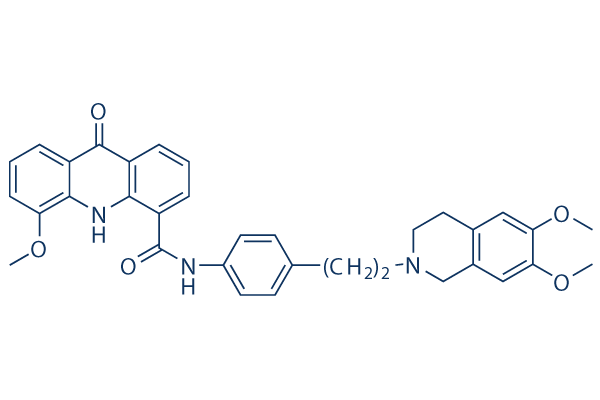
Chemical Structure
Molecular Weight: 563.64
Quality Control
Cell Culture, Treatment & Working Concentration
| Cell Lines | Assay Type | Concentration | Incubation Time | Formulation | Activity Description | PMID |
|---|---|---|---|---|---|---|
| primary glioblastoma stem cells | Function assay | 1 uM | 24 hrs | Inhibition of MDR1 in human primary glioblastoma stem cells assessed as increase in doxorubicin-induced reduction in cell viability at 1 uM after 24 hrs by by LDH release assay | 30584838 | |
| primary mesothelioma stem cells | Function assay | 1 uM | 72 hrs | Inhibition of MDR1 in human primary mesothelioma stem cells assessed as increase in doxorubicin-induced reduction in cell viability at 1 uM after 72 hrs by ATPlite luminescence assay | 30584838 | |
| primary glioblastoma stem cells | Function assay | 1 uM | 72 hrs | Inhibition of MDR1 in human primary glioblastoma stem cells assessed as increase in doxorubicin-induced reduction in cell viability at 1 uM after 72 hrs by ATPlite luminescence assay | 30584838 | |
| primary mesothelioma stem cells | Function assay | 10 to 10000 nM | 3 hrs | Inhibition of MDR1 in human primary mesothelioma stem cells assessed as increase in intracellular doxorubicin accumulation at 10 to 10000 nM after 3 hrs by spectrofluorimetric analysis | 30584838 | |
| primary glioblastoma stem cells | Function assay | 10 to 10000 nM | 3 hrs | Inhibition of MDR1 in human primary glioblastoma stem cells assessed as increase in intracellular doxorubicin accumulation at 10 to 10000 nM after 3 hrs by spectrofluorimetric analysis | 30584838 | |
| NB1643 | qHTS assay | qHTS of pediatric cancer cell lines to identify multiple opportunities for drug repurposing: Primary screen for NB1643 cells | 29435139 | |||
| SK-N-SH | qHTS assay | qHTS of pediatric cancer cell lines to identify multiple opportunities for drug repurposing: Primary screen for SK-N-SH cells | 29435139 | |||
| SK-N-MC | qHTS assay | qHTS of pediatric cancer cell lines to identify multiple opportunities for drug repurposing: Primary screen for SK-N-MC cells | 29435139 | |||
| KBV1 | Function assay | 10 mins | Inhibition of ABCB1 in human KBV1 cells after 10 mins by Calcein-AM microplate assay, IC50=0.193μM | 24900683 | ||
| MCF7/Topo | Function assay | 2 hrs | Inhibition of ABCG2 in human MCF7/Topo cells after 2 hrs by Hoechst 33342 microplate assay, IC50=0.127μM | 24900683 | ||
| CCRF-CEM/VCR1000 | Function assay | Inhibition of P-glycoprotein-mediated daunorubicin efflux from human CCRF-CEM/VCR1000 cells after 240 secs by FACS flow cytometric analysis, IC50=0.07244μM | 22452412 | |||
| Caco2 | Function assay | 3 uM | 30 mins | Inhibition of BCRP-mediated [3H]estrone-3-sulfate transport in human Caco2 cells at 3 uM after 30 mins | 22266779 | |
| Caco2 | Function assay | 3 uM | 30 mins | Inhibition of P-gp-mediated transport in human Caco2 cells at 3 uM after 30 mins | 22266779 | |
| Kb-V1 | Function assay | 10 mins | Inhibition of ABCB1 expressed in Kb-V1 cells after 10 mins by calcein-AM assay, IC50=0.193μM | 21570282 | ||
| MCF7/Topo | Function assay | Inhibition of ABCG2 expressed in human MCF7/Topo cells by Hoechst microplate assay, IC50=0.127μM | 21570282 | |||
| MDCK2-MDR1 | Function assay | 60 mins | Inhibition of human Pgp overexpressed in human MDCK2-MDR1 cells assessed as inhibition of R123 efflux after 60 mins, IC50=0.4μM | 21419632 | ||
| MDCK | Function assay | Inhibition of BCRP expressed in MDCK cells by pheophorbide A assay, IC50=0.43μM | 19932960 | |||
| MCF7 MX | Function assay | Inhibition of BCRP expressed in MCF7 MX cells by Hoechst 33342 staining, IC50=0.4μM | 19932960 | |||
| KBv1 | Function assay | Inhibition of ABCB1 overexpressed in human KBv1 cells by flow cytometric-based calcein-AM efflux assay, IC50=0.193μM | 19170519 | |||
| SKVLB1 | Cytotoxicity assay | Cytotoxicity against human multidrug-resistant SKVLB1 cells in presence of adriamycin, IC50=0.02μM | 11754602 | |||
| SKOV3 | Cytotoxicity assay | Cytotoxicity against human SKOV3 cells, IC50=8.1μM | 11754602 | |||
| SKVLB1 | Cytotoxicity assay | Cytotoxicity against human multidrug-resistant SKVLB1 cells, IC50=1.4μM | 11754602 | |||
| A673 | qHTS assay | qHTS of pediatric cancer cell lines to identify multiple opportunities for drug repurposing: Primary screen for A673 cells | 29435139 | |||
| primary mesothelioma stem cells | Function assay | 1 uM | 24 hrs | Inhibition of MDR1 in human primary mesothelioma stem cells assessed as increase in doxorubicin-induced reduction in cell viability at 1 uM after 24 hrs by by LDH release assay | 30584838 | |
| Click to View More Cell Line Experimental Data | ||||||
Solubility
|
In vitro |
DMSO
: 100 mg/mL
(177.41 mM)
Water : Insoluble Ethanol : Insoluble |
Molarity Calculator
|
In vivo |
|||||
In vivo Formulation Calculator (Clear solution)
Step 1: Enter information below (Recommended: An additional animal making an allowance for loss during the experiment)
Step 2: Enter the in vivo formulation (This is only the calculator, not formulation. Please contact us first if there is no in vivo formulation at the solubility Section.)
Calculation results:
Working concentration: mg/ml;
Method for preparing DMSO master liquid: mg drug pre-dissolved in μL DMSO ( Master liquid concentration mg/mL, Please contact us first if the concentration exceeds the DMSO solubility of the batch of drug. )
Method for preparing in vivo formulation: Take μL DMSO master liquid, next addμL PEG300, mix and clarify, next addμL Tween 80, mix and clarify, next add μL ddH2O, mix and clarify.
Method for preparing in vivo formulation: Take μL DMSO master liquid, next add μL Corn oil, mix and clarify.
Note: 1. Please make sure the liquid is clear before adding the next solvent.
2. Be sure to add the solvent(s) in order. You must ensure that the solution obtained, in the previous addition, is a clear solution before proceeding to add the next solvent. Physical methods such
as vortex, ultrasound or hot water bath can be used to aid dissolving.
Chemical Information, Storage & Stability
| Molecular Weight | 563.64 | Formula | C34H33N3O5 |
Storage (From the date of receipt) | |
|---|---|---|---|---|---|
| CAS No. | 143664-11-3 | Download SDF | Storage of Stock Solutions |
|
|
| Synonyms | GW120918, GG918, GW0918 | Smiles | COC1=CC=CC2=C1NC3=C(C2=O)C=CC=C3C(=O)NC4=CC=C(C=C4)CCN5CCC6=CC(=C(C=C6C5)OC)OC | ||
Mechanism of Action
| Targets/IC50/Ki |
P-gp
BCRP
|
|---|---|
| In vitro |
Elacridar (GF120918) inhibits P-glycoprotein (P-gp) labeling by [3H]azidopine with a IC50 of 0.16 μM. In Caki-1 and ACHN cells, it ( 2.5 μM) significantly ihibits the cell growth. The P-glycoprotein activity is found to be inhibited by this compound. Its combination lead to a significant reduction in ABC Sub-family B Member 2 (ABCG2) expression in 786-O cells. |
| Kinase Assay |
Photoaffinity radiolabeling of P-gp
|
|
10 μL of unlabeled cell membrane suspension (at 0.4 mg of protein/mL) are aliquoted into each well in 96-well plates. 5 μL of Elacridar (GF120918) are then added to each well. The plate is incubated 25 min at 25℃ in the dark. 5 μL of tritiated azidopine (1.8 TBq/mmol) (0.6 μM in HCI 0.2 mM) are added to each well. After 25 min of incubation at 25℃ in the dark, samples are simultaneously irradiated for 2 min at 254 nm at 0℃ with a thin layer chromatography-designed UV lamp directly in contact with the plate. Samples are solubilized in sodium dodecyl sulfate-polyacrylamide gel electrophoresis sample buffer but not heated. After separation on a 7.5% polyacrylamide gel, the gel is treated for fluorography with Amplify and exposed during 3 days onto a photosensitive film. The fluorography is analysed using a Camag thin layer chromatography Scanner II densitometer.
|
|
| In vivo |
Elacridar (GF120918) increases plasma and brain concentrations and brain-to-plasma ratios in wild-type mice when co-administered orally (100 mg/kg, p.o.), equaling the levels in Abcb1a/1b; Abcg2-/- mice. In friend leukemia virus stain B mice, the brain-to-plasm partition coefficient (Kp, brain) of this compound is 0.82, 0.43, and 4.31 after intravenous (2.5 mg/kg), intraperitoneal (100 mg/kg), and oral (100 mg/kg) treatment, respectively. In Mrp4(-/-) mice, it fully inhibits P-gp mediated transport, without siginificant effects on Bcrp1-mediated transport. |
References |
|
Applications
| Methods | Biomarkers | Images | PMID |
|---|---|---|---|
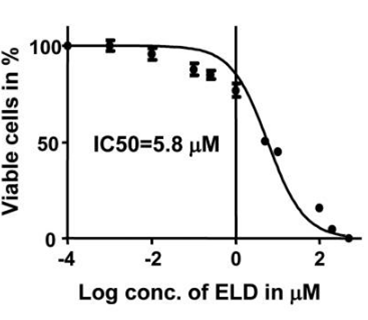
| Growth inhibition assay | Cell viability |
|
25862759 |
Tech Support
Tel: +1-832-582-8158 Ext:3
If you have any other enquiries, please leave a message.
Signaling Pathway Map

Products are for research use only. Not for human use. We do not sell to patients.
©Copyright 2013 Selleck Chemicals. All Rights Reserved.