
-
 Australia
-
 Austria
-
 Belgium
-
 Brazil
-
 Canada
-
 China
China
-
 Czech Republic
-
 Denmark
-
 Finland
-
 France
-
 Germany
-
 Greece
-
 Hong Kong
-
 Hungary
-
 Iceland
-
 India
India
-
 Ireland
-
 Israel
-
 Italy
Italy
-
 Japan
Japan
-
 Korea
Korea
-
 Luxembourg
-
 Malaysia
-
 Netherlands
-
 New Zealand
-
 Norway
-
 Poland
-
 Qatar
Qatar
-
 Romania
-
 Saudi Arabia
-
 Singapore
-
 Spain
Spain
-
 Sweden
-
 Switzerland
-
 Taiwan
-
 Turkey
-
 United Kingdom
-
 United States
research use only
Zibotentan (ZD4054) Endothelin Receptor antagonist
Cat.No.S1456
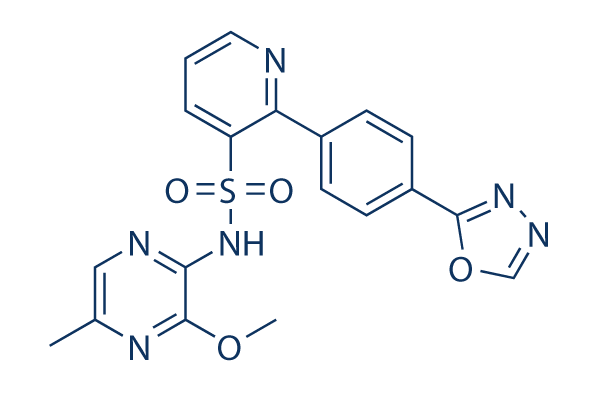
Chemical Structure
Molecular Weight: 424.43
Quality Control
| Related Targets | CXCR Hedgehog/Smoothened PKA Adrenergic Receptor AChR 5-HT Receptor Histamine Receptor Dopamine Receptor Ras KRas |
|---|---|
| Other Endothelin Receptor Inhibitors | BQ-123 Sparsentan (PS-433540, RE-021) Lu-135252 Pearl Extract Carperitide Acetate Atrasentan Aprocitentan |
Solubility
|
In vitro |
DMSO
: 24 mg/mL
(56.54 mM)
Water : Insoluble Ethanol : Insoluble |
Molarity Calculator
|
In vivo |
|||||
In vivo Formulation Calculator (Clear solution)
Step 1: Enter information below (Recommended: An additional animal making an allowance for loss during the experiment)
Step 2: Enter the in vivo formulation (This is only the calculator, not formulation. Please contact us first if there is no in vivo formulation at the solubility Section.)
Calculation results:
Working concentration: mg/ml;
Method for preparing DMSO master liquid: mg drug pre-dissolved in μL DMSO ( Master liquid concentration mg/mL, Please contact us first if the concentration exceeds the DMSO solubility of the batch of drug. )
Method for preparing in vivo formulation: Take μL DMSO master liquid, next addμL PEG300, mix and clarify, next addμL Tween 80, mix and clarify, next add μL ddH2O, mix and clarify.
Method for preparing in vivo formulation: Take μL DMSO master liquid, next add μL Corn oil, mix and clarify.
Note: 1. Please make sure the liquid is clear before adding the next solvent.
2. Be sure to add the solvent(s) in order. You must ensure that the solution obtained, in the previous addition, is a clear solution before proceeding to add the next solvent. Physical methods such
as vortex, ultrasound or hot water bath can be used to aid dissolving.
Chemical Information, Storage & Stability
| Molecular Weight | 424.43 | Formula | C19H16N6O4S |
Storage (From the date of receipt) | |
|---|---|---|---|---|---|
| CAS No. | 186497-07-4 | Download SDF | Storage of Stock Solutions |
|
|
| Synonyms | N/A | Smiles | CC1=CN=C(C(=N1)OC)NS(=O)(=O)C2=C(N=CC=C2)C3=CC=C(C=C3)C4=NN=CO4 | ||
Mechanism of Action
| Targets/IC50/Ki |
ET-A
21 nM
|
|---|---|
| In vitro |
As Zibotentan (ZD4054) specifically inhibits ETA-mediated antiapoptotic effects, but not ETB-mediated proapoptotic effects in human and rat smooth muscle cells, this compound binds to endothelin A receptor (ETA) with high affinity with Ki of 13 nM, and has no affinity for endothelin B receptor (ETB) with IC50 of >10 μM. Treatment at 1 μM inhibits ET-1 induced mitogenic activity in ovarian carcinoma cell lines HEY and OVCA 433 secreting ET-1 and expressing ETA and ETB mRNA. It also inhibits ET-1 induced EGFR transactivation in HEY and OVCA 433 cells. Moreover, it reverts ET-1 mediated epithelial-mesenchymal transition (EMT), by enhancing E-cadherin expression and promoter activity, and inhibiting vascular endothelial growth factor (VEGF) secretion and invasiveness in HEY and OVCA 433 cells. Zibotentan also potently inhibits the basal and ET-1 induced cell proliferation in SKOV-3 and A-2780 cells, associated with the inhibition of AKT and p42/44MAPK phosphorylation, and with increased apoptosis through the inhibition of bcl-2 and activation of caspase-3 and poly(ADP-ribose) polymerase proteins.
|
| Kinase Assay |
Receptor-binding assays
|
|
The inhibition by Zibotentan (ZD4054) (varying concentrations) of 125iodine-ET-1 binding to cloned human ETA is assessed using standard radioligand-binding techniques. Human recombinant ETA is expressed in mouse erythroleukaemic cells, and cell membranes prepared for competitive binding studies using 125iodine-ET-1 as the radioligand. Incubations are carried out in triplicate in the presence of this compound, 100 pM to 100 μM in half-log increments, and inhibition of ET-1 binding is expressed as the geometric mean pIC50 value (concentration to inhibit 50% of binding) with a 95% confidence interval (CI). Its affinity for cloned human ETA is also assessed using the equation of Cheng and Prusoff to determine the equilibrium dissociation constant (Ki) in a further receptor-binding screen utilizing a greater number of concentration-response curves determined in three separate studies.
|
|
| In vivo |
Zibotentan (ZD4054), administered at 10 mg/kg/day for 21 days, potently inhibits the growth of HEY ovarian carcinoma xenografts in mice by 69% with no associated toxicity. This effect is associated with the blocking of cell proliferation, as evaluated by 37% inhibition of Ki-67 expression, and 62% inhibition of tumor-induced vascularization. Consistently, treatment with this compound significantly inhibits the expression of matrix metalloproteinase-2 (MMP-2) and VEGF, as well as the activation of p42/44 MAPK and EGFR, and potently enhances the expression of E-cadherin.
|
References |
|
Clinical Trial Information
(data from https://clinicaltrials.gov, updated on 2024-05-22)
| NCT Number | Recruitment | Conditions | Sponsor/Collaborators | Start Date | Phases |
|---|---|---|---|---|---|
| NCT01119118 | Terminated | Prostate Cancer |
University of Wisconsin Madison|AstraZeneca |
April 2010 | Phase 2 |
| NCT01000948 | Terminated | Prostate Cancer|Metastasis |
Aarhus University Hospital|Rigshospitalet Denmark |
October 2009 | Phase 2 |
| NCT00997945 | Completed | Advanced Solid Malignancies |
AstraZeneca |
October 2009 | Phase 1 |
| NCT00713791 | Completed | Healthy |
AstraZeneca |
June 2008 | Phase 1 |
Tech Support
Tel: +1-832-582-8158 Ext:3
If you have any other enquiries, please leave a message.
Signaling Pathway Map

Products are for research use only. Not for human use. We do not sell to patients.
©Copyright 2013 Selleck Chemicals. All Rights Reserved.